


Photoionization of clusters in intense few-cycle near infrared femtosecond pulses
Literature Information
Publication Date
2014-03-24
DOI
10.1039/C3CP55380A
Impact Factor
3.676
Authors
S. R. Krishnan, R. Gopal, R. Rajeev, J. Jha, V. Sharma, M. Mudrich, R. Moshammer
View Original
Abstract
In this article we present a perspective on the current state of the art in the photoionization of atomic clusters in few-cycle near-infrared laser pulses. Recently, several studies have reported intriguing phenomena associated with the photoionization of clusters by pulses as short as ∼10 fs which approach the natural timescales of collective electronic motion in such nanoscale aggregates. In contrast to the dynamics occurring on few- and sub-picosecond timescales where ionic motion sets in and plays a key role marked by resonant plasmon oscillations, the few-cycle limit precludes cluster expansion due to the nuclear motion of ionic constituents. Thus, pulses lasting just a few optical cycles explore a new “impulsive” regime for the first time in cluster nanoplasmas wherein ions essentially remain “frozen”. Along with the perspective on this new regime, we present first measurements of photoelectron distributions and temperatures.
Recommended Journals

Critical Reviews in Solid State and Materials Sciences

Polycyclic Aromatic Compounds

Journal of Asian Natural Products Research

NDT & E International

Medicinal Chemistry Research

Chinese Journal of Chemistry

Bioorganic & Medicinal Chemistry

Acta Metallurgica Sinica-English Letters

Topics in Catalysis

Colloid Journal
Related Literature
Antinociceptive activity of thiazole-containing cyclized DAMGO and Leu-(Met) enkephalin analogs
Hannah M. Harris, Shainnel O. Eans, Michelle L. Ganno, Jennifer C. Davis, Colette T. Dooley, Jay P. McLaughlin, Adel Nefzi
2019-05-09
Paper
DOI: 10.1039/C9OB00882A
Recent advances in photocatalytic manipulations of Rose Bengal in organic synthesis
Shivani Sharma, Anuj Sharma
2019-03-22
Review Article
DOI: 10.1039/C9OB00092E
Substituent-controlled racemization of dissymmetric coordination capsules
Kentaro Harada, Ryo Sekiya, Takeshi Maehara, Takeharu Haino
2019-03-28
Paper
DOI: 10.1039/C9OB00388F
Synthesis of macrocyclic peptidomimetics via the Ugi-click-strategy
Elena A. Zakharova, Olga I. Shmatova, Irina V. Kutovaya, Valentine G. Nenajdenko
2019-03-04
Paper
DOI: 10.1039/C9OB00229D
Two-component boronic acid catalysis for increased reactivity in challenging Friedel–Crafts alkylations with deactivated benzylic alcohols
Hwee Ting Ang, Jason P. G. Rygus, Dennis G. Hall
2019-05-29
Paper
DOI: 10.1039/C9OB01043B
Late-stage C–H amination of abietane diterpenoids
Alejandro Dana, Pablo H. Di Chenna, Benjamin Darses, Fernando J. Durán, Philippe Dauban
2019-03-22
Paper
DOI: 10.1039/C9OB00272C
Metal-catalysed reactions enabled by guanidine-type ligands
Xi-Yang Cui, Choon-Hong Tan, Dasheng Leow
2019-04-16
Review Article
DOI: 10.1039/C8OB02240B
A highly selective H/D exchange reaction of 1,4-dihydropyridines
Kaiqian Wang, Xiao Peng, Ping Wang, Feng Liang
2019-03-25
Paper
DOI: 10.1039/C9OB00575G
The disruption of verM activates the production of gliocladiosin A and B in Clonostachys rogersoniana
Yuanyuan Pan, Xingzhong Liu, Yongsheng Che
2019-06-28
Communication
DOI: 10.1039/C9OB01102A
Fluorescence-labeled neopeltolide derivatives for subcellular localization imaging
Shota Yanagi, Tomoya Sugai, Takuma Noguchi, Masato Kawakami, Makoto Sasaki, Shinsuke Niwa, Asako Sugimoto, Haruhiko Fuwa
2019-06-25
Communication
DOI: 10.1039/C9OB01276A
You might also like
Compound Q&A
What are the main uses of (3.beta.)-3-Hydroxy-N,N-dimethyl-chol-5-en-24-amide (CAS: 79066-03-8)?
(3.beta.)-3-Hydroxy-N,N-dimethyl-chol-5-en-24-amide (CAS: 79066-03-8) is primari...
79066-03-8(3.beta.)-3-Hydroxy-...
Compound Q&A
What regulatory guidelines apply to 5-(aminomethyl)-2-methoxyphenol (CAS: 89702-89-6)?
5-(Aminomethyl)-2-methoxyphenol (CAS: 89702-89-6) is classified under GHS as a s...
89702-89-65-(aminomethyl)-2-me...
Compound Q&A
What is Thieno[2,3-c]pyridin-7(6H)-one (CAS: 28981-13-7)?
Thieno[2,3-c]pyridin-7(6H)-one (CAS: 28981-13-7) is a heterocyclic organic compo...
28981-13-7Thieno[2,3-c]pyridin...
Compound Q&A
Is 1-[(6-Methoxy-3-pyridinyl)methyl]-4-piperidinamine dihydrochloride (CAS: 1185311-28-7) safe?
1-[(6-Methoxy-3-pyridinyl)methyl]-4-piperidinamine dihydrochloride is generally ...
1185311-28-71-[(6-Methoxy-3-pyri...
Compound Q&A
What regulatory guidelines apply to [(2E)-3-Phenyl-2-propen-1-yl]phosphonic acid (CAS: 146404-58-2)?
[(2E)-3-Phenyl-2-propen-1-yl]phosphonic acid (CAS: 146404-58-2) is regulated und...
146404-58-2[(2E)-3-Phenyl-2-pro...
Compound Q&A
What regulatory guidelines apply to 6-Bromo-7-methoxyquinoline (CAS: 1620515-86-7)?
6-Bromo-7-methoxyquinoline (CAS: 1620515-86-7) falls under the scope of the Glob...
1620515-86-76-Bromo-7-methoxyqui...
Compound Q&A
What industries use (2R)-1-(1-Benzofuran-2-yl)-N-propyl-2-pentanamine (CAS: 260550-89-8)?
This compound is primarily used in the pharmaceutical industry for the developme...
260550-89-8(2R)-1-(1-Benzofuran...
Compound Q&A
What are the main uses of 1-Ethyl-7-[2-methyl-6-(4H-1,2,4-triazol-3-yl)-3-pyridinyl]-3,5-dihydropyrazino[2,3-b]pyrazin-2(1H)-one (CAS: 1228013-15-7)?
1-Ethyl-7-[2-methyl-6-(4H-1,2,4-triazol-3-yl)-3-pyridinyl]-3,5-dihydropyrazino[2...
1228013-15-71-Ethyl-7-[2-methyl-...
Compound Q&A
Are there alternatives to {5-(Acryloylamino)-2-[(dimethylamino)methyl]phenyl}boronic acid (CAS: 1217500-78-1) in synthesis?
Alternative reagents such as 2-[(dimethylamino)methyl]phenylboronic acid or rela...
1217500-78-1{5-(Acryloylamino)-2...
Compound Q&A
What is 3-(Piperidin-4-yloxy)pyridine (CAS: 310881-48-2)?
3-(Piperidin-4-yloxy)pyridine (CAS: 310881-48-2) is an organic compound with the...
310881-48-23-(Piperidin-4-yloxy...
Source Journal
Physical Chemistry Chemical Physics

CiteScore:
5.5
Self-citation Rate:
10.3%
Articles per Year:
3036
Physical Chemistry Chemical Physics (PCCP) is an international journal co-owned by 19 physical chemistry and physics societies from around the world. This journal publishes original, cutting-edge research in physical chemistry, chemical physics and biophysical chemistry. To be suitable for publication in PCCP, articles must include significant innovation and/or insight into physical chemistry; this is the most important criterion that reviewers and Editors will judge against when evaluating submissions. The journal has a broad scope and welcomes contributions spanning experiment, theory, computation and data science. Topical coverage includes spectroscopy, dynamics, kinetics, statistical mechanics, thermodynamics, electrochemistry, catalysis, surface science, quantum mechanics, quantum computing and machine learning. Interdisciplinary research areas such as polymers and soft matter, materials, nanoscience, energy, surfaces/interfaces, and biophysical chemistry are welcomed if they demonstrate significant innovation and/or insight into physical chemistry. Joined experimental/theoretical studies are particularly appreciated when complementary and based on up-to-date approaches.
Recommended Compounds
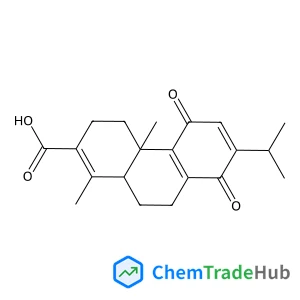
(4aS,10aS)-7-Isopropyl-1,4a-dimethyl-5,8-dioxo-3,4,4a,5,8,9,10,10a-octahydro-2-phenanthrenecarboxylic acid
CAS Number:
142950-86-5
Molecular Formula:
C20H24O4
![4-[(4-Bromophenyl)sulfonyl]thiomorpholine structure](https://static.chemtradehub.com/structs/223/223555-81-5-2d67.webp "4-[(4-Bromophenyl)sulfonyl]thiomorpholine structure")
Recommended Suppliers






Disclaimer
This page provides academic journal information for reference and research purposes only. We are not affiliated with any journal publishers and do not handle publication submissions. For publication-related inquiries, please contact the respective journal publishers directly.
If you notice any inaccuracies in the information displayed, please contact us at support@chemtradehub.com. We will promptly review and address your concerns.