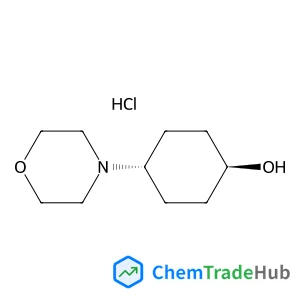
trans-4-(4-Morpholinyl)cyclohexanol hydrochloride (1:1)
CAS Number:
1588441-09-1
Molecular Formula:
C10H20ClNO2
Shota Yanagi, Tomoya Sugai, Takuma Noguchi, Masato Kawakami, Makoto Sasaki, Shinsuke Niwa, Asako Sugimoto, Haruhiko Fuwa
Design, synthesis and functional analysis of fluorescent derivatives of neopeltolide, an antiproliferative marine macrolide, are reported herein. Live cell imaging using the fluorescent derivatives showed rapid cellular uptake and localization within the endoplasmic reticulum as well as the mitochondria.
Mireia Segado, Yannick Mercier, Isabel Gómez, Mar Reguero
DOI: 10.1039/C5CP04693A
Afshan Mohajeri, Akbar Omidvar
DOI: 10.1039/C5CP02453F
Yao Liu, Yirong Zhou, Junxi Zhang, Shuojiong Xu
DOI: 10.1039/C5CP02059J
Takeshi Morita, Kumiko Miki, Ayako Nitta, Hiroyo Ohgi, Peter Westh
DOI: 10.1039/C5CP02329G
Wenqi Xiong, Congxin Xia, Yuting Peng, Juan Du, Tianxing Wang, Jicai Zhang, Yu Jia
DOI: 10.1039/C5CP07140B
Luigi Cigarini, Davide Vanossi, Claudio Fontanesi
DOI: 10.1039/C5CP01852H
Geon-Hyoung An, Bon-Ryul Koo, Hyo-Jin Ahn
DOI: 10.1039/C6CP00035E
Phuong D. Dau, P. B. Armentrout, Maria C. Michelini, John K. Gibson
DOI: 10.1039/C6CP00494F
Eric B. Lindgren, Ho-Kei Chan, Anthony J. Stace, Elena Besley
DOI: 10.1039/C5CP07709E
1-(2,4,6-Trifluorophenyl)ethanol is an organic compound with the CAS number 1250...
1-(2,4-Dimethoxybenzyl)-4-(hydroxymethyl)-2-pyrrolidinone (CAS: 919111-34-5) is ...
(7S,15R)-6β,15-Diacetoxy-7α,20-epoxy-7-hydroxykaura-2,16-dien-1-one is a crystal...
The compound rac-ethyl (1r,4r)-4-hydroxycyclohexane-1-carboxylate, trans (CAS: 3...
The market for 2-(2,4-Difluorophenoxy)-3-nitropyridine (CAS: 175135-62-3) is cur...
The main uses of 6-Diazo-5-oxo-L-norleucine (CAS: 157-03-9) include research in ...
When handling 2-Aminoethyl-mono-amide-DOTA-tris(tBu ester) (CAS: 173308-19-5), i...
5-Methylimidazo[1,2-a]pyridine-3-carbaldehyde (CAS: 178488-37-4) can be synthesi...
There are alternative reagents that can be used in the synthesis of 2,4,6-Trihyd...
(2Z)-3-(5-Fluoro-1H-indol-3-yl)-2-sulfanylacrylic acid is a chemical compound wi...

Organic & Biomolecular Chemistry (OBC) publishes original and high impact research and reviews in organic chemistry. We welcome research that shows new or significantly improved protocols or methodologies in total synthesis, synthetic methodology or physical and theoretical organic chemistry as well as research that shows a significant advance in the organic chemistry or molecular design aspects of chemical biology, catalysis, supramolecular and macromolecular chemistry, theoretical chemistry, mechanism-oriented physical organic chemistry, medicinal chemistry or natural products. Articles published in the journal should report new work which makes a highly-significant impact in the field. Routine and incremental work is generally not suitable for publication in the journal. More details about key areas of our scope are below. In all cases authors should include in their article clear rationale for why their research has been carried out.

![2-Methyl-2-propanyl 1,6-diazaspiro[3.4]octane-6-carboxylate structure](https://static.chemtradehub.com/structs/115/1158749-79-1-81ee.webp "2-Methyl-2-propanyl 1,6-diazaspiro[3.4]octane-6-carboxylate structure")