












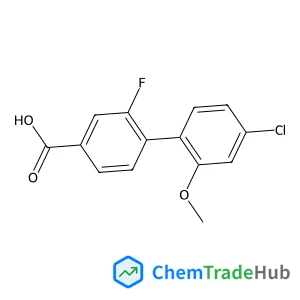
4-(4-Chloro-2-methoxyphenyl)-3-fluorobenzoic acid
CAS Number:
1261970-23-3
Molecular Formula:
C14H10ClFO3
Maarten T. P. Beerepoot, Daniel H. Friese, Kenneth Ruud
We present a quantum chemical study of the two-photon absorption (TPA) properties of yellow fluorescent protein (YFP), a mutant of the extensively studied green fluorescent protein. The aromatic chromophore of YFP has a π-stacking interaction with the aromatic ring of a tyrosine residue (Tyr203) in a parallel-displaced structure with a distance of about 3.4 Å. We study the TPA spectrum of the π-stacking system of YFP using the well-established Coulomb-attenuated B3LYP density functional (CAM-B3LYP) and the second-order approximate coupled-cluster model CC2. This work presents both the first comprehensive study of the two-photon absorption spectrum of YFP and the largest-scale coupled-cluster calculation of two-photon absorption that has ever been performed. We analyze the intermolecular charge-transfer (ICT) transitions in this stacked system and show that the ICT transitions are an important mechanism for enhancing the TPA cross sections in YFP. We investigate the distance dependence of the ICT transitions and show that their TPA cross sections are strongly dependent on the separation of the aromatic moieties. This provides a means for tuning the TPA properties of YFP and other structurally related fluorescent proteins through molecular engineering.
Lianjie Xue, Fehmi Bardak, George Tamas, Edward L. Quitevis
DOI: 10.1039/C6CP08263G
Hua-Bin Sun, Ying-Xian Zhou, Lu-Lu Zhang, Xue-Lin Yang, Xing-Zhong Cao, Hanu Arave, Hui Fang, Gan Liang
DOI: 10.1039/C6CP07760A
Alexandra R. McIsaac, David A. Mazziotti
DOI: 10.1039/C6CP07563K
Riham El Kurdi, Digambara Patra
DOI: 10.1039/C6CP08607A
Eesh Vaghela, M. J. Keshvani, Keval Gadani, Zalak Joshi, Hetal Boricha, K. Asokan, D. Venkateshwarlu, V. Ganesan, N. A. Shah, P. S. Solanki
DOI: 10.1039/C6CP07730G
Shimon Vega
DOI: 10.1039/C6CP07881H
G. W. Driver, Y. Huang, A. Laaksonen, T. Sparrman, Y.-L. Wang, P.-O. Westlund
DOI: 10.1039/C6CP05801A
P. Modak, Ashok K. Verma
DOI: 10.1039/C6CP07805B
Elijah G. Schnitzler, Nathan A. Seifert, Supriya Ghosh, Javix Thomas, Yunjie Xu, Wolfgang Jäger
DOI: 10.1039/C6CP08741H
(5-Sulfamoyl-3-pyridinyl)boronic acid is primarily used in chemical synthesis, p...
Benzyl 2-methyl-2-(methylsulfonyl)-4-pentenoate is typically synthesized via est...
When handling 8-Fluoroquinolin-6-ol (CAS: 209353-22-0), it is important to use p...
1,3-Dibromo-5-(2-methyl-2-propanyl)benzene (CAS: 129316-09-2) is a crystalline c...
Ethyl 7-chloro-4-oxo-1-(1,3-thiazol-2-yl)-1,4-dihydro-1,8-naphthyridine-3-carbox...
When handling Delta-7-Avenasterol (CAS: 23290-26-8), it is important to wear app...
Proper handling involves the use of personal protective equipment such as gloves...
When handling 2-Methyl-2-proanyl 4-[(2-aminophenyl)amino]-1-piperidinecarboxylat...
N-Methyl-4-chlorobenzylamine hydrochloride (CAS: 65542-24-7) is a organic compou...
[2-(Dodecyloxy)ethoxy]acetic acid (CAS: 27306-90-7) is generally considered safe...

Physical Chemistry Chemical Physics (PCCP) is an international journal co-owned by 19 physical chemistry and physics societies from around the world. This journal publishes original, cutting-edge research in physical chemistry, chemical physics and biophysical chemistry. To be suitable for publication in PCCP, articles must include significant innovation and/or insight into physical chemistry; this is the most important criterion that reviewers and Editors will judge against when evaluating submissions. The journal has a broad scope and welcomes contributions spanning experiment, theory, computation and data science. Topical coverage includes spectroscopy, dynamics, kinetics, statistical mechanics, thermodynamics, electrochemistry, catalysis, surface science, quantum mechanics, quantum computing and machine learning. Interdisciplinary research areas such as polymers and soft matter, materials, nanoscience, energy, surfaces/interfaces, and biophysical chemistry are welcomed if they demonstrate significant innovation and/or insight into physical chemistry. Joined experimental/theoretical studies are particularly appreciated when complementary and based on up-to-date approaches.
![4-Fluoro-2-(4-{[(3S,4R)-4-(2-hydroxy-2-propanyl)-3-pyrrolidinyl]amino}-6,7-dimethoxy-2-quinazolinyl)phenol hydrochloride (1:1) structure](https://static.chemtradehub.com/structs/143/1431697-96-9-619c.webp "4-Fluoro-2-(4-{[(3S,4R)-4-(2-hydroxy-2-propanyl)-3-pyrrolidinyl]amino}-6,7-dimethoxy-2-quinazolinyl)phenol hydrochloride (1:1) structure")



