












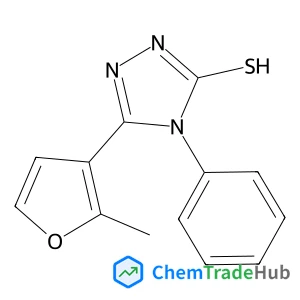
5-(2-Methyl-3-furyl)-4-phenyl-2,4-dihydro-3H-1,2,4-triazole-3-thione
CAS Number:
346464-59-3
Molecular Formula:
C13H11N3OS
Narges Yaghoobi Nia, Pooria Farahani, Hassan Sabzyan, Mahmoud Zendehdel, Mohsen Oftadeh
A combined experimental and computational investigation conducted to understand the nature of the interactions between cobalt II/III redox mediators ([Co(bpy)3]2+/3+) and their impact on the performance of the corresponding dye-sensitized solar cells (DSCs) is reported. The fully optimized equilibrium structures of cobalt(II/III)-tris-bipyridine complexes in the gas phase and acetonitrile solvent are obtained by the density functional B3LYP method using LanL2DZ and 6-31G(d,p) basis sets. The harmonic vibrational frequencies, infrared intensities and Raman scattering activities of the complexes are also calculated. The scaled computational vibrational wavenumbers show very good agreement with the experimental values. Calculations of the electronic properties of the complexes are also performed at the TD-B3LYP/6-31G(p,d)[LanL2DZ] level of theory. Detailed interpretations of the infrared and Raman spectra of the complexes in different phases are reported. Detailed atomic orbital coefficients of the frontier molecular orbitals and their major contributions to electronic excitations of the complexes are also reported. These results are in good agreement with the experimental electrochemical values. Marcus diagram is derived for the electron transfer reaction Co(II) + D35+ → Co(III) + D35 using the Co–N bond length as a reaction coordinate.
Wulan Tri Wahyuni, Frank Marken
DOI: 10.1039/C9AN02186H
L. Klukova, J. Filip, S. Belicky, A. Vikartovska, J. Tkac
DOI: 10.1039/C6AN00793G
Zhichao Pei, Björn Ingemarsson, Teodor Aastrup, Olof Ramström
DOI: 10.1039/C6AN00735J
Shruti D. Bindesri, Ricardo Jebailey, Najwan Albarghouthi, Cory C. Pye, Christa L. Brosseau
DOI: 10.1039/C9AN02173F
Szymon Bocian, Katarzyna Krzemińska, Bogusław Buszewski
DOI: 10.1039/C6AN00139D
Yu Du, Xiaojian Li, Xiang Ren, Huan Wang, Dan Wu, Hongmin Ma, Dawei Fan, Qin Wei
DOI: 10.1039/C9AN02288K
Lei Zhang, Zhenyu Tang, LiLi Hou, Yang Qu, Yawen Deng, Chenghao Zhang, Congxia Xie, Zhongtao Wu
DOI: 10.1039/C9AN02286D
Xiang-Juan Kong, Shuang Wu, Yao Cen, Ting-Ting Chen, Ru-Qin Yu, Xia Chu
DOI: 10.1039/C6AN00738D
Nicole A. Schneck, Vera B. Ivleva, Cindy X. Cai, Jonathan W. Cooper, Q. Paula Lei
DOI: 10.1039/C9AN02098E
DOI: 10.1039/C6AN00590J
When handling lithium chloride hydrate (1:1:1) (CAS: 16712-20-2), it is importan...
4-(4H-1,2,4-Triazol-4-yl)piperidine is generally considered safe for use in phar...
Waste containing 1,3-Thiazole-2-carboxamide (CAS: 16733-85-0) should be collecte...
5-(Difluoromethyl)-2-fluorobenzonitrile (CAS: 934175-58-3) is subject to regulat...
Methyl 3-acetamido-2-thiophenecarboxylate can be synthesized by the reaction of ...
4-Isoquinolinecarbonitrile is a chemical compound with the CAS number 34846-65-6...
Store Methyl 1H-1,2,3-triazole-4-carboxylate (CAS: 877309-59-6) in a cool, dry p...
6-Bromo[1,3]thiazolo[5,4-b]pyridin-2-amine (CAS: 1160791-13-8) is subject to the...
(2S,3S)-2-Ammonio-3-(3,4-dihydroxyphenyl)-3-hydroxypropanoate (CAS: 23651-95-8) ...
7-Bromo-3-methyl-3,4-dihydroquinazolin-4-one is a solid with a crystalline form....

Physical Chemistry Chemical Physics (PCCP) is an international journal co-owned by 19 physical chemistry and physics societies from around the world. This journal publishes original, cutting-edge research in physical chemistry, chemical physics and biophysical chemistry. To be suitable for publication in PCCP, articles must include significant innovation and/or insight into physical chemistry; this is the most important criterion that reviewers and Editors will judge against when evaluating submissions. The journal has a broad scope and welcomes contributions spanning experiment, theory, computation and data science. Topical coverage includes spectroscopy, dynamics, kinetics, statistical mechanics, thermodynamics, electrochemistry, catalysis, surface science, quantum mechanics, quantum computing and machine learning. Interdisciplinary research areas such as polymers and soft matter, materials, nanoscience, energy, surfaces/interfaces, and biophysical chemistry are welcomed if they demonstrate significant innovation and/or insight into physical chemistry. Joined experimental/theoretical studies are particularly appreciated when complementary and based on up-to-date approaches.
![(R)-N-[(S)-1-[2-(Diphenylphosphino)phenyl]ethyl]-2-methylpropane-2-sulfinamide structure](https://static.chemtradehub.com/structs/159/1595319-98-4-33e7.webp "(R)-N-[(S)-1-[2-(Diphenylphosphino)phenyl]ethyl]-2-methylpropane-2-sulfinamide structure")



