












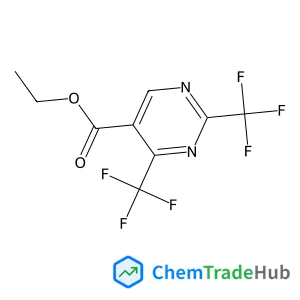
Ethyl 2,4-bis(trifluoromethyl)-5-pyrimidinecarboxylate
CAS Number:
188781-15-9
Molecular Formula:
C9H6F6N2O2
Eric De Vito
Binary mixtures of cyclic (TMS) or acyclic sulfones (MIS, EIS and EMS) with EMC or DMC have been used in electrolytes containing LiPF6 (1 M) in both Li4Ti5O12/Li half-cells and Li4+xTi5O12/Li4Ti5O12 symmetric cells and compared with standard EC/EMC or EC/DMC mixtures. In half-cells, sulfone-based electrolytes cannot be satisfactorily cycled owing to the formation of a resistive layer at the lithium interface, which is not stable and generates species (RSO2− and RSO3−) able to migrate toward the titanate electrode interface. Potentiostatic and galvanostatic tests of Li4Ti5O12/Li half-cells show that charge transfer resistance increases drastically when sulfones are used in the electrolyte composition. Moreover, cyclability and coulombic efficiency are low. Conversely, when symmetric Li4+xTi5O12/Li4Ti5O12 cells are used, it is demonstrated that MIS-(methyl isopropyl sulfone) and TMS-(tetra methyl sulfone) based electrolytes exhibit reasonable electrochemical performances as compared to the EC/DMC or EC/EMC standard mixtures. Surface analysis by XPS of both the Li4+xTi5O12 (partially oxidized) and Li7Ti5O12 (reduced) electrodes taken from symmetric cells reveals that sulfones do not participate in the formation of surface layers. Alkylcarbonates (EMC or DMC), used as co-solvents in sulfone-based binary electrolytes, ensure the formation of surface layers at the titanate interfaces. Therefore, EMC reduction at the two Li4+xTi5O12/electrolyte interfaces in symmetric cells leads to the formation of carbonates, ethers and mineral compounds such as ROCO2Li and Li2CO3. Finally, huge amounts of LiF are detected at the titanate electrode surface, resulting in an increase in the resistivity of symmetric cells and capacity losses.
Pradeep Sachan, Prakash Chandra Mondal
DOI: 10.1039/C9AN01948K
Urban J. Wünsch, Jeffrey A. Hawkes
DOI: 10.1039/C9AN02176K
Kamonwad Ngamchuea, Christopher Batchelor-McAuley, Philip J. Cowen, Clare Williams, Luís Moreira Gonçalves, Richard G. Compton
DOI: 10.1039/C6AN01139J
Yue Zhao, Yaxin Wang, Yongjun Zhang, Yang Liu, Xiao Xia Han, Bing Zhao, Jinghai Yang
DOI: 10.1039/C6AN00945J
Jun Yang, Donglei Jiang, Xiulan Sun
DOI: 10.1039/C9AN02289A
Hui Cheng, Lingling Xu, Haili Zhang, Guosong Lai
DOI: 10.1039/C6AN00651E
Shixuan Yang, Zhihua Song, Jinhua Li, Qiaocui Shi, Huiyan You, Huitao Liu, Min Lv, Lingxin Chen
DOI: 10.1039/C9AN02127B
Zhichao Pei, Björn Ingemarsson, Teodor Aastrup, Olof Ramström
DOI: 10.1039/C6AN00735J
Soham Samanta, Barun Kumar Datta, Madhurima Boral, Abhijit Nandan, Gopal Das
DOI: 10.1039/C6AN00657D
When handling lithium chloride hydrate (1:1:1) (CAS: 16712-20-2), it is importan...
4-(4H-1,2,4-Triazol-4-yl)piperidine is generally considered safe for use in phar...
Waste containing 1,3-Thiazole-2-carboxamide (CAS: 16733-85-0) should be collecte...
5-(Difluoromethyl)-2-fluorobenzonitrile (CAS: 934175-58-3) is subject to regulat...
Methyl 3-acetamido-2-thiophenecarboxylate can be synthesized by the reaction of ...
4-Isoquinolinecarbonitrile is a chemical compound with the CAS number 34846-65-6...
Store Methyl 1H-1,2,3-triazole-4-carboxylate (CAS: 877309-59-6) in a cool, dry p...
6-Bromo[1,3]thiazolo[5,4-b]pyridin-2-amine (CAS: 1160791-13-8) is subject to the...
(2S,3S)-2-Ammonio-3-(3,4-dihydroxyphenyl)-3-hydroxypropanoate (CAS: 23651-95-8) ...
7-Bromo-3-methyl-3,4-dihydroquinazolin-4-one is a solid with a crystalline form....

Physical Chemistry Chemical Physics (PCCP) is an international journal co-owned by 19 physical chemistry and physics societies from around the world. This journal publishes original, cutting-edge research in physical chemistry, chemical physics and biophysical chemistry. To be suitable for publication in PCCP, articles must include significant innovation and/or insight into physical chemistry; this is the most important criterion that reviewers and Editors will judge against when evaluating submissions. The journal has a broad scope and welcomes contributions spanning experiment, theory, computation and data science. Topical coverage includes spectroscopy, dynamics, kinetics, statistical mechanics, thermodynamics, electrochemistry, catalysis, surface science, quantum mechanics, quantum computing and machine learning. Interdisciplinary research areas such as polymers and soft matter, materials, nanoscience, energy, surfaces/interfaces, and biophysical chemistry are welcomed if they demonstrate significant innovation and/or insight into physical chemistry. Joined experimental/theoretical studies are particularly appreciated when complementary and based on up-to-date approaches.
![(1R,5R)-3-{[(2-Methyl-2-propanyl)oxy]carbonyl}-3-azabicyclo[3.1.0]hexane-1-carboxylic acid structure](https://static.chemtradehub.com/structs/116/1165450-63-4-bfe1.webp "(1R,5R)-3-{[(2-Methyl-2-propanyl)oxy]carbonyl}-3-azabicyclo[3.1.0]hexane-1-carboxylic acid structure")
![5,10-Dihydroindeno[2,1-a]indene structure](https://static.chemtradehub.com/structs/654/6543-29-9-71ca.webp "5,10-Dihydroindeno[2,1-a]indene structure")
![N-[2-(2-Pyridinyl)ethyl]-1-propanamine structure](https://static.chemtradehub.com/structs/554/55496-57-6-22b4.webp "N-[2-(2-Pyridinyl)ethyl]-1-propanamine structure")



