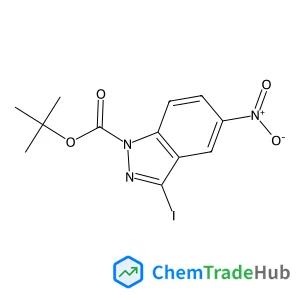
Tert-butyl 3-iodo-5-nitro-1H-indazole-1-carboxylate
CAS Number:
459133-69-8
Molecular Formula:
C12H12IN3O4
The first page of this article is displayed as the abstract.
Eleonora Ballerini, Paolo Crotti, Ileana Frau, Daniela Lanari, Ferdinando Pizzo, Luigi Vaccaro
DOI: 10.1039/C3GC40988K
Abdoulaye Gassama, Cédric Ernenwein, Ali Youssef, Mickaël Agach, Emmanuel Riguet, Siniša Marinković, Boris Estrine, Norbert Hoffmann
DOI: 10.1039/C3GC00062A
Carlos Vila, Magnus Rueping
DOI: 10.1039/C3GC40587G
Navneet Chandak, Pawan Kumar, Jitander K. Kapoor, Pawan K. Sharma
DOI: 10.1039/C3GC40797G
Lu Zhao, Yao Wang, Liang Jin, Minglei Qin, Xiang Li, Anjie Wang, Yongkang Hu
DOI: 10.1039/C3GC00092C
Dwun Kit Jonathan Yeung, Tao Gao, Jiayao Huang, Shaofa Sun, Haibing Guo, Jian Wang
DOI: 10.1039/C3GC41126E
Hamid Salehzadeh, Davood Nematollahi, Hooman Hesari
DOI: 10.1039/C3GC40954F
Daqian Xu, Wenfang Wang, Chengxia Miao, Qiaohong Zhang, Chungu Xia, Wei Sun
DOI: 10.1039/C3GC41206G
Fen-Fen Wang, Chun-Ling Liu, Wen-Sheng Dong
DOI: 10.1039/C3GC40836A
When handling 4-Methyl-6-(trifluoromethyl)quinoline (CAS: 40716-16-3), safety go...
4-(3,5-Difluorophenyl)aniline is an aromatic organic compound with the CAS numbe...
5-{[4-(Trifluoromethyl)phenyl]sulfanyl}-1,2,3-thiadiazole-4-carboxylic acid can ...
The market for 4-Benzylaniline hydrochloride (CAS: 6317-57-3) is steadily growin...
[3-(Diethylsulfamoyl)phenyl]boronic acid is generally considered safe when handl...
3-Bromo-2,5-dimethoxyaniline is mainly used in the pharmaceutical and chemical i...
N-Methyl-1-(5-methyl-1H-indol-3-yl)methanamine (CAS: 915922-67-7) is subject to ...
This compound is primarily used in the pharmaceutical industry for the synthesis...
2-Methyl-2-propanyl [(1S,3R)-3-aminocyclohexyl]carbamate (CAS: 1298101-47-9) sho...
Ethyl 2-bromo-4,4,4-trifluorobutanoate (CAS: 367-33-9) is utilized in the pharma...

ChemComm publishes urgent research which is of outstanding significance and interest to experts in the field, while also appealing to the journal’s broad chemistry readership. Our communication format is ideally suited to short, urgent studies that are of such importance that they require accelerated publication. Our scope covers all topics in chemistry, and research at the interface of chemistry and other disciplines (such as materials science, nanoscience, physics, engineering and biology) where there is a significant novelty in the chemistry aspects. Major topic areas covered include: Analytical Chemistry Catalysis Chemical Biology and medicinal chemistry Computational Chemistry and Machine Learning Energy and sustainable chemistry Environmental Chemistry Green Chemistry Inorganic Chemistry Materials Chemistry Nanoscience Organic Chemistry Physical Chemistry Polymer Chemistry Supramolecular Chemistry
![2,4-Dichloro-6-isopropyl-5H-pyrrolo[3,4-d]pyrimidin-7(6H)-one structure](https://static.chemtradehub.com/structs/107/1079649-94-7-ad4a.webp "2,4-Dichloro-6-isopropyl-5H-pyrrolo[3,4-d]pyrimidin-7(6H)-one structure")