












Chromonic liquid crystals: properties and applications as functional materials
Literature Information
Publication Date
2008-01-07
DOI
10.1039/B714319B
Impact Factor
6.222
Authors
Suk-Wah Tam-Chang, Liming Huang
View Original
Abstract
Chromonic liquid crystals (or chromonics) are formed by the self-organization of aromatic compounds with ionic or hydrophilic groups in aqueous solutions. This review summarizes the research on chromonic liquid crystals in the last two decades. The research embraced the studies of commercially available chromonic dyes and drugs, the syntheses and investigations of molecularly designed mesogens, the invention of novel processes for aligning chromonic liquid crystals, and the development of new applications as functional materials and biosensors.
Recommended Journals
Related Literature
Highly efficient iron(0) nanoparticle-catalyzed hydrogenation in water in flow
Go Hamasaka, Takao Osako, Yoichi M. A. Yamada, Chao-Jun Li, Audrey Moores
2013-06-27
Paper
DOI: 10.1039/C3GC40789F
Tungstate based poly(ionic liquid) entrapped magnetic nanoparticles: a robust oxidation catalyst
Ali Pourjavadi, Seyed Hassan Hosseini, Firouz Matloubi Moghaddam, Behzad Koushki Foroushani, Craig Bennett
2013-08-08
Paper
DOI: 10.1039/C3GC41307A
Visible-light mediated heterogeneous C–H functionalization: oxidative multi-component reactions using a recyclable titanium dioxide (TiO2) catalyst
Carlos Vila, Magnus Rueping
2013-06-10
Communication
DOI: 10.1039/C3GC40587G
Selective aqueous phase oxidation of 5-hydroxymethylfurfural to 2,5-furandicarboxylic acid over Pt/C catalysts: influence of the base and effect of bismuth promotion
Hicham Ait Rass, Nadine Essayem, Michèle Besson
2013-06-10
Paper
DOI: 10.1039/C3GC40727F
Engaging isatins in solvent-free, sterically congested Passerini reaction
Trinadh Kaicharla, Santhivardhana Reddy Yetra, Tony Roy, Akkattu T. Biju
2013-04-02
Paper
DOI: 10.1039/C3GC40454D
Iodine-mediated arylation of benzoxazoles with aldehydes
Yew Chin Teo, Siti Nurhanna Riduan, Yugen Zhang
2013-06-28
Communication
DOI: 10.1039/C3GC41027G
A straightforward double coupling of furan moieties onto epoxidized triglycerides: synthesis of monomers based on two renewable resources
Antonio J. F. Carvalho
2013-04-18
Communication
DOI: 10.1039/C3GC40358K
Highly efficient production of lactic acid from cellulose using lanthanide triflate catalysts
Fen-Fen Wang, Chun-Ling Liu, Wen-Sheng Dong
2013-06-21
Communication
DOI: 10.1039/C3GC40836A
Organic solvent-free and efficient manufacture of functionalized cellulose nanocrystalsvia one-pot tandem reactions
Lirong Tang, Biao Huang, Nating Yang, Tao Li, Qilin Lu, Wenyi Lin, Xuerong Chen
2013-06-26
Communication
DOI: 10.1039/C3GC40965A
You might also like
Compound Q&A
What precautions should be taken when handling 4-Methyl-6-(trifluoromethyl)quinoline (CAS: 40716-16-3)?
When handling 4-Methyl-6-(trifluoromethyl)quinoline (CAS: 40716-16-3), safety go...
40716-16-34-Methyl-6-(trifluor...
Compound Q&A
What is 4-(3,5-Difluorophenyl)aniline (CAS: 405058-00-6)?
4-(3,5-Difluorophenyl)aniline is an aromatic organic compound with the CAS numbe...
405058-00-64-(3,5-Difluoropheny...
Compound Q&A
How is 5-{[4-(Trifluoromethyl)phenyl]sulfanyl}-1,2,3-thiadiazole-4-carboxylic acid (CAS: 338982-07-3) typically synthesized?
5-{[4-(Trifluoromethyl)phenyl]sulfanyl}-1,2,3-thiadiazole-4-carboxylic acid can ...
338982-07-35-{[4-(Trifluorometh...
Compound Q&A
What is the market or research trend for 4-Benzylaniline hydrochloride (CAS: 6317-57-3)?
The market for 4-Benzylaniline hydrochloride (CAS: 6317-57-3) is steadily growin...
6317-57-34-Benzylaniline hydr...
Compound Q&A
Is [3-(Diethylsulfamoyl)phenyl]boronic acid (CAS: 871329-58-7) safe?
[3-(Diethylsulfamoyl)phenyl]boronic acid is generally considered safe when handl...
871329-58-7[3-(Diethylsulfamoyl...
Compound Q&A
What are the main uses of 3-Bromo-2,5-dimethoxyaniline (CAS: 115929-62-9)?
3-Bromo-2,5-dimethoxyaniline is mainly used in the pharmaceutical and chemical i...
115929-62-93-Bromo-2,5-dimethox...
Compound Q&A
What regulatory guidelines apply to N-Methyl-1-(5-methyl-1H-indol-3-yl)methanamine (CAS: 915922-67-7)?
N-Methyl-1-(5-methyl-1H-indol-3-yl)methanamine (CAS: 915922-67-7) is subject to ...
915922-67-7N-Methyl-1-(5-methyl...
Compound Q&A
What industries use Carbamic acid, N-[(5S)-5,6-diamino-6-oxohexyl]-, 1,1-dimethylethyl ester (CAS: 24828-96-4)?
This compound is primarily used in the pharmaceutical industry for the synthesis...
24828-96-4Carbamic acid, N-[(5...
Compound Q&A
How should 2-Methyl-2-propanyl [(1S,3R)-3-aminocyclohexyl]carbamate (CAS: 1298101-47-9) be stored?
2-Methyl-2-propanyl [(1S,3R)-3-aminocyclohexyl]carbamate (CAS: 1298101-47-9) sho...
1298101-47-92-Methyl-2-propanyl ...
Compound Q&A
What industries use Ethyl 2-bromo-4,4,4-trifluorobutanoate (CAS: 367-33-9)?
Ethyl 2-bromo-4,4,4-trifluorobutanoate (CAS: 367-33-9) is utilized in the pharma...
367-33-9Ethyl 2-bromo-4,4,4-...
Source Journal
Chemical Communications

CiteScore:
8.6
Self-citation Rate:
4.7%
Articles per Year:
2458
ChemComm publishes urgent research which is of outstanding significance and interest to experts in the field, while also appealing to the journal’s broad chemistry readership. Our communication format is ideally suited to short, urgent studies that are of such importance that they require accelerated publication. Our scope covers all topics in chemistry, and research at the interface of chemistry and other disciplines (such as materials science, nanoscience, physics, engineering and biology) where there is a significant novelty in the chemistry aspects. Major topic areas covered include: Analytical Chemistry Catalysis Chemical Biology and medicinal chemistry Computational Chemistry and Machine Learning Energy and sustainable chemistry Environmental Chemistry Green Chemistry Inorganic Chemistry Materials Chemistry Nanoscience Organic Chemistry Physical Chemistry Polymer Chemistry Supramolecular Chemistry
Recommended Compounds
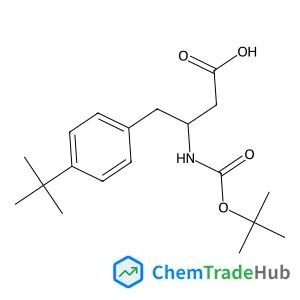
(S)-3-((tert-Butoxycarbonyl)amino)-4-(4-(tert-butyl)phenyl)butanoic acid
CAS Number:
403661-85-8
Molecular Formula:
C19H29NO4
Recommended Suppliers





Disclaimer
This page provides academic journal information for reference and research purposes only. We are not affiliated with any journal publishers and do not handle publication submissions. For publication-related inquiries, please contact the respective journal publishers directly.
If you notice any inaccuracies in the information displayed, please contact us at support@chemtradehub.com. We will promptly review and address your concerns.