












Excited states using the simplified Tamm–Dancoff-Approach for range-separated hybrid density functionals: development and application
Literature Information
Publication Date
2013-11-29
DOI
10.1039/C3CP54517B
Impact Factor
3.676
Authors
Andreas Hansen, Stefan Grimme
View Original
Abstract
The recently introduced sTDA methodology [S. Grimme, J. Chem. Phys., 2013, 138, 244104] to compute excitation spectra of huge molecular systems is extended to range-separated hybrid (RSH) density functionals. The three empirical parameters of the method which describe a screened two-electron interaction are obtained for some common RSH functionals (ωB97 family, CAM-B3LYP, LC-BLYP) from a fit to theoretical SCS-CC2 reference vertical excitation energies for a set of small to medium-sized chromophores. The method is cross-validated on a set of inter- and intramolecular charge transfer states and a set composed of typical valence transitions. Overall small deviations from reference data of only about 0.2–0.4 eV are found with best performance for CAM-B3LYP and ωB97X-D3. To demonstrate versatility and robustness of the new methodology, applications (the UV/Vis spectrum of the pyridine polymer and the ECD spectrum of (P)-[11]helicene) and frequently used charge transfer examples are discussed. In one case, 11 000+ excited electronic states of a system containing 330 atoms were calculated. We show that the asymptotically correct sTDA–RSH combination yields results often superior to those based on global hybrids and that it opens up new possibilities for the computation of excited states in materials science and bio-molecular systems.
Related Literature
Scholarly publishing: a partnership with mutual benefits and individual responsibilities
2018-12-20
Editorial
DOI: 10.1039/C8RP90013B
Redox, transmetalation, and stacking properties of tetrathiafulvalene-2,3,6,7-tetrathiolate bridged tin, nickel, and palladium compounds
Jiaze Xie, Jan-Niklas Boyn, Alexander S. Filatov, Andrew J. McNeece, David A. Mazziotti, John S. Anderson
2019-12-04
Edge Article
DOI: 10.1039/C9SC04381K
Celecoxib cocrystal polymorphs with cyclic amides: synthons of a sulfonamide drug with carboxamide coformers
Geetha Bolla, Sudhir Mittapalli, Ashwini Nangia
2013-09-23
Communication
DOI: 10.1039/C3CE41885E
Isothermal kinase-triggered supramolecular assemblies as drug sensitizers
Zhe Miao, Chengling Wu, Fangfei He, Peng Ren, Shuo Bai
2019-12-06
Edge Article
DOI: 10.1039/C9SC04317A
Temperature-dependent guest reorientation: a reversible order–disorder transformation in a single crystal
Matteo Lusi, Leonard J. Barbour
2013-10-10
Communication
DOI: 10.1039/C3CE41572D
A conformational analysis of transition metal η1-acyl complexes: steric interactions and stereoelectronic effects
Review Article
DOI: 10.1039/CS9881700147
You might also like
Compound Q&A
What are the main uses of 1H-Indazole-6-carbonitrile (CAS: 141290-59-7)?
1H-Indazole-6-carbonitrile finds applications in pharmaceuticals, where it serve...
141290-59-71H-Indazole-6-carbon...
Compound Q&A
How should waste containing Dioctyl (2E)-2-butenedioate (CAS: 2997-85-5) be handled?
Waste containing Dioctyl (2E)-2-butenedioate (CAS: 2997-85-5) should be collecte...
2997-85-5Dioctyl (2E)-2-buten...
Compound Q&A
What industries use Sodium [(1,2-benzoxazol-3-ylmethyl)sulfonyl]azanide (CAS: 68291-98-5)?
Sodium [(1,2-benzoxazol-3-ylmethyl)sulfonyl]azanide is primarily used in pharmac...
68291-98-5Sodium [(1,2-benzoxa...
Compound Q&A
Are there alternatives to Dimethyl 4-(4,4,5,5-tetramethyl-1,3,2-dioxaborolan-2-yl)-2,6-pyridinedicarboxylate (CAS: 741709-66-0) in synthesis?
Dimethyl 4-(4,4,5,5-tetramethyl-1,3,2-dioxaborolan-2-yl)-2,6-pyridinedicarboxyla...
741709-66-0Dimethyl 4-(4,4,5,5-...
Compound Q&A
How should waste containing 2-Fluoro-6-hydrazinopyridine (CAS: 80714-39-2) be handled?
Waste containing 2-Fluoro-6-hydrazinopyridine (CAS: 80714-39-2) should be manage...
80714-39-22-Fluoro-6-hydrazino...
Compound Q&A
What is 6-Formyl-2-pyridinecarboxylic acid (CAS: 499214-11-8)?
6-Formyl-2-pyridinecarboxylic acid is an organic compound with the molecular for...
499214-11-86-Formyl-2-pyridinec...
Compound Q&A
What is the market or research trend for 3-(3,4-dimethoxyphenyl)-2,5-dimethyl-N-(2-morpholin-4-ylethyl)pyrazolo[1,5-a]pyrimidin-7-amine (CAS: 900874-91-1)?
Research trends for this compound indicate a focus on its potential applications...
900874-91-13-(3,4-dimethoxyphen...
Compound Q&A
How is 9H-Tribenzo[b,d,f]azepine (CAS: 29875-73-8) typically synthesized?
9H-Tribenzo[b,d,f]azepine is typically synthesized via a multi-step process invo...
29875-73-89H-Tribenzo[b,d,f]az...
Compound Q&A
How is 1-Cyclopropyl-7-ethoxy-6-fluoro-8-methoxy-4-oxo-1,4-dihydro-3-quinolinecarboxylic acid (CAS: 1797982-51-4) typically synthesized?
1-Cyclopropyl-7-ethoxy-6-fluoro-8-methoxy-4-oxo-1,4-dihydro-3-quinolinecarboxyli...
1797982-51-41-Cyclopropyl-7-etho...
Compound Q&A
How should waste containing Methyl 3-oxo-1,2,3,4-tetrahydro-6-quinoxalinecarboxylate (CAS: 671820-52-3) be handled?
Waste containing Methyl 3-oxo-1,2,3,4-tetrahydro-6-quinoxalinecarboxylate (CAS: ...
671820-52-3Methyl 3-oxo-1,2,3,4...
Source Journal
Physical Chemistry Chemical Physics

CiteScore:
5.5
Self-citation Rate:
10.3%
Articles per Year:
3036
Physical Chemistry Chemical Physics (PCCP) is an international journal co-owned by 19 physical chemistry and physics societies from around the world. This journal publishes original, cutting-edge research in physical chemistry, chemical physics and biophysical chemistry. To be suitable for publication in PCCP, articles must include significant innovation and/or insight into physical chemistry; this is the most important criterion that reviewers and Editors will judge against when evaluating submissions. The journal has a broad scope and welcomes contributions spanning experiment, theory, computation and data science. Topical coverage includes spectroscopy, dynamics, kinetics, statistical mechanics, thermodynamics, electrochemistry, catalysis, surface science, quantum mechanics, quantum computing and machine learning. Interdisciplinary research areas such as polymers and soft matter, materials, nanoscience, energy, surfaces/interfaces, and biophysical chemistry are welcomed if they demonstrate significant innovation and/or insight into physical chemistry. Joined experimental/theoretical studies are particularly appreciated when complementary and based on up-to-date approaches.
Recommended Compounds
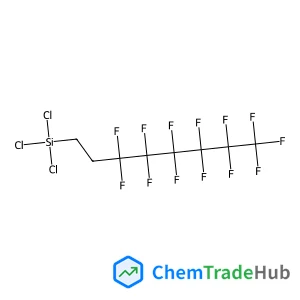
Trichloro(3,3,4,4,5,5,6,6,7,7,8,8,8-tridecafluorooctyl)silane
CAS Number:
78560-45-9
Molecular Formula:
C8H4Cl3F13Si
Recommended Suppliers




Disclaimer
This page provides academic journal information for reference and research purposes only. We are not affiliated with any journal publishers and do not handle publication submissions. For publication-related inquiries, please contact the respective journal publishers directly.
If you notice any inaccuracies in the information displayed, please contact us at support@chemtradehub.com. We will promptly review and address your concerns.