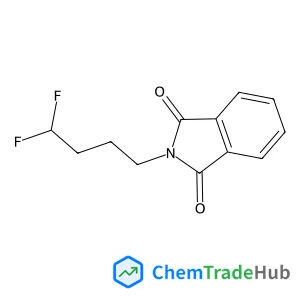
2-(4,4-Difluorobutyl)-1H-isoindole-1,3(2H)-dione
CAS Number:
1265341-14-7
Molecular Formula:
C12H11F2NO2
François-Xavier Coudert, Alain H. Fuchs, Alexander V. Neimark
A graphical abstract is available for this content

Electroanalysis

Bioorganic & Medicinal Chemistry Letters

Colloid Journal

Chinese Journal of Chemistry

Cellulose

Journal of Chemical Sciences

Journal of the Indian Institute of Science

Critical Reviews in Solid State and Materials Sciences

Journal of Asian Natural Products Research

Medicinal Chemistry Research
Davide Pantarotto, Wesley R. Browne, Ben L. Feringa
DOI: 10.1039/B715310D
Jun-ichi Ito, Satoshi Ujiie, Hisao Nishiyama
DOI: 10.1039/B800387D
Takaaki Tsuruoka, Rena Takahashi, Toshihiro Nakamura, Minoru Fujii, Kensuke Akamatsu, Hidemi Nawafune
DOI: 10.1039/B717732A
Suresh R. Chawrai, Neil R. Williamson, George P. C. Salmond, Finian J. Leeper
DOI: 10.1039/B719353J
Michele R. Chierotti, Roberto Gobetto
DOI: 10.1039/B711551B
Peng Gao, Dirk Beckmann, Hoi Nok Tsao, Xinliang Feng, Volker Enkelmann, Wojciech Pisula, Klaus Müllen
DOI: 10.1039/B717608B
Anaïs Medina, Christian G. Claessens, G. M. Aminur Rahman, Al Mokhtar Lamsabhi, Otilia Mó, Manuel Yáñez, Dirk M. Guldi, Tomás Torres
DOI: 10.1039/B719226F
Kalyan V. Vasudevan, Michael Findlater, Alan H. Cowley
DOI: 10.1039/B719251G
N-(4-Methoxybenzyl)-2-pyridinamine (CAS: 52818-63-0) is increasingly being used ...
When handling Ethyl 4-(2-chlorophenyl)-1,3-thiazole-2-carboxylate, appropriate p...
Diethyldiselane (CAS: 628-39-7) is classified under the Globally Harmonized Syst...
The market for oxocopper (CAS: 12053-18-8) is primarily driven by its use in cat...
The market for 5-{[(2-Methyl-2-propanyl)oxy]carbonyl}-5-azaspiro[2.4]heptane-7-c...
2-(1-Pyrrolidinyl)-4-pyridinamine is a chemical compound with the CAS number 359...
2-(3-Pyridinyl)-1-azabicyclo[2.2.2]octane (CAS: 91556-75-1) is a crystalline sol...
(S)-Alpha-allyl-proline hydrochloride is usually synthesized via a Wittig reacti...
3-Methyl-1,2-oxazole-5-carboxylic acid (CAS: 4857-42-5) is an organic compound w...
Lys-SMCC-DM1 is synthesized via a multi-step process involving the coupling of S...

Physical Chemistry Chemical Physics (PCCP) is an international journal co-owned by 19 physical chemistry and physics societies from around the world. This journal publishes original, cutting-edge research in physical chemistry, chemical physics and biophysical chemistry. To be suitable for publication in PCCP, articles must include significant innovation and/or insight into physical chemistry; this is the most important criterion that reviewers and Editors will judge against when evaluating submissions. The journal has a broad scope and welcomes contributions spanning experiment, theory, computation and data science. Topical coverage includes spectroscopy, dynamics, kinetics, statistical mechanics, thermodynamics, electrochemistry, catalysis, surface science, quantum mechanics, quantum computing and machine learning. Interdisciplinary research areas such as polymers and soft matter, materials, nanoscience, energy, surfaces/interfaces, and biophysical chemistry are welcomed if they demonstrate significant innovation and/or insight into physical chemistry. Joined experimental/theoretical studies are particularly appreciated when complementary and based on up-to-date approaches.