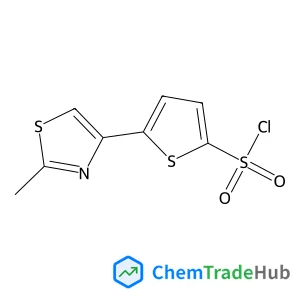
5-(2-Methyl-1,3-thiazol-4-yl)-2-thiophenesulfonyl chloride
CAS Number:
215434-25-6
Molecular Formula:
C8H6ClNO2S3
Himadri Chakraborti, Kommula Bramhaiah, Neena Susan John, Suman Kalyan Pal
The quenching of the fluorescence of 1-aminopyrene (1-Ap) by reduced graphene oxide (rGO) has been investigated using spectroscopic techniques. In spite of the upward curvature in the Stern–Volmer plot, the unchanged spectral signature of the absorption of 1-Ap in the presence of rGO and the decrease in fluorescence lifetime with increasing rGO concentration point toward the dynamic nature of the quenching. Detailed analysis of steady state and time-resolved spectroscopic data has shown that the quenching arises due to the photoinduced electron transfer from 1-Ap to rGO. This is again supported by estimating the Gibb's free energy change for the ground as well as excited state electron transfer. Ab initio calculations under the density functional theory (DFT) formalism reveal that the possibility of π–π stacking is very slim in the 1-Ap–rGO system and the electron density resides completely on 1-Ap in the highest occupied molecular orbital (HOMO) and on graphene in the lowest unoccupied molecular orbital (LUMO), supporting the experimental findings of the intermolecular electron transfer between 1-Ap and rGO in the excited state.
Yuxian Gao, Rongtan Li, Shilong Chen, Liangfeng Luo, Tian Cao, Weixin Huang
DOI: 10.1039/C5CP04570C
Zhe Li, Dmitry Bedrov, Oleg Borodin, Andreas Heuer
DOI: 10.1039/C5CP05111H
Weiliu Fan
DOI: 10.1039/C5CP05591A
Petru Apostol, Juliana Eccher, Marta Elisa Rosso Dotto, Cassiano Batesttin Costa, Thiago Cazati, Elizabeth A. Hillard, Harald Bock, Ivan H. Bechtold
DOI: 10.1039/C5CP05582B
Takeshi Yanai, George I. Fann, Gregory Beylkin
DOI: 10.1039/C4CP05821F
Janet E. Del Bene, Ibon Alkorta, José Elguero
DOI: 10.1039/C5CP05832E
J. Soulestin, M. Sclavons
DOI: 10.1039/C5CP04969E
Juan Corchado-García, Luis E. Betancourt, Carlos A. Vélez, Sanjaya D. Senanayake, Dario Stacchiola, Kotaro Sasaki, Maxime J.-F. Guinel, Yunyun Zhou, Chin Li Cheung, Carlos R. Cabrera
DOI: 10.1039/C5CP04813C
Yan Wang, Hai Li, Jijun Zhang, Xinyu Yan, Zexiang Chen
DOI: 10.1039/C5CP05336F
Waste containing 6-Chloro-5-(2'-hydroxy-3'-methoxy-4-biphenylyl)-3-(3-methoxyphe...
(3alpha,5alpha)-3-Hydroxypregnane-11,20-dione is primarily used in the pharmaceu...
The market for 4-Amino-6-chloro-2-pyridinecarboxylic acid (CAS: 546141-56-4) is ...
Alternatives to (2-Benzoylethyl)trimethylammonium chloride (CAS: 24472-88-6) in ...
N-[4-Nitro-3-(trifluoromethyl)phenyl]acetamide (CAS: 393-12-4) is generally safe...
Alternative reagents such as other phosphates or similar functional groups can b...
There are alternatives to N,N'-Bis(3-aminopropyl)-1,3-propanediamine (CAS: 4605-...
When handling Aluminium trihexadecanoate, it is important to use appropriate per...
(1,1-Dioxido-3-oxo-1,2-benzothiazol-2(3H)-yl)acetic acid is a chemical compound ...
Several alternatives to 5,5-dimethyloxolan-2-one (CAS: 3123-97-5) can be used in...

Physical Chemistry Chemical Physics (PCCP) is an international journal co-owned by 19 physical chemistry and physics societies from around the world. This journal publishes original, cutting-edge research in physical chemistry, chemical physics and biophysical chemistry. To be suitable for publication in PCCP, articles must include significant innovation and/or insight into physical chemistry; this is the most important criterion that reviewers and Editors will judge against when evaluating submissions. The journal has a broad scope and welcomes contributions spanning experiment, theory, computation and data science. Topical coverage includes spectroscopy, dynamics, kinetics, statistical mechanics, thermodynamics, electrochemistry, catalysis, surface science, quantum mechanics, quantum computing and machine learning. Interdisciplinary research areas such as polymers and soft matter, materials, nanoscience, energy, surfaces/interfaces, and biophysical chemistry are welcomed if they demonstrate significant innovation and/or insight into physical chemistry. Joined experimental/theoretical studies are particularly appreciated when complementary and based on up-to-date approaches.
![4-{[4-(Trifluoromethoxy)benzyl]oxy}benzonitrile structure](https://static.chemtradehub.com/structs/103/1036629-63-6-2172.webp "4-{[4-(Trifluoromethoxy)benzyl]oxy}benzonitrile structure")
![1-(2-Chlorophenyl)-6-[(2S)-3,3,3-trifluoro-2-methylpropyl]-1,7-dihydro-4H-pyrazolo[3,4-d]pyrimidin-4-one structure](https://static.chemtradehub.com/structs/794/794568-91-5-0c34.webp "1-(2-Chlorophenyl)-6-[(2S)-3,3,3-trifluoro-2-methylpropyl]-1,7-dihydro-4H-pyrazolo[3,4-d]pyrimidin-4-one structure")