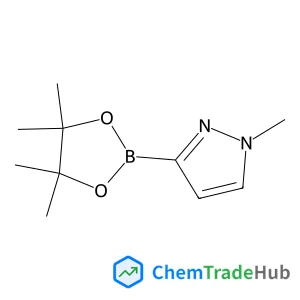
1-Methyl-3-(4,4,5,5-tetramethyl-1,3,2-dioxaborolan-2-yl)-1H-pyrazole
CAS Number:
1020174-04-2
Molecular Formula:
C10H17BN2O2
Jishnu Bhattacharya, C. Wolverton
Spinel oxides represent an important class of cathode materials for Li-ion batteries. Two major variants of the spinel crystal structure are normal and inverse. The relative stability of normal and inverse ordering at different stages of lithiation has important consequences in lithium diffusivity, voltage, capacity retention and battery life. In this paper, we investigate the relative structural stability of normal and inverse structures of the 3d transition metal oxide spinels with first-principles DFT calculations. We have considered ternary spinel oxides LixM2O4 with M = Ti, V, Cr, Mn, Fe, Co and Ni in both lithiated (x = 1) and delithiated (x = 0) conditions. We find that for all lithiated spinels, the normal structure is preferred regardless of the metal. We observe that the normal structure for all these oxides has a lower size mismatch between octahedral cations compared to the inverse structure. With delithiation, many of the oxides undergo a change in stability with vanadium in particular, showing a tendency to occupy tetrahedral sites. We find that in the delithiated oxide, only vanadium ions can access a +5 oxidation state which prefers tetrahedral coordination. We have also calculated the average voltage of lithiation for these spinels. The calculated voltages agree well with the previously measured and calculated values, wherever available. For the yet to be characterized spinels, our calculation provides voltage values which can motivate further experimental attention. Lastly, we observe that all the normal spinel oxides of the 3d transition metal series have a driving force for a transformation to the non-spinel structure upon delithiation.

Cellulose

Journal of Asian Natural Products Research

Main Group Chemistry

Bioorganic & Medicinal Chemistry

Critical Reviews in Solid State and Materials Sciences

Biocatalysis and Biotransformation

Journal of the Indian Institute of Science

Journal of Chemical Sciences

Acta Metallurgica Sinica-English Letters

Chinese Journal of Chemistry
Dehua Yu
DOI: 10.1039/D2AN01169G
Hui Xi, Hanlin Jiang, Mario Juhas, Yang Zhang
DOI: 10.1039/D2AN01057G
Ismael AL Mulla, John P. Lowry, Pier Andrea Serra, Robert D. O'Neill
DOI: 10.1039/B810227A
Jingjing Kuang, Zhibo Fu, Xuezhi Sun, Chuhui Lin, Shenglong Yang, Jiayao Xu, Min Zhang, Hongyang Zhang, Fanghong Ning, Ping Hu
DOI: 10.1039/D2AN01410F
Reza Derakhshan, Abas Ramiar, Amirhosein Ghasemi
DOI: 10.1039/D2AN01308H
Lin Mei, Yanmei Shi, Yange Shi, Pengpeng Yan, Chunlei Lin, Yue Sun, Bingjie Wei, Jing Li
DOI: 10.1039/D2AN01432G
Na Li, Minhui Li, Mei Li
DOI: 10.1039/D2AN01798A
Ke-Peng Lai, Yu-Chen Su, Bo-Siang Fu, Kung-Hung Lin, Hwang-Shang Kou
DOI: 10.1039/D2AN01433E
Karin Y. Chumbimuni-Torres, Joseph Wang
DOI: 10.1039/B902171J
When handling 4-(2-Furylmethyl)thiomorpholine 1,1-dioxide (CAS: 79206-94-3), it ...
When handling 4-Chloro-N-[2-(4-morpholinyl)ethyl]benzamide (CAS: 71320-77-9), it...
Waste containing this compound (CAS: 62921-74-8) should be handled according to ...
Waste containing (S)-Methyl 2-amino-3-cyclohexylpropanoate should be collected i...
This compound can be synthesized using a multi-step process involving the conjug...
There are several alternatives to (2E)-3-(3,4-Dichlorophenyl)acrylic acid in syn...
Ethyl 6-(2-nitrophenyl)imidazo[2,1-b][1,3]thiazole-3-carboxylate (CAS: 925437-84...
Waste containing 2-(1,3-Thiazol-2-yl)ethanamine (CAS: 18453-07-1) should be coll...
Methyl 5-iodo-2-methylbenzoate can be synthesized through the iodination of meth...
5-Chloro[1,2,4]triazolo[1,5-a]pyridine is commonly synthesized via the condensat...

Physical Chemistry Chemical Physics (PCCP) is an international journal co-owned by 19 physical chemistry and physics societies from around the world. This journal publishes original, cutting-edge research in physical chemistry, chemical physics and biophysical chemistry. To be suitable for publication in PCCP, articles must include significant innovation and/or insight into physical chemistry; this is the most important criterion that reviewers and Editors will judge against when evaluating submissions. The journal has a broad scope and welcomes contributions spanning experiment, theory, computation and data science. Topical coverage includes spectroscopy, dynamics, kinetics, statistical mechanics, thermodynamics, electrochemistry, catalysis, surface science, quantum mechanics, quantum computing and machine learning. Interdisciplinary research areas such as polymers and soft matter, materials, nanoscience, energy, surfaces/interfaces, and biophysical chemistry are welcomed if they demonstrate significant innovation and/or insight into physical chemistry. Joined experimental/theoretical studies are particularly appreciated when complementary and based on up-to-date approaches.
![1,2-Diphenyl-4-[2-(phenylsulfinyl)ethyl]-3,5-pyrazolidinedione structure](https://static.chemtradehub.com/structs/57-/57-96-5-efcc.webp "1,2-Diphenyl-4-[2-(phenylsulfinyl)ethyl]-3,5-pyrazolidinedione structure")
![N-[(Benzyloxy)carbonyl]serine structure](https://static.chemtradehub.com/structs/276/2768-56-1-77f7.webp "N-[(Benzyloxy)carbonyl]serine structure")