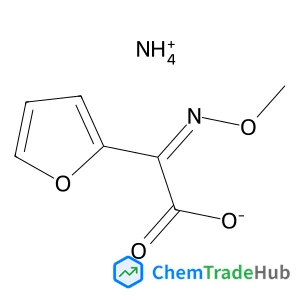
Ammonium (Z)-2-(furan-2-yl)-2-(methoxyimino)acetate
CAS Number:
97148-39-5
Molecular Formula:
C7H10N2O4
H. W. Choi, Y. H. Kim, Y. H. Rim, Y. S. Yang
The formation of crystalline LiNbO3 (LN) from LN glass has been studied by means of differential scanning calorimetry and in situ synchrotron X-ray diffraction. The LN glass with no glass former was prepared by the polymerized complex method. The isothermal kinetics of the crystallization process is described using the Johnson–Mehl–Avrami–Kolmogorov (JMAK) equation and the Avrami exponent n is found to be ∼2.0, indicating that the crystallization mechanism is diffusion-controlled growth with a decreasing nucleation rate. The effective activation energy of crystallization calculated from isothermal measurements is 6.51 eV. It is found that the LN glass directly transforms into a rhombohedral LN crystal without any intermediate crystalline phase and most crystal grains are confined within the size of ∼40 nm irrespective of different isothermal temperatures. Application of JMAK theory to the non-isothermal thermoanalytical study of crystallization of LN glass is discussed.

Photochemical & Photobiological Sciences

Advanced Engineering Materials

Molecular Diversity

Journal of Enzyme inhibition and Medicinal Chemistry

Environmental Toxicology and Pharmacology

Lab on a Chip

Current Pharmaceutical Biotechnology

Coloration Technology

Faraday Discussions

Nature Reviews Drug Discovery
T. Fukushima, A. Stroppa, S. Picozzi, J. M. Perez-Mato
DOI: 10.1039/C1CP20626E
Qing Lin, Xiaolong Zou, Gang Zhou, Rui Liu, Jian Wu, Jia Li, Wenhui Duan
DOI: 10.1039/C1CP20783K
Guangfeng Jiang
DOI: 10.1039/C0CP02949A
DOI: 10.1039/C0CP02407D
R. De Lisi, G. Lazzara, S. Milioto
DOI: 10.1039/C1CP20737G
Ramdas Pophale, Phillip A. Cheeseman, Michael W. Deem
DOI: 10.1039/C0CP02255A
Soumik Sarkar, Abhinandan Makhal, Tanujjal Bora, Sunandan Baruah, Joydeep Dutta, Samir Kumar Pal
DOI: 10.1039/C1CP20892F
F. Saija
DOI: 10.1039/C0CP02625E
1H-Indazole-6-carbonitrile finds applications in pharmaceuticals, where it serve...
Waste containing Dioctyl (2E)-2-butenedioate (CAS: 2997-85-5) should be collecte...
Sodium [(1,2-benzoxazol-3-ylmethyl)sulfonyl]azanide is primarily used in pharmac...
Dimethyl 4-(4,4,5,5-tetramethyl-1,3,2-dioxaborolan-2-yl)-2,6-pyridinedicarboxyla...
Waste containing 2-Fluoro-6-hydrazinopyridine (CAS: 80714-39-2) should be manage...
6-Formyl-2-pyridinecarboxylic acid is an organic compound with the molecular for...
Research trends for this compound indicate a focus on its potential applications...
9H-Tribenzo[b,d,f]azepine is typically synthesized via a multi-step process invo...
1-Cyclopropyl-7-ethoxy-6-fluoro-8-methoxy-4-oxo-1,4-dihydro-3-quinolinecarboxyli...
Waste containing Methyl 3-oxo-1,2,3,4-tetrahydro-6-quinoxalinecarboxylate (CAS: ...

Physical Chemistry Chemical Physics (PCCP) is an international journal co-owned by 19 physical chemistry and physics societies from around the world. This journal publishes original, cutting-edge research in physical chemistry, chemical physics and biophysical chemistry. To be suitable for publication in PCCP, articles must include significant innovation and/or insight into physical chemistry; this is the most important criterion that reviewers and Editors will judge against when evaluating submissions. The journal has a broad scope and welcomes contributions spanning experiment, theory, computation and data science. Topical coverage includes spectroscopy, dynamics, kinetics, statistical mechanics, thermodynamics, electrochemistry, catalysis, surface science, quantum mechanics, quantum computing and machine learning. Interdisciplinary research areas such as polymers and soft matter, materials, nanoscience, energy, surfaces/interfaces, and biophysical chemistry are welcomed if they demonstrate significant innovation and/or insight into physical chemistry. Joined experimental/theoretical studies are particularly appreciated when complementary and based on up-to-date approaches.