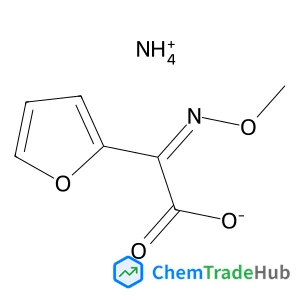
Ammonium (Z)-2-(furan-2-yl)-2-(methoxyimino)acetate
CAS Number:
97148-39-5
Molecular Formula:
C7H10N2O4
R. De Lisi, G. Lazzara, S. Milioto
The study highlighted the main forces driving the formation of hydroxypropyl-cyclodextrins (HP-CDs) + poly(propylene) glycol 725 g mol−1 inclusion complexes. The temperature parameter was chosen as the variable to modulate the hydrophobicity of the polymer, and consequently ITC experiments as functions of temperature as well as DSC measurements were done in a systematic way. The polymer is not included into HP-α-CD, it is strongly bound to HP-β-CD and it is floating in HP-γ-CD. The stability of the inclusion complexes is entropy controlled. The gain of the entropy is a unique result compared to the opposite literature findings for inclusion complexes based on polymers and CDs. This peculiarity is ascribable to the removal of water molecules from cages during complexation and this effect compensates the entropy loss due to constraints caused by the CD threading. In spite the host–guest van der Waals contacts are optimized, the enthalpies for the inclusion complex formation are positive and reveal the large heat required for dehydrating the propylene oxide units. All the macrocycles enhanced the polymer solubility in water. Increasing the affinity of the macrocycle to the macromolecule makes more expanded the one-phase area of the binodal curve. A new thermodynamic approach was proposed to predict quantitatively the binodal curve as well as the dependence of the enthalpy of separation phase on the macrocycle composition. The agreement between the experimental data and the computed values was excellent.
G. Grancini, D. Fazzi, H.-J. Egelhaaf, T. Sauermann, M. R. Antognazza, M. Caironi, A. Petrozza
DOI: 10.1039/C4CP00801D
Jie Li, Yibin Jiang, Juan Cheng, Yilin Zhang, Huimin Su, Jacky W. Y. Lam, Herman H. Y. Sung, Kam Sing Wong, Hoi Sing Kwok
DOI: 10.1039/C4CP04052J
Pengyao Xing, Xiaoxiao Chu, Mingfang Ma, Shangyang Li, Aiyou Hao
DOI: 10.1039/C4CP00367E
Paula Mori-Sánchez, Aron J. Cohen
DOI: 10.1039/C4CP01170H
Roberto Verucchi, Luca Pasquali, Angelo Giglia, Giovanna Fronzoni, Mauro Sambi, Giulia Mangione
DOI: 10.1039/C4CP03958K
Yan Zhou, Peng Zhang
DOI: 10.1039/C4CP01199F
L. Nierzwicki, M. Wieczor, V. Censi, M. Baginski, L. Calucci, S. Samaritani, J. Czub, C. Forte
DOI: 10.1039/C4CP04360J
Ivan Popov, Alexander Puzenko, Airat Khamzin, Yuri Feldman
DOI: 10.1039/C4CP04271A
Ali Dabirian, Bernard Dam, Roel van de Krol
DOI: 10.1039/C4CP01583E
1H-Indazole-6-carbonitrile finds applications in pharmaceuticals, where it serve...
Waste containing Dioctyl (2E)-2-butenedioate (CAS: 2997-85-5) should be collecte...
Sodium [(1,2-benzoxazol-3-ylmethyl)sulfonyl]azanide is primarily used in pharmac...
Dimethyl 4-(4,4,5,5-tetramethyl-1,3,2-dioxaborolan-2-yl)-2,6-pyridinedicarboxyla...
Waste containing 2-Fluoro-6-hydrazinopyridine (CAS: 80714-39-2) should be manage...
6-Formyl-2-pyridinecarboxylic acid is an organic compound with the molecular for...
Research trends for this compound indicate a focus on its potential applications...
9H-Tribenzo[b,d,f]azepine is typically synthesized via a multi-step process invo...
1-Cyclopropyl-7-ethoxy-6-fluoro-8-methoxy-4-oxo-1,4-dihydro-3-quinolinecarboxyli...
Waste containing Methyl 3-oxo-1,2,3,4-tetrahydro-6-quinoxalinecarboxylate (CAS: ...

Physical Chemistry Chemical Physics (PCCP) is an international journal co-owned by 19 physical chemistry and physics societies from around the world. This journal publishes original, cutting-edge research in physical chemistry, chemical physics and biophysical chemistry. To be suitable for publication in PCCP, articles must include significant innovation and/or insight into physical chemistry; this is the most important criterion that reviewers and Editors will judge against when evaluating submissions. The journal has a broad scope and welcomes contributions spanning experiment, theory, computation and data science. Topical coverage includes spectroscopy, dynamics, kinetics, statistical mechanics, thermodynamics, electrochemistry, catalysis, surface science, quantum mechanics, quantum computing and machine learning. Interdisciplinary research areas such as polymers and soft matter, materials, nanoscience, energy, surfaces/interfaces, and biophysical chemistry are welcomed if they demonstrate significant innovation and/or insight into physical chemistry. Joined experimental/theoretical studies are particularly appreciated when complementary and based on up-to-date approaches.