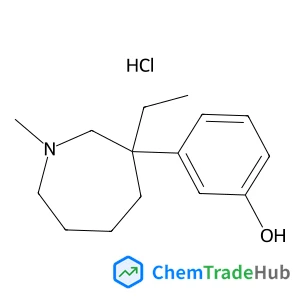
3-(3-Ethyl-1-methyl-3-azepanyl)phenol hydrochloride (1:1)
CAS Number:
59263-76-2
Molecular Formula:
C15H24ClNO
Vladimir Tripković, Keld T. Lundgaard, Kristian E. Jensen, Heine A. Hansen, Jens S. Hummelshøj, Tejs Vegge, Jan Rossmeisl
With surging interest in high energy density batteries, much attention has recently been devoted to metal–air batteries. The zinc–air battery has been known for more than a hundred years and is commercially available as a primary battery, but recharging has remained elusive, in part because the fundamental mechanisms still remain to be fully understood. Here, we present a density functional theory investigation of the zinc dissolution (oxidation) on the anode side in the zinc–air battery. Two models are envisaged, the most stable (0001) surface and a kink surface. The kink model proves to be more accurate as it brings about some important features of bulk dissolution and yields results in good agreement with experiments. From the adsorption energies of hydroxyl species and experimental values, we construct a free energy diagram and confirm that there is a small overpotential associated with the reaction. The applied methodology provides new insight into computational modelling and design of secondary metal–air batteries.

Journal of Chemical Sciences

Main Group Chemistry

Journal of Asian Natural Products Research

NDT & E International

Critical Reviews in Solid State and Materials Sciences

Herald of the Russian Academy of Sciences

Chinese Journal of Chemistry

Topics in Catalysis

Heteroatom Chemistry

Acta Metallurgica Sinica-English Letters
Guoxing Wu, Alaa Eldin A. Salem, Lei Su, Bing Shi Li
DOI: 10.1039/D2AN90082C
Melissa M. Mariani, Peter Lampen, Bayden R. Wood
DOI: 10.1039/B822408K
Paul Bassan, Hugh J. Byrne, Joe Lee, Franck Bonnier, Colin Clarke, Paul Dumas, Ehsan Gazi, Michael D. Brown, Peter Gardner
DOI: 10.1039/B821349F
Dehua Yu
DOI: 10.1039/D2AN01169G
Xi Chen, Shuli Tang, Dallas Freitas, Erin Hirtzel, Heyong Cheng, Xin Yan
DOI: 10.1039/D2AN01174C
Fan Li, Juan Zhang, Xuni Cao, Lihua Wang, Di Li, Shiping Song, Bangce Ye, Chunhai Fan
DOI: 10.1039/B900900K
Ya-Ting Chen, Bin Li, Jia-Liang Chen, Xun-Cheng Su
DOI: 10.1039/D2AN01632J
Hogyeong Gwak, Seong Min Ha, Jae-Woo Song, Kyung-A. Hyun
DOI: 10.1039/D2AN01380K
Ke-Peng Lai, Yu-Chen Su, Bo-Siang Fu, Kung-Hung Lin, Hwang-Shang Kou
DOI: 10.1039/D2AN01433E
Antje Hermelink, Angelika Brauer, Peter Lasch, Dieter Naumann
DOI: 10.1039/B822574E
When handling 4-(2-Furylmethyl)thiomorpholine 1,1-dioxide (CAS: 79206-94-3), it ...
When handling 4-Chloro-N-[2-(4-morpholinyl)ethyl]benzamide (CAS: 71320-77-9), it...
Waste containing this compound (CAS: 62921-74-8) should be handled according to ...
Waste containing (S)-Methyl 2-amino-3-cyclohexylpropanoate should be collected i...
This compound can be synthesized using a multi-step process involving the conjug...
There are several alternatives to (2E)-3-(3,4-Dichlorophenyl)acrylic acid in syn...
Ethyl 6-(2-nitrophenyl)imidazo[2,1-b][1,3]thiazole-3-carboxylate (CAS: 925437-84...
Waste containing 2-(1,3-Thiazol-2-yl)ethanamine (CAS: 18453-07-1) should be coll...
Methyl 5-iodo-2-methylbenzoate can be synthesized through the iodination of meth...
5-Chloro[1,2,4]triazolo[1,5-a]pyridine is commonly synthesized via the condensat...

Physical Chemistry Chemical Physics (PCCP) is an international journal co-owned by 19 physical chemistry and physics societies from around the world. This journal publishes original, cutting-edge research in physical chemistry, chemical physics and biophysical chemistry. To be suitable for publication in PCCP, articles must include significant innovation and/or insight into physical chemistry; this is the most important criterion that reviewers and Editors will judge against when evaluating submissions. The journal has a broad scope and welcomes contributions spanning experiment, theory, computation and data science. Topical coverage includes spectroscopy, dynamics, kinetics, statistical mechanics, thermodynamics, electrochemistry, catalysis, surface science, quantum mechanics, quantum computing and machine learning. Interdisciplinary research areas such as polymers and soft matter, materials, nanoscience, energy, surfaces/interfaces, and biophysical chemistry are welcomed if they demonstrate significant innovation and/or insight into physical chemistry. Joined experimental/theoretical studies are particularly appreciated when complementary and based on up-to-date approaches.