













Phenotypic heterogeneity within microbial populations at the single-cell level investigated by confocal Raman microspectroscopy
Literature Information
Publication Date
2009-03-25
DOI
10.1039/B822574E
Impact Factor
4.616
Authors
Antje Hermelink, Angelika Brauer, Peter Lasch, Dieter Naumann
View Original
Abstract
Single cells in genetically homogeneous microbial cultures exhibit marked phenotypic heterogeneity that is considered to bolster the fitness of the whole population. Heterogeneity on the single-cell level is typically masked in conventional studies of microbial populations, which rely on data averaged across thousands or millions of cells in a sample. Here we introduce confocal Raman microspectroscopy as a method for investigating and illustrating the spatial heterogeneity of microbial cell populations. By the use of three different test organisms as model systems, we show pronounced cellular heterogeneity even in colonies cultivated under laboratory conditions.
Related Literature
The synergistic effect of rigid and flexible substituents on insertion polymerization with α-diimine nickel and palladium catalysts
Zijuan Hai, Zhou Lu, Shuaikang Li, Zhong-Yan Cao, Shengyu Dai
2021-07-30
Paper
DOI: 10.1039/D1PY00812A
Photo cleavable thioacetal block copolymers for controlled release
Yongjun Men, Tobias G. Brevé, Antonia G. Denkova, Rienk Eelkema
2021-06-08
Paper
DOI: 10.1039/D1PY00514F
Correlations of nanoscale film morphologies and topological confinement of three-armed cage block copolymers
Brian J. Ree, Yusuke Satoh, Takuya Isono, Toshifumi Satoh
2021-05-25
Paper
DOI: 10.1039/D1PY00421B
Visible light-degradable supramolecular gels comprising cross-linked polyrotaxanes capped with trithiocarbonate groups
Tae Woong Kang, Atsushi Tamura, Yoshinori Arisaka, Nobuhiko Yui
2021-06-09
Paper
DOI: 10.1039/D1PY00569C
Biobased polymers derived from itaconic acid bearing clickable groups with potent antibacterial activity and negligible hemolytic activity
A. Funes, R. Cuervo-Rodríguez
2021-05-05
Paper
DOI: 10.1039/D1PY00098E
Nitroreductase-responsive polymeric micelles based on 4-nitrobenzyl and AIE moieties for intracellular doxorubicin release
Xue-Yi Sun, Ya-Xuan Liang, Cheng-Yan Wu, Quan Tang, Rui Liu, Zhong-Lin Lu, Lan He
2021-04-05
Paper
DOI: 10.1039/D1PY00232E
Engineering of pH-triggered nanoplatforms based on novel poly(2-methyl-2-oxazoline)-b-poly[2-(diisopropylamino)ethyl methacrylate] diblock copolymers with tunable morphologies for biomedical applications
Peter Černoch, Alessandro Jager, Zulfiya Černochová, Vladimir Sincari, Lindomar J. C. Albuquerque, Rafal Konefal, Ewa Pavlova, Fernando C. Giacomelli, Eliezer Jager
2021-04-14
Paper
DOI: 10.1039/D1PY00141H
Helical polymer self-assembly and chiral nanostructure formation
Randall A. Scanga, James F. Reuther
2021-02-16
Review Article
DOI: 10.1039/D0PY01558J
Oxazoline-methacrylate graft-copolymers with upper critical solution temperature behaviour in Yubase oil
Matilde Concilio, Nga Nguyen, C. Remzi Becer
2021-05-28
Paper
DOI: 10.1039/D1PY00534K
You might also like
Compound Q&A
What precautions should be taken when handling lithium chloride hydrate (1:1:1) (CAS: 16712-20-2)?
When handling lithium chloride hydrate (1:1:1) (CAS: 16712-20-2), it is importan...
16712-20-2Lithium chloride hyd...
Compound Q&A
Is 4-(4H-1,2,4-Triazol-4-yl)piperidine (CAS: 690261-92-8) safe?
4-(4H-1,2,4-Triazol-4-yl)piperidine is generally considered safe for use in phar...
690261-92-84-(4H-1,2,4-Triazol-...
Compound Q&A
How should waste containing 1,3-Thiazole-2-carboxamide (CAS: 16733-85-0) be handled?
Waste containing 1,3-Thiazole-2-carboxamide (CAS: 16733-85-0) should be collecte...
16733-85-01,3-Thiazole-2-carbo...
Compound Q&A
What regulatory guidelines apply to 5-(Difluoromethyl)-2-fluorobenzonitrile (CAS: 934175-58-3)?
5-(Difluoromethyl)-2-fluorobenzonitrile (CAS: 934175-58-3) is subject to regulat...
934175-58-35-(Difluoromethyl)-2...
Compound Q&A
How is Methyl 3-acetamido-2-thiophenecarboxylate (CAS: 22288-79-5) typically synthesized?
Methyl 3-acetamido-2-thiophenecarboxylate can be synthesized by the reaction of ...
22288-79-5Methyl 3-acetamido-2...
Compound Q&A
What is 4-Isoquinolinecarbonitrile (CAS: 34846-65-6)?
4-Isoquinolinecarbonitrile is a chemical compound with the CAS number 34846-65-6...
34846-65-64-Isoquinolinecarbon...
Compound Q&A
How should Methyl 1H-1,2,3-triazole-4-carboxylate (CAS: 877309-59-6) be stored?
Store Methyl 1H-1,2,3-triazole-4-carboxylate (CAS: 877309-59-6) in a cool, dry p...
877309-59-6Methyl 1H-1,2,3-tria...
Compound Q&A
What regulatory guidelines apply to 6-Bromo[1,3]thiazolo[5,4-b]pyridin-2-amine (CAS: 1160791-13-8)?
6-Bromo[1,3]thiazolo[5,4-b]pyridin-2-amine (CAS: 1160791-13-8) is subject to the...
1160791-13-86-Bromo[1,3]thiazolo...
Compound Q&A
Is (2S,3S)-2-Ammonio-3-(3,4-dihydroxyphenyl)-3-hydroxypropanoate (CAS: 23651-95-8) safe?
(2S,3S)-2-Ammonio-3-(3,4-dihydroxyphenyl)-3-hydroxypropanoate (CAS: 23651-95-8) ...
23651-95-8(2S,3S)-2-Ammonio-3-...
Compound Q&A
What are the physical and chemical properties of 7-bromo-3-methyl-3,4-dihydroquinazolin-4-one (CAS: 1293987-84-4)?
7-Bromo-3-methyl-3,4-dihydroquinazolin-4-one is a solid with a crystalline form....
1293987-84-47-bromo-3-methyl-3,4...
Source Journal
Analyst

CiteScore:
7.8
Self-citation Rate:
5.6%
Articles per Year:
653
Analyst publishes analytical and bioanalytical research that reports premier fundamental discoveries and inventions, and the applications of those discoveries, unconfined by traditional discipline barriers.
Recommended Compounds
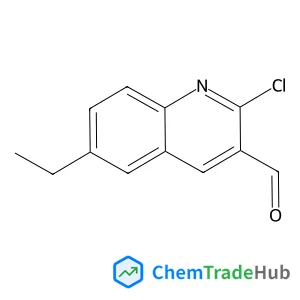
![1-[4-(4-Methyl-1H-imidazol-1-yl)phenyl]ethanone structure](https://static.chemtradehub.com/structs/142/142161-53-3-7f55.webp "1-[4-(4-Methyl-1H-imidazol-1-yl)phenyl]ethanone structure")
Recommended Suppliers




Disclaimer
This page provides academic journal information for reference and research purposes only. We are not affiliated with any journal publishers and do not handle publication submissions. For publication-related inquiries, please contact the respective journal publishers directly.
If you notice any inaccuracies in the information displayed, please contact us at support@chemtradehub.com. We will promptly review and address your concerns.