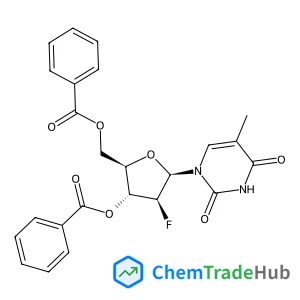
1-(3',5'-Di-O-benzoyl-2'-deoxy-2'-fluoro-b-D-arabinofuranosyl)thymine
CAS Number:
97614-47-6
Molecular Formula:
C24H21FN2O7
Nidal Saleh, Samia Zrig, Thierry Roisnel, Laure Guy, Radovan Bast, Trond Saue, Benoît Darquié, Jeanne Crassous
With their rich electronic, vibrational, rotational and hyperfine structure, molecular systems have the potential to play a decisive role in precision tests of fundamental physics. For example, electroweak nuclear interactions should cause small energy differences between the two enantiomers of chiral molecules, a signature of parity symmetry breaking. Enantioenriched oxorhenium(VII) complexes S-(−)- and R-(+)-3 bearing a chiral 2-methyl-1-thio-propanol ligand have been prepared as potential candidates for probing molecular parity violation effects via high resolution laser spectroscopy of the ReO stretching. Although the rhenium atom is not a stereogenic centre in itself, experimental vibrational circular dichroism (VCD) spectra revealed a surrounding chiral environment, evidenced by the ReO bond stretching mode signal. The calculated VCD spectrum of the R enantiomer confirmed the position of the sulfur atom cis to the methyl, as observed in the solid-state X-ray crystallographic structure, and showed the presence of two conformers of comparable stability. Relativistic quantum chemistry calculations indicate that the vibrational shift between enantiomers due to parity violation is above the target sensitivity of an ultra-high resolution infrared spectroscopy experiment under active preparation.
Wen Lu, Ze Yuan, Chunyang Xu, Jiqiang Ning, Yijun Zhong, Ziyang Zhang, Yong Hu
DOI: 10.1039/C8TA10998B
Andrea Marcucci, Francesca Zurlo, Isabella Natali Sora, Stefano Casciardi, Silvia Licoccia, Elisabetta Di Bartolomeo
DOI: 10.1039/C8TA10645B
Tianpeng Jiao, Shaoran Yang, Bin Liu, Wenjun Zhang, Kaili Zhang
DOI: 10.1039/C9TA00466A
Pushparathinam Gopinath, Venkatachalam Ramkumar, Kannoth Manheri Muraleedharan
DOI: 10.1039/C4CE01938E
Kalani Periyapperuma, Jennifer M. Pringle, Laura Sanchez-Cupido, Maria Forsyth, Cristina Pozo-Gonzalo
DOI: 10.1039/D1GC00361E
Sahil Garg, Mengran Li, Adam Z. Weber, Liye Li, Victor Rudolph, Guoxiong Wang, Thomas E. Rufford
DOI: 10.1039/C9TA13298H
Fergal P. Byrne, Jamie M. Z. Assemat, Amy E. Stanford, Thomas J. Farmer
DOI: 10.1039/D1GC01783G
Evgeny A. Uslamin, Nikolay A. Kosinov, Evgeny A. Pidko, Emiel J. M. Hensen
DOI: 10.1039/C8GC01528G
Junlong Yang, Yajiang Huang, Yadong Lv, Pengfei Zhao, Qi Yang, Guangxian Li
DOI: 10.1039/C3TA11989K
Zhenzhen Zhou, Jian-Gong Ma, Jianbo Gao
DOI: 10.1039/D1GC01677F
(5-Sulfamoyl-3-pyridinyl)boronic acid is primarily used in chemical synthesis, p...
Benzyl 2-methyl-2-(methylsulfonyl)-4-pentenoate is typically synthesized via est...
When handling 8-Fluoroquinolin-6-ol (CAS: 209353-22-0), it is important to use p...
1,3-Dibromo-5-(2-methyl-2-propanyl)benzene (CAS: 129316-09-2) is a crystalline c...
Ethyl 7-chloro-4-oxo-1-(1,3-thiazol-2-yl)-1,4-dihydro-1,8-naphthyridine-3-carbox...
When handling Delta-7-Avenasterol (CAS: 23290-26-8), it is important to wear app...
Proper handling involves the use of personal protective equipment such as gloves...
When handling 2-Methyl-2-proanyl 4-[(2-aminophenyl)amino]-1-piperidinecarboxylat...
N-Methyl-4-chlorobenzylamine hydrochloride (CAS: 65542-24-7) is a organic compou...
[2-(Dodecyloxy)ethoxy]acetic acid (CAS: 27306-90-7) is generally considered safe...

Physical Chemistry Chemical Physics (PCCP) is an international journal co-owned by 19 physical chemistry and physics societies from around the world. This journal publishes original, cutting-edge research in physical chemistry, chemical physics and biophysical chemistry. To be suitable for publication in PCCP, articles must include significant innovation and/or insight into physical chemistry; this is the most important criterion that reviewers and Editors will judge against when evaluating submissions. The journal has a broad scope and welcomes contributions spanning experiment, theory, computation and data science. Topical coverage includes spectroscopy, dynamics, kinetics, statistical mechanics, thermodynamics, electrochemistry, catalysis, surface science, quantum mechanics, quantum computing and machine learning. Interdisciplinary research areas such as polymers and soft matter, materials, nanoscience, energy, surfaces/interfaces, and biophysical chemistry are welcomed if they demonstrate significant innovation and/or insight into physical chemistry. Joined experimental/theoretical studies are particularly appreciated when complementary and based on up-to-date approaches.
![N-[4-(Cyanoethynyl)phenyl]-16-oxo-4,7,10,13-tetraoxa-17-azahenicos-1-yn-21-amide structure](https://static.chemtradehub.com/structs/218/2183440-36-8-68cb.webp "N-[4-(Cyanoethynyl)phenyl]-16-oxo-4,7,10,13-tetraoxa-17-azahenicos-1-yn-21-amide structure")
![(3E)-3-[4-Hydroxy-3,5-bis(2-methyl-2-propanyl)benzylidene]dihydro-2(3H)-furanone structure](https://static.chemtradehub.com/structs/102/102271-49-8-cba7.webp "(3E)-3-[4-Hydroxy-3,5-bis(2-methyl-2-propanyl)benzylidene]dihydro-2(3H)-furanone structure")