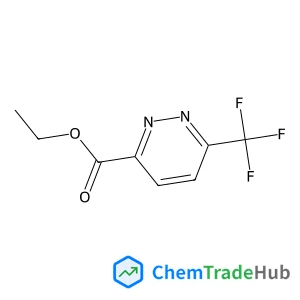
Ethyl 6-(trifluoromethyl)pyridazine-3-carboxylate
CAS Number:
1192155-06-8
Molecular Formula:
C8H7F3N2O2
B. Muthuraj, Sameer Hussain, Parameswar Krishnan Iyer
Enhanced levels of toxic metals, especially iron, from the labile iron pool in the brain are primarily responsible for the pathogenesis of several neurological disorders, such as Alzheimer's disease (AD). These metals are a major source for generating highly toxic reactive oxygen species (ROS), accelerating amyloid β (Aβ) peptide aggregation in the brains of AD patients. Aβ has high affinity for iron, resulting in its accumulation and localization in brain plaques enhancing neurotoxic H2O2, oxidative stress and free radical formation. Hence, controlling neurotoxicity would also involve regulation of the redox-active metals present, along with the Aβ. Non toxic conjugated polymer (CP) poly(1,4-bis-(8-(8-hydroxyquinoline)-octyloxy)-benzene) (PHQ) binds iron containing heme and non-heme proteins, such as ferritin, at nanomolar levels with the highest known selectivity (a Stern–Volmer constant (Ksv) value of 0.84 × 10⁷ M−1) in cerebrospinal fluid (CSF) and has been utilized to interact with the bound iron, including non-heme ferritin, in the Aβ protofibril aggregates and diminish their accumulation. The anti-AD activity of PHQ was confirmed via in vitro control studies by doping CSF of healthy individuals (H-CSF) with Aβ(1–40) with and without iron using a Thioflavin-T (ThT) binding assay test and electron microscopy analysis. This conceptually new strategy to clear the cerebral deposits using a CP allows the toxic aggregated Aβ peptide fibrils present in the CSF to be successfully disrupted under physiological conditions.
Saeid Arabnejad, Koichi Yamashita, Sergei Manzhos
DOI: 10.1039/C7CP00510E
Yani Zhao, Marek Cieplak
DOI: 10.1039/C7CP03829A
O. Palumbo, M. A. Navarra, J.-B. Brubach, P. Roy, A. Paolone
DOI: 10.1039/C7CP00850C
I. León, E. R. Alonso, S. Mata, C. Cabezas, M. A. Rodríguez, J.-U. Grabow, J. L. Alonso
DOI: 10.1039/C7CP03924G
Sandeep Verma
DOI: 10.1039/C7CP04069E
Masaaki Fujii
DOI: 10.1039/C7CP03480F
Sara Macchi, Riccardo Nifosì, Sebastiano Di Pietro, Claudia Boccardi, Francesca D'Autilia, Fabio Beltram, Francesco Cardarelli
DOI: 10.1039/C7CP04320A
Martin Hangaard Hansen, Anders Nilsson, Jan Rossmeisl
DOI: 10.1039/C7CP03576D
6-(3-Fluorophenyl)picolinic acid is generally considered safe for laboratory use...
(3R)-3-Pyrrolidinol is used in the pharmaceutical industry as a precursor for dr...
When handling (4R,5R)-4,5-Diethoxycarbonyl-2,2-dimethyldioxolane (CAS: 59779-75-...
1-(6-Chloroimidazo[1,2-b]pyridazin-3-yl)ethanone is often synthesized via a mult...
The market for N-Ethyl-3,4-dimethylbenzylamine (CAS: 39180-83-1) remains steady,...
Tert-butyl 3-(pyrrolidin-1-yl)azetidine-1-carboxylate is a chemical compound wit...
1-Bromo-3-chloro-2,4-dimethoxybenzene (CAS: 1228956-93-1) falls under the classi...
The safety of 8-Bromo-2-methyl-3,4-dihydroisoquinolin-1(2H)-one (CAS: 1368622-07...
Benzyl [(3S)-2,6-dioxo-3-piperidinyl]carbamate is generally safe when handled wi...
1-{[4-(4,4,5,5-Tetramethyl-1,3,2-dioxaborolan-2-yl)phenyl]sulfonyl}pyrrolidine s...

Polymer Chemistry welcomes submissions in all areas of polymer science that have a strong focus on macromolecular chemistry. Manuscripts may cover a broad range of fields, yet no direct application focus is required.