


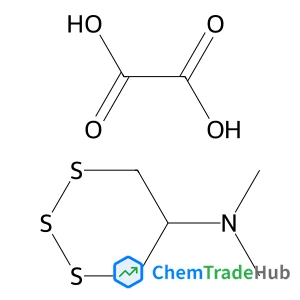
Oxalic acid compound with cyclohexylsulfamothioic O-acid (11)
CAS Number:
31895-22-4
Molecular Formula:
C7H13NO4S3
Robert J. Salter, Mark A. Blitz, Dwayne E. Heard, Tamás Kovács, Michael J. Pilling, Andrew R. Rickard, Paul W. Seakins
The formation of HCO and of H in the photolysis of glyoxal have been investigated over the wavelength ranges 310–335 nm for HCO and 193–340 nm for H. Dye laser photolysis was coupled with cavity ring-down spectroscopy for HCO, and with laser induced fluorescence spectroscopy for H. Absolute quantum yields were determined using actinometers based on (a) Cl2 photolysis and the Cl + HCHO reaction for HCO and (b) N2O photolysis (and O1D + H2) and CH2CO photolysis (and CH2 + O2) for H. The quantum yields were found to be pressure independent in this wavelength region. Quantum yields for all product channels under atmospheric conditions were calculated and compared with literature values. Differences between this work and previously published work and their atmospheric implications are discussed.

Kinetics and Catalysis

Journal of Medicinal Chemistry

Journal of Heterocyclic Chemistry

Journal of Organometallic Chemistry

Pharmacological Reviews

Pure and Applied Chemistry

Organic Preparations and Procedures International

Science Progress

European Journal of Wood and Wood Products

Proceedings of the National Academy of Sciences of the United States of America
Clifton K. Fagerquist, Emma Yee, William G. Miller
DOI: 10.1039/B702859H
Malin Edvardsson, Michael Rodahl, Fredrik Höök
DOI: 10.1039/B601800A
Moritz Hebestreit, Ulrich Flenker, Gregor Fußhöller, Hans Geyer, Ute Güntner, Ute Mareck, Thomas Piper, Mario Thevis, Christiane Ayotte, Wilhelm Schänzer
DOI: 10.1039/B603668F
Elodie Ly, Olivier Piot, Rolf Wolthuis, Anne Durlach, Philipe Bernard, Michel Manfait
DOI: 10.1039/B715924B
DOI: 10.1039/B510878K
Douglas A. Stuart, Kevin B. Biggs, Richard P. Van Duyne
DOI: 10.1039/B513326B
Dianping Tang, Yuling Cui, Guonan Chen
DOI: 10.1039/C2AN36500F
Nak-Hyun Kwon, Kyung-Sun Lee, Mi-Sook Won, Yoon-Bo Shim
DOI: 10.1039/B706905G
Waste containing (6-Bromo-2-naphthyl)oxy](dimethyl)(2-methyl-2-propanyl)silane (...
7-Fluoro-4-isoquinolinecarboxylic acid can be synthesized via a multi-step proce...
2,3,5,6-Tetrabromothieno[3,2-b]thiophene is a crystalline compound with a high m...
1-[4-(Benzylamino)-7,8-dihydro-5H-pyrano[4,3-d]pyrimidin-2-yl]-2-methyl-1H-indol...
The market for imidazo[5,1-d]-1,2,3,5-tetrazine-8-carboxylic acid, 3,4-dihydro-3...
3-(Triisopropylsilyl)propiolaldehyde is a synthetic organic compound with the CA...
6-Nitro-2H-1,4-benzoxazin-3(4H)-one (CAS: 81721-87-1) is subject to various regu...
Waste containing (3-Fluorophenyl)(4-{[(2-methyl-2-propanyl)oxy]carbonyl}-1-piper...
N,N'-4,4'-Biphenyldiyldiisonicotinamide is a white crystalline solid with a mole...
6-Bromo-8-fluoro-2-quinazolinol is primarily used in the pharmaceutical industry...

Physical Chemistry Chemical Physics (PCCP) is an international journal co-owned by 19 physical chemistry and physics societies from around the world. This journal publishes original, cutting-edge research in physical chemistry, chemical physics and biophysical chemistry. To be suitable for publication in PCCP, articles must include significant innovation and/or insight into physical chemistry; this is the most important criterion that reviewers and Editors will judge against when evaluating submissions. The journal has a broad scope and welcomes contributions spanning experiment, theory, computation and data science. Topical coverage includes spectroscopy, dynamics, kinetics, statistical mechanics, thermodynamics, electrochemistry, catalysis, surface science, quantum mechanics, quantum computing and machine learning. Interdisciplinary research areas such as polymers and soft matter, materials, nanoscience, energy, surfaces/interfaces, and biophysical chemistry are welcomed if they demonstrate significant innovation and/or insight into physical chemistry. Joined experimental/theoretical studies are particularly appreciated when complementary and based on up-to-date approaches.
![2,2'-{2,2-Propanediylbis[(2,6-dibromo-4,1-phenylene)oxy]}diethanol structure](https://static.chemtradehub.com/structs/416/4162-45-2-b3d6.webp "2,2'-{2,2-Propanediylbis[(2,6-dibromo-4,1-phenylene)oxy]}diethanol structure")





