













Ion formation mechanisms in UV-MALDI
Literature Information
Publication Date
2006-07-27
DOI
10.1039/B605646F
Impact Factor
4.616
Authors
View Original
Abstract
Matrix Assisted Laser Desorption/Ionization (MALDI) is a very widely used analytical method, but has been developed in a highly empirical manner. Deeper understanding of ionization mechanisms could help to design better methods and improve interpretation of mass spectra. This review summarizes current mechanistic thinking, with emphasis on the most common MALDI variant using ultraviolet laser excitation. A two-step framework is gaining acceptance as a useful model for many MALDI experiments. The steps are primary ionization during or shortly after the laser pulse, followed by secondary reactions in the expanding plume of desorbed material. Primary ionization in UV-MALDI remains somewhat controversial, the two main approaches are the cluster and pooling/photoionization models. Secondary events are less contentious, ion–molecule reaction thermodynamics and kinetics are often invoked, but details differ. To the extent that local thermal equilibrium is approached in the plume, the mass spectra may be straightforwardly interpreted in terms of charge transfer thermodynamics.
Recommended Journals
Related Literature
A lead-free ferroelectric Bi0.5Na0.5TiO3 based flexible, lightweight nanogenerator for motion monitoring applications
Nirmal Prashanth Maria Joseph Raj, Abisegapriyan KS, Gaurav Khandelwal, Nagamalleswara Rao Alluri, Sang-Jae Kim
2020-09-03
Paper
DOI: 10.1039/D0SE00963F
A techno-economic analysis method for guiding research and investment directions for c-Si photovoltaics and its application to Al-BSF, PERC, LDSE and advanced hydrogenation
Nathan L. Chang, Anita Ho-Baillie, Stuart Wenham, Michael Woodhouse, Rhett Evans, Budi Tjahjono, Fred Qi, Chee Mun Chong, Renate J. Egan
2018-02-28
Paper
DOI: 10.1039/C8SE00047F
MoS2/CoB with Se doping on carbon cloth to drive overall water-splitting in an alkaline electrolyte
Min Song, Ying Zhao, Zexing Wu, Xien Liu
2020-08-14
Communication
DOI: 10.1039/D0SE00864H
The impacts of PbI2 purity on the morphology and device performance of one-step spray-coated planar heterojunction perovskite solar cells
Jiaxu Yao, Liyan Yang, Feilong Cai, Yu Yan, Robert S. Gurney, Dan Liu, Tao Wang
2017-11-27
Paper
DOI: 10.1039/C7SE00536A
A precious-metal-free Fe-intercalated carbon nitride porous-network with enhanced activity for the oxygen reduction reaction and methanol-tolerant oxygen reduction reaction
Ammar Bin Yousaf, John R. Monnier, John W. Weidner, Mohammad K. Hassan, Syed Javaid Zaidi, Peter Kasak
2020-07-27
Paper
DOI: 10.1039/D0SE00671H
A noble metal-free photocatalytic system based on a novel cobalt tetrapyridyl catalyst for hydrogen production in fully aqueous medium
N. Queyriaux, E. Giannoudis, C. D. Windle, S. Roy, J. Pécaut, A. G. Coutsolelos, V. Artero, M. Chavarot-Kerlidou
2017-12-07
Communication
DOI: 10.1039/C7SE00428A
A multi-shelled CeO2/Co@N-doped hollow carbon microsphere as a trifunctional electrocatalyst for a rechargeable zinc–air battery and overall water splitting
Yue Yu, Yuqi Liu, Xiaolei Peng, Xianchun Liu, Yan Xing, Shuangxi Xing
2020-08-03
Paper
DOI: 10.1039/D0SE00735H
Efficient conversion of cellulose to 5-hydroxymethylfurfural catalyzed by a cobalt-phosphonate catalyst
Xue Min, Yadong Liu, Miaomiao Han, Zhong-Ming Sun
2020-09-17
Paper
DOI: 10.1039/D0SE01006E
Fabrication of lead-free CsBi3I10 based compact perovskite thin films by employing solvent engineering and anti-solvent treatment techniques: an efficient photo-conversion efficiency up to 740 nm
Towhid H. Chowdhury, Shanthi Subashchandran, Idriss Bedja, Hamid M. Ghaithan, Ashraful Islam
2020-07-22
Paper
DOI: 10.1039/D0SE00786B
Carbon onion/sulfur hybrid cathodes via inverse vulcanization for lithium–sulfur batteries
Soumyadip Choudhury, Kumar Raju, Kenneth I. Ozoemena, Lars Borchardt
2017-10-31
Paper
DOI: 10.1039/C7SE00452D
You might also like
Compound Q&A
How should waste containing (6-Bromo-2-naphthyl)oxy](dimethyl)(2-methyl-2-propanyl)silane be handled?
Waste containing (6-Bromo-2-naphthyl)oxy](dimethyl)(2-methyl-2-propanyl)silane (...
100751-65-3[(6-Bromo-2-naphthyl...
Compound Q&A
How is 7-Fluoro-4-isoquinolinecarboxylic acid (CAS: 1841081-40-0) typically synthesized?
7-Fluoro-4-isoquinolinecarboxylic acid can be synthesized via a multi-step proce...
1841081-40-07-Fluoro-4-isoquinol...
Compound Q&A
What are the physical and chemical properties of 2,3,5,6-Tetrabromothieno[3,2-b]thiophene (CAS: 124638-53-5)?
2,3,5,6-Tetrabromothieno[3,2-b]thiophene is a crystalline compound with a high m...
124638-53-52,3,5,6-Tetrabromoth...
Compound Q&A
Is 1-[4-(Benzylamino)-7,8-dihydro-5H-pyrano[4,3-d]pyrimidin-2-yl]-2-methyl-1H-indole-4-carboxamide (CAS: 1542705-92-9) safe?
1-[4-(Benzylamino)-7,8-dihydro-5H-pyrano[4,3-d]pyrimidin-2-yl]-2-methyl-1H-indol...
1542705-92-91-[4-(Benzylamino)-7...
Compound Q&A
What is the market or research trend for imidazo[5,1-d]-1,2,3,5-tetrazine-8-carboxylic acid, 3,4-dihydro-3-methyl-4-oxo- (CAS: 113942-30-6)?
The market for imidazo[5,1-d]-1,2,3,5-tetrazine-8-carboxylic acid, 3,4-dihydro-3...
113942-30-6Imidazo[5,1-d]-1,2,3...
Compound Q&A
What is 3-(Triisopropylsilyl)propiolaldehyde (CAS: 163271-80-5)?
3-(Triisopropylsilyl)propiolaldehyde is a synthetic organic compound with the CA...
163271-80-53-(Triisopropylsilyl...
Compound Q&A
What regulatory guidelines apply to 6-Nitro-2H-1,4-benzoxazin-3(4H)-one (CAS: 81721-87-1)?
6-Nitro-2H-1,4-benzoxazin-3(4H)-one (CAS: 81721-87-1) is subject to various regu...
81721-87-16-Nitro-2H-1,4-benzo...
Compound Q&A
How should waste containing (3-Fluorophenyl)(4-{[(2-methyl-2-propanyl)oxy]carbonyl}-1-piperazinyl)acetic acid (CAS: 885272-91-3) be handled?
Waste containing (3-Fluorophenyl)(4-{[(2-methyl-2-propanyl)oxy]carbonyl}-1-piper...
885272-91-3(3-Fluorophenyl)(4-{...
Compound Q&A
What are the physical and chemical properties of N,N'-4,4'-Biphenyldiyldiisonicotinamide (CAS: 55119-40-9)?
N,N'-4,4'-Biphenyldiyldiisonicotinamide is a white crystalline solid with a mole...
55119-40-9N,N'-4,4'-Biphenyldi...
Compound Q&A
What industries use 6-Bromo-8-fluoro-2-quinazolinol (CAS: 1036756-15-6)?
6-Bromo-8-fluoro-2-quinazolinol is primarily used in the pharmaceutical industry...
1036756-15-66-Bromo-8-fluoro-2-q...
Source Journal
Analyst

CiteScore:
7.8
Self-citation Rate:
5.6%
Articles per Year:
653
Analyst publishes analytical and bioanalytical research that reports premier fundamental discoveries and inventions, and the applications of those discoveries, unconfined by traditional discipline barriers.
Recommended Compounds
![2-{[4-(2-Methoxyethyl)phenoxy]methyl}oxirane structure](https://static.chemtradehub.com/structs/567/56718-70-8-f037.webp "2-{[4-(2-Methoxyethyl)phenoxy]methyl}oxirane structure")

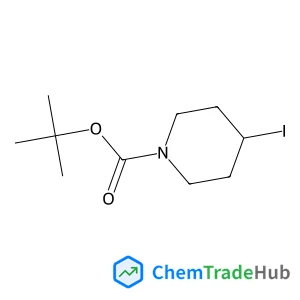
2-Methyl-2-propanyl 4-iodo-1-piperidinecarboxylate
CAS Number:
301673-14-3
Molecular Formula:
C10H18INO2

Recommended Suppliers







Disclaimer
This page provides academic journal information for reference and research purposes only. We are not affiliated with any journal publishers and do not handle publication submissions. For publication-related inquiries, please contact the respective journal publishers directly.
If you notice any inaccuracies in the information displayed, please contact us at support@chemtradehub.com. We will promptly review and address your concerns.