













An efficient route for the synthesis of phosphorus–selenium macro-heterocycles
Literature Information
Publication Date
2013-02-13
DOI
10.1039/C3CC40515J
Impact Factor
6.222
Authors
Guoxiong Hua, Alexandra M. Z. Slawin, Rebecca A. M. Randall, David B. Cordes, L. Ellis Crawford, Michael Bühl, J. Derek Woollins
View Original
Abstract
Four-membered ring [PhP(Se)(μ-Se)]2 (Woollins' reagent, WR) reacts with disodium alkenyl-diols followed by in situ ring-closure reaction with appropriate dibromoalkanes affording a series of unusual nine- to fifteen-membered organoselenophosphorus macrocycles bearing the O–P–Se–Cn–Se–P–O or O–P–Se–Cn–O–P–Se linkage.
Related Literature
The electronic spectrum of C11 in its linear and cyclic conformation
Max Mühlhäuser, George E. Froudakis, Sigrid D. Peyerimhoff
2001-08-17
Paper
DOI: 10.1039/B103528M
Processes during liquation of Vycor glass studied by positron annihilation lifetime spectroscopy
Bożena Jasińska, Andrzej L. Dawidowicz, Tomasz Goworek, Stanisław Radkiewicz
2000-06-22
Paper
DOI: 10.1039/B002499F
Basis set effect on hydrogen bond stabilization energy estimation of the Watson–Crick type nucleic acid base pairs using medium-size basis sets: single point MP2 evaluations at the HF optimized structures
Shun-ichi Kawahara, Tadafumi Uchimaru
2000-06-09
Paper
DOI: 10.1039/B001507P
Quenching methods for chemical reaction dynamics within mixed quantum/classical approximation
2000-06-19
Paper
DOI: 10.1039/B002326O
Thermochemical aspects of the rotational dynamics of the ammonium ion in an environment of water molecules
David A. Johnson
2000-06-05
Paper
DOI: 10.1039/B002569K
Oxygen reduction kinetics at platinum electrodes covered with perfluorinated ionomer in the presence of impurity cations Fe3+, Ni2+ and Cu2+
Tatsuhiro Okada, Yuusuke Ayato, Jørgen Dale, Makoto Yuasa, Isao Sekine, Odd Andreas Asbjørnsen
2000-06-29
Paper
DOI: 10.1039/B002566F
Joint experimental and theoretical study of the poly(styryl sodium) and poly(α-methylstyryl sodium) polymerization/depolymerization
2001-09-20
Paper
DOI: 10.1039/B105389M
Kinetics of the gas-phase reaction of atomic chlorine with selected monoterpenes
Qadir K. Timerghazin, Parisa A. Ariya
2001-08-22
Paper
DOI: 10.1039/B101380G
You might also like
Compound Q&A
What are the main uses of 1H-Indazole-6-carbonitrile (CAS: 141290-59-7)?
1H-Indazole-6-carbonitrile finds applications in pharmaceuticals, where it serve...
141290-59-71H-Indazole-6-carbon...
Compound Q&A
How should waste containing Dioctyl (2E)-2-butenedioate (CAS: 2997-85-5) be handled?
Waste containing Dioctyl (2E)-2-butenedioate (CAS: 2997-85-5) should be collecte...
2997-85-5Dioctyl (2E)-2-buten...
Compound Q&A
What industries use Sodium [(1,2-benzoxazol-3-ylmethyl)sulfonyl]azanide (CAS: 68291-98-5)?
Sodium [(1,2-benzoxazol-3-ylmethyl)sulfonyl]azanide is primarily used in pharmac...
68291-98-5Sodium [(1,2-benzoxa...
Compound Q&A
Are there alternatives to Dimethyl 4-(4,4,5,5-tetramethyl-1,3,2-dioxaborolan-2-yl)-2,6-pyridinedicarboxylate (CAS: 741709-66-0) in synthesis?
Dimethyl 4-(4,4,5,5-tetramethyl-1,3,2-dioxaborolan-2-yl)-2,6-pyridinedicarboxyla...
741709-66-0Dimethyl 4-(4,4,5,5-...
Compound Q&A
How should waste containing 2-Fluoro-6-hydrazinopyridine (CAS: 80714-39-2) be handled?
Waste containing 2-Fluoro-6-hydrazinopyridine (CAS: 80714-39-2) should be manage...
80714-39-22-Fluoro-6-hydrazino...
Compound Q&A
What is 6-Formyl-2-pyridinecarboxylic acid (CAS: 499214-11-8)?
6-Formyl-2-pyridinecarboxylic acid is an organic compound with the molecular for...
499214-11-86-Formyl-2-pyridinec...
Compound Q&A
What is the market or research trend for 3-(3,4-dimethoxyphenyl)-2,5-dimethyl-N-(2-morpholin-4-ylethyl)pyrazolo[1,5-a]pyrimidin-7-amine (CAS: 900874-91-1)?
Research trends for this compound indicate a focus on its potential applications...
900874-91-13-(3,4-dimethoxyphen...
Compound Q&A
How is 9H-Tribenzo[b,d,f]azepine (CAS: 29875-73-8) typically synthesized?
9H-Tribenzo[b,d,f]azepine is typically synthesized via a multi-step process invo...
29875-73-89H-Tribenzo[b,d,f]az...
Compound Q&A
How is 1-Cyclopropyl-7-ethoxy-6-fluoro-8-methoxy-4-oxo-1,4-dihydro-3-quinolinecarboxylic acid (CAS: 1797982-51-4) typically synthesized?
1-Cyclopropyl-7-ethoxy-6-fluoro-8-methoxy-4-oxo-1,4-dihydro-3-quinolinecarboxyli...
1797982-51-41-Cyclopropyl-7-etho...
Compound Q&A
How should waste containing Methyl 3-oxo-1,2,3,4-tetrahydro-6-quinoxalinecarboxylate (CAS: 671820-52-3) be handled?
Waste containing Methyl 3-oxo-1,2,3,4-tetrahydro-6-quinoxalinecarboxylate (CAS: ...
671820-52-3Methyl 3-oxo-1,2,3,4...
Source Journal
Chemical Communications

CiteScore:
8.6
Self-citation Rate:
4.7%
Articles per Year:
2458
ChemComm publishes urgent research which is of outstanding significance and interest to experts in the field, while also appealing to the journal’s broad chemistry readership. Our communication format is ideally suited to short, urgent studies that are of such importance that they require accelerated publication. Our scope covers all topics in chemistry, and research at the interface of chemistry and other disciplines (such as materials science, nanoscience, physics, engineering and biology) where there is a significant novelty in the chemistry aspects. Major topic areas covered include: Analytical Chemistry Catalysis Chemical Biology and medicinal chemistry Computational Chemistry and Machine Learning Energy and sustainable chemistry Environmental Chemistry Green Chemistry Inorganic Chemistry Materials Chemistry Nanoscience Organic Chemistry Physical Chemistry Polymer Chemistry Supramolecular Chemistry
Recommended Compounds
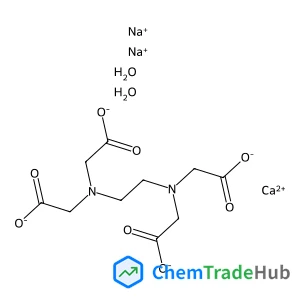
EthylenediaminetetraaceticacidcalciumDisodiumsalthydrate
CAS Number:
23411-34-9
Molecular Formula:
C10H16CaN2Na2O10


Recommended Suppliers







Disclaimer
This page provides academic journal information for reference and research purposes only. We are not affiliated with any journal publishers and do not handle publication submissions. For publication-related inquiries, please contact the respective journal publishers directly.
If you notice any inaccuracies in the information displayed, please contact us at support@chemtradehub.com. We will promptly review and address your concerns.