












Quenching methods for chemical reaction dynamics within mixed quantum/classical approximation
Literature Information
Publication Date
2000-06-19
DOI
10.1039/B002326O
Impact Factor
3.676
Authors
View Original
Abstract
We have derived the quenching methods, which were obtained previously based on physical intuitions (L. Wang and D. C. Clary, Chem. Phys. Lett., 1996, 262, 284; L. Wang, J. Chem. Phys., 1998, 108, 7538) from the time dependent Schrödinger equation using the quantum/classical multi-configuration time dependent self-consistent field (Q/C MCTDSCF) approximation. A theoretical ground for the quenching methods is therefore established through the present derivation. The present derivation shows that the quenching methods are just the Q/C MCTDSCF treatments. Moreover, implementations of the methods are given in detail. The relationships between the quenching methods and other relevant quantum/classical and quantum/semiclassical theories are also discussed.
Related Literature
Electronic interactions within composites of polyanilines formed under acidic and alkaline conditions. Conductivity, ESR, Raman, UV-vis and fluorescence studies
L. Dennany, P. C. Innis, S. T. McGovern, G. G. Wallace, Robert J. Forster
2011-01-04
Paper
DOI: 10.1039/C0CP00699H
Microenvironment-switchable singlet oxygen generation by axially-coordinated hydrophilic ruthenium phthalocyanine dendrimers
Uwe Hahn, Francesca Setaro, Xavier Ragàs, Angus Gray-Weale, Santi Nonell, Tomas Torres
2010-12-21
Paper
DOI: 10.1039/C0CP01015D
Hydrogen bond strength and network structure effects on hydration of non-polar molecules
R. M. Lynden-Bell, N. Giovambattista, P. G. Debenedetti, T. Head-Gordon, P. J. Rossky
2010-12-10
Paper
DOI: 10.1039/C0CP01701A
Enhanced photocatalytic activity of mesoporous TiO2 aggregates by embedding carbon nanotubes as electron-transfer channel
Jiaguo Yu, Tingting Ma, Shengwei Liu
2010-12-21
Paper
DOI: 10.1039/C0CP01139H
Aggregation behavior of gemini surfactants and their interaction with macromolecules in aqueous solution
Yuchun Han, Yilin Wang
2011-01-12
Perspective
DOI: 10.1039/C0CP01196G
In situFTIR spectroelectrochemical study on the mechanism of ethylene glycol electrocatalytic oxidation at a Pd electrode
Lianqin Wang, Hui Meng, Pei Kang Shen, Claudio Bianchini, Francesco Vizza, Zidong Wei
2010-12-08
Paper
DOI: 10.1039/C0CP01913E
Improved light olefin yield from methyl bromide coupling over modified SAPO-34 molecular sieves
Aihua Zhang, Shouli Sun, Zachary J. A. Komon, Neil Osterwalder, Sagar Gadewar, Peter Stoimenov, Daniel J. Auerbach, Galen D. Stucky, Eric W. McFarland
2011-01-04
Paper
DOI: 10.1039/C0CP01985B
Two-mode dynamics in dispersed systems: the case of particle-stabilized foams studied by diffusing wave spectroscopy
Antonio Stocco, Jérôme Crassous, Anniina Salonen, Arnaud Saint-Jalmes, Dominique Langevin
2010-11-25
Paper
DOI: 10.1039/C0CP01152E
MRCI investigation of different isomers of Ni2O2H2+‡
Olaf Hübner, Hans-Jörg Himmel
2010-12-08
Paper
DOI: 10.1039/C0CP01170C
Structure and binding of the H4 histone tail and the effects of lysine 16 acetylation
Darren Yang, Gaurav Arya
2010-12-15
Paper
DOI: 10.1039/C0CP01487G
You might also like
Compound Q&A
What are the main uses of 1H-Indazole-6-carbonitrile (CAS: 141290-59-7)?
1H-Indazole-6-carbonitrile finds applications in pharmaceuticals, where it serve...
141290-59-71H-Indazole-6-carbon...
Compound Q&A
How should waste containing Dioctyl (2E)-2-butenedioate (CAS: 2997-85-5) be handled?
Waste containing Dioctyl (2E)-2-butenedioate (CAS: 2997-85-5) should be collecte...
2997-85-5Dioctyl (2E)-2-buten...
Compound Q&A
What industries use Sodium [(1,2-benzoxazol-3-ylmethyl)sulfonyl]azanide (CAS: 68291-98-5)?
Sodium [(1,2-benzoxazol-3-ylmethyl)sulfonyl]azanide is primarily used in pharmac...
68291-98-5Sodium [(1,2-benzoxa...
Compound Q&A
Are there alternatives to Dimethyl 4-(4,4,5,5-tetramethyl-1,3,2-dioxaborolan-2-yl)-2,6-pyridinedicarboxylate (CAS: 741709-66-0) in synthesis?
Dimethyl 4-(4,4,5,5-tetramethyl-1,3,2-dioxaborolan-2-yl)-2,6-pyridinedicarboxyla...
741709-66-0Dimethyl 4-(4,4,5,5-...
Compound Q&A
How should waste containing 2-Fluoro-6-hydrazinopyridine (CAS: 80714-39-2) be handled?
Waste containing 2-Fluoro-6-hydrazinopyridine (CAS: 80714-39-2) should be manage...
80714-39-22-Fluoro-6-hydrazino...
Compound Q&A
What is 6-Formyl-2-pyridinecarboxylic acid (CAS: 499214-11-8)?
6-Formyl-2-pyridinecarboxylic acid is an organic compound with the molecular for...
499214-11-86-Formyl-2-pyridinec...
Compound Q&A
What is the market or research trend for 3-(3,4-dimethoxyphenyl)-2,5-dimethyl-N-(2-morpholin-4-ylethyl)pyrazolo[1,5-a]pyrimidin-7-amine (CAS: 900874-91-1)?
Research trends for this compound indicate a focus on its potential applications...
900874-91-13-(3,4-dimethoxyphen...
Compound Q&A
How is 9H-Tribenzo[b,d,f]azepine (CAS: 29875-73-8) typically synthesized?
9H-Tribenzo[b,d,f]azepine is typically synthesized via a multi-step process invo...
29875-73-89H-Tribenzo[b,d,f]az...
Compound Q&A
How is 1-Cyclopropyl-7-ethoxy-6-fluoro-8-methoxy-4-oxo-1,4-dihydro-3-quinolinecarboxylic acid (CAS: 1797982-51-4) typically synthesized?
1-Cyclopropyl-7-ethoxy-6-fluoro-8-methoxy-4-oxo-1,4-dihydro-3-quinolinecarboxyli...
1797982-51-41-Cyclopropyl-7-etho...
Compound Q&A
How should waste containing Methyl 3-oxo-1,2,3,4-tetrahydro-6-quinoxalinecarboxylate (CAS: 671820-52-3) be handled?
Waste containing Methyl 3-oxo-1,2,3,4-tetrahydro-6-quinoxalinecarboxylate (CAS: ...
671820-52-3Methyl 3-oxo-1,2,3,4...
Source Journal
Physical Chemistry Chemical Physics

CiteScore:
5.5
Self-citation Rate:
10.3%
Articles per Year:
3036
Physical Chemistry Chemical Physics (PCCP) is an international journal co-owned by 19 physical chemistry and physics societies from around the world. This journal publishes original, cutting-edge research in physical chemistry, chemical physics and biophysical chemistry. To be suitable for publication in PCCP, articles must include significant innovation and/or insight into physical chemistry; this is the most important criterion that reviewers and Editors will judge against when evaluating submissions. The journal has a broad scope and welcomes contributions spanning experiment, theory, computation and data science. Topical coverage includes spectroscopy, dynamics, kinetics, statistical mechanics, thermodynamics, electrochemistry, catalysis, surface science, quantum mechanics, quantum computing and machine learning. Interdisciplinary research areas such as polymers and soft matter, materials, nanoscience, energy, surfaces/interfaces, and biophysical chemistry are welcomed if they demonstrate significant innovation and/or insight into physical chemistry. Joined experimental/theoretical studies are particularly appreciated when complementary and based on up-to-date approaches.
Recommended Compounds
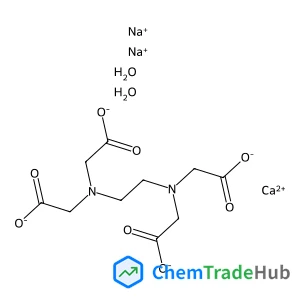
EthylenediaminetetraaceticacidcalciumDisodiumsalthydrate
CAS Number:
23411-34-9
Molecular Formula:
C10H16CaN2Na2O10
Recommended Suppliers




Disclaimer
This page provides academic journal information for reference and research purposes only. We are not affiliated with any journal publishers and do not handle publication submissions. For publication-related inquiries, please contact the respective journal publishers directly.
If you notice any inaccuracies in the information displayed, please contact us at support@chemtradehub.com. We will promptly review and address your concerns.