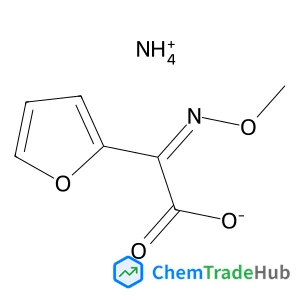
Ammonium (Z)-2-(furan-2-yl)-2-(methoxyimino)acetate
CAS Number:
97148-39-5
Molecular Formula:
C7H10N2O4
Tatsuhiro Okada, Yuusuke Ayato, Jørgen Dale, Makoto Yuasa, Isao Sekine, Odd Andreas Asbjørnsen
The effect of impurity cations on the kinetics of oxygen reduction at a platinum surface covered with perfluoro-sulfonated ionomer film was investigated in 0.1 N H2SO4 in the presence of 0.001 N Fe3+, Ni2+ or Cu2+ ions, using rotating disk electrodes. The platinum disk of a rotating disk electrode was spin-coated with Nafion® solution, and after drying the Nafion® the film-covered platinum was tested for oxygen reduction kinetics. Koutecky–Levich plots and linear sweep voltammetry made possible the independent measurement of both charge transfer and diffusion kinetics of oxygen reduction at the same electrode. The rate of the charge transfer of the oxygen reduction reaction at the platinum/ionomer membrane interface was calculated along with the immersion time. It was discovered that the impurity ions hindered enormously the rate of the charge transfer step at platinum covered with perfluorosulfonated ionomer. No suppression effect for oxygen reduction was observed for bare platinum in a solution containing impurity ions, indicating that the hindrance effect is specific to the metal electrode/ionomer membrane interface. Also, both the diffusion coefficient of oxygen and oxygen concentration in the membrane were decreased by the presence of impurity cations. The relevance of the problem to the performance degradation of polymer electrolyte fuel cells is discussed in relation to the occurrence of contamination by these impurity ions during the operation of the cell.
Xi Huang, Huihui Liu, Jiyun Wang, Caiqiao Xiong
DOI: 10.1039/C9SC90270H
Michael C. Ryan, Yeon Jung Kim, James B. Gerken, Fei Wang, Michael M. Aristov, Joseph R. Martinelli, Shannon S. Stahl
DOI: 10.1039/C9SC04305E
Geetha Bolla, Sudhir Mittapalli, Ashwini Nangia
DOI: 10.1039/C3CE41885E
Sk. Asif Ikbal, Sanfaori Brahma, Sankar Prasad Rath
DOI: 10.1039/C4CC06092J
Ying Shang, Na Li, Tingting Liu, Bo-Han Li, Kunqian Yu, Yi Zang, James T. Brewster, II, Maria L. Odyniec, Maria Weber, Steven D. Bull, Jia Li, Tony D. James, Xiao-Peng He, He Tian
DOI: 10.1039/C9SC03961A
Lindsay B. Wheeler, Jennifer L. Chiu, Jennifer L. Maeng, Randy L. Bell
DOI: 10.1039/C8RP00157J
Jun Yang, Jingjing Cao, Dingyi Shen, Jie Xiong, Jianfeng Tang, Shanshan Hu
DOI: 10.1039/C6CE01981A
1H-Indazole-6-carbonitrile finds applications in pharmaceuticals, where it serve...
Waste containing Dioctyl (2E)-2-butenedioate (CAS: 2997-85-5) should be collecte...
Sodium [(1,2-benzoxazol-3-ylmethyl)sulfonyl]azanide is primarily used in pharmac...
Dimethyl 4-(4,4,5,5-tetramethyl-1,3,2-dioxaborolan-2-yl)-2,6-pyridinedicarboxyla...
Waste containing 2-Fluoro-6-hydrazinopyridine (CAS: 80714-39-2) should be manage...
6-Formyl-2-pyridinecarboxylic acid is an organic compound with the molecular for...
Research trends for this compound indicate a focus on its potential applications...
9H-Tribenzo[b,d,f]azepine is typically synthesized via a multi-step process invo...
1-Cyclopropyl-7-ethoxy-6-fluoro-8-methoxy-4-oxo-1,4-dihydro-3-quinolinecarboxyli...
Waste containing Methyl 3-oxo-1,2,3,4-tetrahydro-6-quinoxalinecarboxylate (CAS: ...

Physical Chemistry Chemical Physics (PCCP) is an international journal co-owned by 19 physical chemistry and physics societies from around the world. This journal publishes original, cutting-edge research in physical chemistry, chemical physics and biophysical chemistry. To be suitable for publication in PCCP, articles must include significant innovation and/or insight into physical chemistry; this is the most important criterion that reviewers and Editors will judge against when evaluating submissions. The journal has a broad scope and welcomes contributions spanning experiment, theory, computation and data science. Topical coverage includes spectroscopy, dynamics, kinetics, statistical mechanics, thermodynamics, electrochemistry, catalysis, surface science, quantum mechanics, quantum computing and machine learning. Interdisciplinary research areas such as polymers and soft matter, materials, nanoscience, energy, surfaces/interfaces, and biophysical chemistry are welcomed if they demonstrate significant innovation and/or insight into physical chemistry. Joined experimental/theoretical studies are particularly appreciated when complementary and based on up-to-date approaches.