












Processes during liquation of Vycor glass studied by positron annihilation lifetime spectroscopy
Literature Information
Publication Date
2000-06-22
DOI
10.1039/B002499F
Impact Factor
3.676
Authors
Bożena Jasińska, Andrzej L. Dawidowicz, Tomasz Goworek, Stanisław Radkiewicz
View Original
Abstract
This study concerns Vycor glass subjected to liquation in the temperature range 725–950 K and leached in hot acid in order to produce pores. Three stages of pore creation were observed with increasing liquation temperature: The initial structure of nanopores with a radius of about 0.5 nm (like in the nonliquated glass) disappears, giving way to the next group, dominant at 875 K, whose average radius is 1.15 nm, independently of the liquation time. The spread of these radii is narrow, 0.15 nm. At the highest temperatures, the intensity of this component decreases rapidly (down to 1%), and large pores begin to grow; the specific surface area diminishes. About 900 K, the total positronium formation probability decreases significantly, which can be ascribed to the partial crystallization of silica.
Related Literature
Celecoxib cocrystal polymorphs with cyclic amides: synthons of a sulfonamide drug with carboxamide coformers
Geetha Bolla, Sudhir Mittapalli, Ashwini Nangia
2013-09-23
Communication
DOI: 10.1039/C3CE41885E
Protein encapsulation: a new approach for improving the capability of small-molecule fluorogenic probes
Ying Shang, Na Li, Tingting Liu, Bo-Han Li, Kunqian Yu, Yi Zang, James T. Brewster, II, Maria L. Odyniec, Maria Weber, Steven D. Bull, Jia Li, Tony D. James, Xiao-Peng He, He Tian
2019-11-27
Edge Article
DOI: 10.1039/C9SC03961A
Scholarly publishing: a partnership with mutual benefits and individual responsibilities
2018-12-20
Editorial
DOI: 10.1039/C8RP90013B
Simonsen Lecture. Cobalt-mediated radical reactions in organic synthesis
Review Article
DOI: 10.1039/CS9881700361
Ortho esters and dialkoxycarbenium ions: reactivity, stability, structure, and new synthetic applications
Review Article
DOI: 10.1039/CS9871600075
Reaction branching and extreme kinetic isotope effects in the study of reaction mechanisms
Review Article
DOI: 10.1039/CS9891800209
Robert Robinson Lecture. Post-B12 problems in corrin synthesis
Review Article
DOI: 10.1039/CS9760500377
You might also like
Compound Q&A
What are the main uses of 1H-Indazole-6-carbonitrile (CAS: 141290-59-7)?
1H-Indazole-6-carbonitrile finds applications in pharmaceuticals, where it serve...
141290-59-71H-Indazole-6-carbon...
Compound Q&A
How should waste containing Dioctyl (2E)-2-butenedioate (CAS: 2997-85-5) be handled?
Waste containing Dioctyl (2E)-2-butenedioate (CAS: 2997-85-5) should be collecte...
2997-85-5Dioctyl (2E)-2-buten...
Compound Q&A
What industries use Sodium [(1,2-benzoxazol-3-ylmethyl)sulfonyl]azanide (CAS: 68291-98-5)?
Sodium [(1,2-benzoxazol-3-ylmethyl)sulfonyl]azanide is primarily used in pharmac...
68291-98-5Sodium [(1,2-benzoxa...
Compound Q&A
Are there alternatives to Dimethyl 4-(4,4,5,5-tetramethyl-1,3,2-dioxaborolan-2-yl)-2,6-pyridinedicarboxylate (CAS: 741709-66-0) in synthesis?
Dimethyl 4-(4,4,5,5-tetramethyl-1,3,2-dioxaborolan-2-yl)-2,6-pyridinedicarboxyla...
741709-66-0Dimethyl 4-(4,4,5,5-...
Compound Q&A
How should waste containing 2-Fluoro-6-hydrazinopyridine (CAS: 80714-39-2) be handled?
Waste containing 2-Fluoro-6-hydrazinopyridine (CAS: 80714-39-2) should be manage...
80714-39-22-Fluoro-6-hydrazino...
Compound Q&A
What is 6-Formyl-2-pyridinecarboxylic acid (CAS: 499214-11-8)?
6-Formyl-2-pyridinecarboxylic acid is an organic compound with the molecular for...
499214-11-86-Formyl-2-pyridinec...
Compound Q&A
What is the market or research trend for 3-(3,4-dimethoxyphenyl)-2,5-dimethyl-N-(2-morpholin-4-ylethyl)pyrazolo[1,5-a]pyrimidin-7-amine (CAS: 900874-91-1)?
Research trends for this compound indicate a focus on its potential applications...
900874-91-13-(3,4-dimethoxyphen...
Compound Q&A
How is 9H-Tribenzo[b,d,f]azepine (CAS: 29875-73-8) typically synthesized?
9H-Tribenzo[b,d,f]azepine is typically synthesized via a multi-step process invo...
29875-73-89H-Tribenzo[b,d,f]az...
Compound Q&A
How is 1-Cyclopropyl-7-ethoxy-6-fluoro-8-methoxy-4-oxo-1,4-dihydro-3-quinolinecarboxylic acid (CAS: 1797982-51-4) typically synthesized?
1-Cyclopropyl-7-ethoxy-6-fluoro-8-methoxy-4-oxo-1,4-dihydro-3-quinolinecarboxyli...
1797982-51-41-Cyclopropyl-7-etho...
Compound Q&A
How should waste containing Methyl 3-oxo-1,2,3,4-tetrahydro-6-quinoxalinecarboxylate (CAS: 671820-52-3) be handled?
Waste containing Methyl 3-oxo-1,2,3,4-tetrahydro-6-quinoxalinecarboxylate (CAS: ...
671820-52-3Methyl 3-oxo-1,2,3,4...
Source Journal
Physical Chemistry Chemical Physics

CiteScore:
5.5
Self-citation Rate:
10.3%
Articles per Year:
3036
Physical Chemistry Chemical Physics (PCCP) is an international journal co-owned by 19 physical chemistry and physics societies from around the world. This journal publishes original, cutting-edge research in physical chemistry, chemical physics and biophysical chemistry. To be suitable for publication in PCCP, articles must include significant innovation and/or insight into physical chemistry; this is the most important criterion that reviewers and Editors will judge against when evaluating submissions. The journal has a broad scope and welcomes contributions spanning experiment, theory, computation and data science. Topical coverage includes spectroscopy, dynamics, kinetics, statistical mechanics, thermodynamics, electrochemistry, catalysis, surface science, quantum mechanics, quantum computing and machine learning. Interdisciplinary research areas such as polymers and soft matter, materials, nanoscience, energy, surfaces/interfaces, and biophysical chemistry are welcomed if they demonstrate significant innovation and/or insight into physical chemistry. Joined experimental/theoretical studies are particularly appreciated when complementary and based on up-to-date approaches.
Recommended Compounds
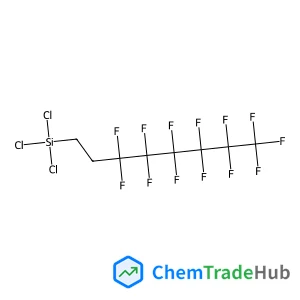
Trichloro(3,3,4,4,5,5,6,6,7,7,8,8,8-tridecafluorooctyl)silane
CAS Number:
78560-45-9
Molecular Formula:
C8H4Cl3F13Si
Recommended Suppliers







Disclaimer
This page provides academic journal information for reference and research purposes only. We are not affiliated with any journal publishers and do not handle publication submissions. For publication-related inquiries, please contact the respective journal publishers directly.
If you notice any inaccuracies in the information displayed, please contact us at support@chemtradehub.com. We will promptly review and address your concerns.