












A comparative study of the SET-LRP of oligo(ethylene oxide) methyl ether acrylate in DMSO and in H2O
Literature Information
Publication Date
2012-10-08
DOI
10.1039/C2PY20782F
Impact Factor
5.582
Authors
Nga H. Nguyen, Hao-Jan Sun, Martin E. Levere, Virgil Percec
View Original
Abstract
A comparative analysis of the SET-LRP of oligo(ethylene oxide) methyl ether acrylate (OEOMEA) in DMSO and in H2O at 25 °C is reported. Both the catalysis with activated Cu(0) wire/Me6-TREN and with mimics of “nascent” Cu(0) nanoparticles/Me6-TREN resulted in a higher rate of polymerization in water than in DMSO. This result is consistent with the acceleration expected for SET-LRP by a more polar reaction solvent, and with the difference between the equilibrium constants of disproportionation of CuBr in DMSO (Kd = 1.4–4.4) and in water (Kd = 106 to 107), both much higher in the presence of Me6-TREN. The inefficient access of the Cu(0) catalyst to the hydrophobic reactive centers of the monomer and initiator assembled in micellar structures explains the induction time observed in the SET-LRP of OEOMEA in water. This induction period is longer for Cu(0) wire. The use of “nascent” Cu(0) nanoparticles prepared by the disproportionation of CuBr in DMSO, in combination with 5 mol% CuBr2, led to an extremely efficient SET-LRP of OEOMEA in water. This SET-LRP in water is fast and follows first order kinetics to complete monomer conversion with linear dependence of experimental Mn on conversion, and narrow molecular weight distribution. Under the polymerization conditions investigated in both water and DMSO, no reduction in the absorbance of CuBr2/Me6-TREN was observed by online UV-vis spectroscopy. This excludes the formation of CuBr by reduction of CuBr2 by Cu(0) during the SET-LRP in DMSO and in water.
Related Literature
Novel highly active FSM-16 supported molybdenum catalyst for hydrotreatment
Shelu Garg, Thallada Bhaskar, Kapil Soni, Gnanamani Muthu Kumaran, Akinori Muto, Yusaku Sakata, Gudimella Murali Dhar
2008-09-15
Communication
DOI: 10.1039/B809808E
Self-assembly of amphiphilic poly(phenylene ethynylene)s in water–potassium dodecanoate–decanol lyotropic liquid crystals
Jean Bouffard, Timothy M. Swager
2008-10-01
Communication
DOI: 10.1039/B814598A
A metallopolymer case-history: polymer, ring or ligand reaction?
Edwin C. Constable, Kate Harris, Catherine E. Housecroft, Markus Neuburger, Silvia Schaffner
2008-09-17
Communication
DOI: 10.1039/B811204E
Crystallographic characterization and identification of a minor isomer of C84fullerene
Lars Epple, Konstantin Amsharov, Kalin Simeonov, Ina Dix, Martin Jansen
2008-09-26
Communication
DOI: 10.1039/B811872H
Stacking of double bonds for photochemical [2+2] cycloaddition reactions in the solid state
Mangayarkarasi Nagarathinam, Abdul Malik Puthan Peedikakkal, Jagadese J. Vittal
2008-09-01
Feature Article
DOI: 10.1039/B809136F
(κ2-P,S)Pt(benzyl) complexes derived from 1/3-PiPr2-2-StBu-indene: facile synthesis of carbanion- and borate-containing zwitterions
Kevin D. Hesp, Robert McDonald, Michael J. Ferguson, Gabriele Schatte, Mark Stradiotto
2008-10-06
Communication
DOI: 10.1039/B813421A
Fabrication of porous carbon nanotube network
Jun-Wei Su, Shu-Juan Fu, Shangjr Gwo, Kuna-Jiuh Lin
2008-10-08
Communication
DOI: 10.1039/B812868E
Rhodium-catalysed cyclisation reaction of allenynes with arylboronic acids
Tomoya Miura, Keita Ueda, Yusuke Takahashi, Masahiro Murakami
2008-09-16
Communication
DOI: 10.1039/B810665G
You might also like
Compound Q&A
What are the main uses of 1H-Indazole-6-carbonitrile (CAS: 141290-59-7)?
1H-Indazole-6-carbonitrile finds applications in pharmaceuticals, where it serve...
141290-59-71H-Indazole-6-carbon...
Compound Q&A
How should waste containing Dioctyl (2E)-2-butenedioate (CAS: 2997-85-5) be handled?
Waste containing Dioctyl (2E)-2-butenedioate (CAS: 2997-85-5) should be collecte...
2997-85-5Dioctyl (2E)-2-buten...
Compound Q&A
What industries use Sodium [(1,2-benzoxazol-3-ylmethyl)sulfonyl]azanide (CAS: 68291-98-5)?
Sodium [(1,2-benzoxazol-3-ylmethyl)sulfonyl]azanide is primarily used in pharmac...
68291-98-5Sodium [(1,2-benzoxa...
Compound Q&A
Are there alternatives to Dimethyl 4-(4,4,5,5-tetramethyl-1,3,2-dioxaborolan-2-yl)-2,6-pyridinedicarboxylate (CAS: 741709-66-0) in synthesis?
Dimethyl 4-(4,4,5,5-tetramethyl-1,3,2-dioxaborolan-2-yl)-2,6-pyridinedicarboxyla...
741709-66-0Dimethyl 4-(4,4,5,5-...
Compound Q&A
How should waste containing 2-Fluoro-6-hydrazinopyridine (CAS: 80714-39-2) be handled?
Waste containing 2-Fluoro-6-hydrazinopyridine (CAS: 80714-39-2) should be manage...
80714-39-22-Fluoro-6-hydrazino...
Compound Q&A
What is 6-Formyl-2-pyridinecarboxylic acid (CAS: 499214-11-8)?
6-Formyl-2-pyridinecarboxylic acid is an organic compound with the molecular for...
499214-11-86-Formyl-2-pyridinec...
Compound Q&A
What is the market or research trend for 3-(3,4-dimethoxyphenyl)-2,5-dimethyl-N-(2-morpholin-4-ylethyl)pyrazolo[1,5-a]pyrimidin-7-amine (CAS: 900874-91-1)?
Research trends for this compound indicate a focus on its potential applications...
900874-91-13-(3,4-dimethoxyphen...
Compound Q&A
How is 9H-Tribenzo[b,d,f]azepine (CAS: 29875-73-8) typically synthesized?
9H-Tribenzo[b,d,f]azepine is typically synthesized via a multi-step process invo...
29875-73-89H-Tribenzo[b,d,f]az...
Compound Q&A
How is 1-Cyclopropyl-7-ethoxy-6-fluoro-8-methoxy-4-oxo-1,4-dihydro-3-quinolinecarboxylic acid (CAS: 1797982-51-4) typically synthesized?
1-Cyclopropyl-7-ethoxy-6-fluoro-8-methoxy-4-oxo-1,4-dihydro-3-quinolinecarboxyli...
1797982-51-41-Cyclopropyl-7-etho...
Compound Q&A
How should waste containing Methyl 3-oxo-1,2,3,4-tetrahydro-6-quinoxalinecarboxylate (CAS: 671820-52-3) be handled?
Waste containing Methyl 3-oxo-1,2,3,4-tetrahydro-6-quinoxalinecarboxylate (CAS: ...
671820-52-3Methyl 3-oxo-1,2,3,4...
Source Journal
Polymer Chemistry

CiteScore:
8.6
Self-citation Rate:
7.3%
Articles per Year:
457
Polymer Chemistry welcomes submissions in all areas of polymer science that have a strong focus on macromolecular chemistry. Manuscripts may cover a broad range of fields, yet no direct application focus is required.
Recommended Compounds
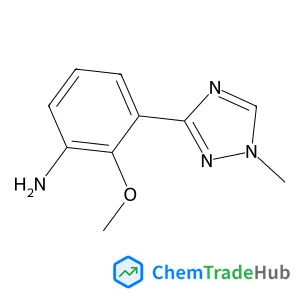
2-Methoxy-3-(1-methyl-1H-1,2,4-triazol-3-yl)aniline
CAS Number:
1609394-10-6
Molecular Formula:
C10H12N4O
Recommended Suppliers




Disclaimer
This page provides academic journal information for reference and research purposes only. We are not affiliated with any journal publishers and do not handle publication submissions. For publication-related inquiries, please contact the respective journal publishers directly.
If you notice any inaccuracies in the information displayed, please contact us at support@chemtradehub.com. We will promptly review and address your concerns.