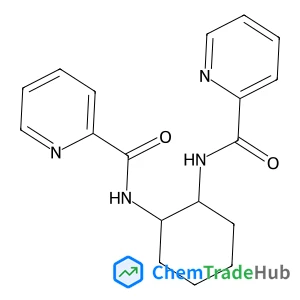
N,N'-(1R,2R)-1,2-Cyclohexanediyldi(2-pyridinecarboxamide)
CAS Number:
218290-24-5
Molecular Formula:
C18H20N4O2
Jun Gao, Weiqi Tong, Qun Qian, Kunhua Lin
We report the design, synthesis and characterization of two copolymers, PQTF and PQTTST, based on 3,3′′′-didodecylquaterthiophene (QT), fluorene and 2,5-dithienylsilole. The spectroscopic, thermal properties and electrochemical properties were investigated. Thermal gravimetric analysis showed that they have good thermal stability with the decomposition temperature higher than 400 °C. The UV-vis absorption and cyclic voltammetry measurements revealed that the introduction of a fluorene unit into the backbone of PQTF resulted in a blue-shift of the longest wavelength absorption and a reduction of the HOMO level to −5.32 eV, while the absorption spectra red-shifted, and the LUMO level reduced to −3.59 eV with the incorporation of a 2,5-dithienylsilole unit into the backbone of PQTTST. In comparison with the homopolymer PQT, the copolymers exhibited disordered alkyl chain stacking. Bulk-heterojunction solar cells fabricated with PQTTST and PC60BM displayed power conversion efficiencies (PCE) of 1.49%, short-circuit currents (Jsc) of 4.77 mA cm−2 and open-circuit voltages (Voc) of 0.72 V. This PCE is the highest recorded for QT-based polymer donor and PC60BM acceptor bulk heterojunction (BHJ) photovoltaic cells.

Chinese Journal of Chemistry

Journal of Chemical Sciences

Acta Metallurgica Sinica-English Letters

Journal of Asian Natural Products Research

NDT & E International

Main Group Chemistry

Colloid Journal

Herald of the Russian Academy of Sciences

Electroanalysis

Critical Reviews in Solid State and Materials Sciences
Sven Thorwirth, Jürgen Gauss, Michael C. McCarthy, François Shindo, Patrick Thaddeus
DOI: 10.1039/B814558J
Katharine Geramita, Jennifer McBee, Yuefei Tao, Rachel A. Segalman, T. Don Tilley
DOI: 10.1039/B813440E
Yu Xia, Yu Wang, Kai Chen, Liming Tang
DOI: 10.1039/B811412A
Till Riehm, Gabriele De Paoli, Hubert Wadepohl, Luisa De Cola, Lutz H. Gade
DOI: 10.1039/B811864G
Mangayarkarasi Nagarathinam, Abdul Malik Puthan Peedikakkal, Jagadese J. Vittal
DOI: 10.1039/B809136F
Liz O’Donovan, Michael P. Carty, Fawaz Aldabbagh
DOI: 10.1039/B814706J
Yuangang Li, Minghua Liu
DOI: 10.1039/B812567H
Fabio Cicoira, Konstantin Yu. Chernichenko, Elizabeth S. Balenkova, Federico Rosei, Valentine G. Nenajdenko, Dmitrii F. Perepichka
DOI: 10.1039/B809259A
1H-Indazole-6-carbonitrile finds applications in pharmaceuticals, where it serve...
Waste containing Dioctyl (2E)-2-butenedioate (CAS: 2997-85-5) should be collecte...
Sodium [(1,2-benzoxazol-3-ylmethyl)sulfonyl]azanide is primarily used in pharmac...
Dimethyl 4-(4,4,5,5-tetramethyl-1,3,2-dioxaborolan-2-yl)-2,6-pyridinedicarboxyla...
Waste containing 2-Fluoro-6-hydrazinopyridine (CAS: 80714-39-2) should be manage...
6-Formyl-2-pyridinecarboxylic acid is an organic compound with the molecular for...
Research trends for this compound indicate a focus on its potential applications...
9H-Tribenzo[b,d,f]azepine is typically synthesized via a multi-step process invo...
1-Cyclopropyl-7-ethoxy-6-fluoro-8-methoxy-4-oxo-1,4-dihydro-3-quinolinecarboxyli...
Waste containing Methyl 3-oxo-1,2,3,4-tetrahydro-6-quinoxalinecarboxylate (CAS: ...

Polymer Chemistry welcomes submissions in all areas of polymer science that have a strong focus on macromolecular chemistry. Manuscripts may cover a broad range of fields, yet no direct application focus is required.
![2-Methyl-2-propanyl 4-{2-fluoro-5-[(4-oxo-3,4-dihydro-1-phthalazinyl)methyl]benzoyl}-1-piperazinecarboxylate structure](https://static.chemtradehub.com/structs/763/763114-04-1-65a9.webp "2-Methyl-2-propanyl 4-{2-fluoro-5-[(4-oxo-3,4-dihydro-1-phthalazinyl)methyl]benzoyl}-1-piperazinecarboxylate structure")