












Schiff's base as a stimuli-responsive linker in polymer chemistry
Literature Information
Publication Date
2012-06-28
DOI
10.1039/C2PY20290E
Impact Factor
5.582
Authors
Yan Xin, Jinying Yuan
View Original
Abstract
Schiff-base reactions are widely used in the field of chemistry. With many advantages, such as mild reaction conditions and high reaction rates, they were employed for protecting various functional groups and synthesizing a series of organic ligands. In polymer chemistry, they can serve as potential pH-responsive linkers in polymer chains because of their sensitive responses to changes in the pH value. With certain particular designs, the Schiff-base structure can cooperate with other reversible covalent bonds or supra-molecular interactions to form assemblies or gels, providing various functions and applications. This article aims to give a critical review of the recent literature on the Schiff-base reactions used in polymer chemistry and how they serve as a way of linking structures together. We will also cover some of the important developments on the functions and applications of these polymers.
Recommended Journals
Related Literature
Deprotonative cadmation of functionalized aromatics
Jean-Martial L’Helgoual’ch, Floris Chevallier, Mitsuhiro Yonehara, Masanobu Uchiyama, Aïcha Derdour, Florence Mongin
2008-09-17
Communication
DOI: 10.1039/B809543D
Reversible fluorescence modulation through energy transfer with ABC triblock copolymer micelles as scaffolds
Jian Chen, Fang Zeng, Shuizhu Wu, Jianqing Zhao, Qiming Chen, Zhen Tong
2008-09-25
Communication
DOI: 10.1039/B810677K
Novel highly active FSM-16 supported molybdenum catalyst for hydrotreatment
Shelu Garg, Thallada Bhaskar, Kapil Soni, Gnanamani Muthu Kumaran, Akinori Muto, Yusaku Sakata, Gudimella Murali Dhar
2008-09-15
Communication
DOI: 10.1039/B809808E
A genetic selection system for evolving enantioselectivity of enzymes
Manfred T. Reetz, Horst Höbenreich, Pankaj Soni, Layla Fernández
2008-09-22
Communication
DOI: 10.1039/B814538E
Functional biomimetic models for the active site in the respiratory enzyme cytochrome c oxidase
James P. Collman, Richard A. Decréau
2008-09-04
Feature Article
DOI: 10.1039/B808070B
Molecularly imprinted cavities template the macrocyclization of tetrapeptides
Dar-Fu Tai, Yee-Fung Lin
2008-09-29
Communication
DOI: 10.1039/B813439A
Non-hydrolytic synthesis of mesoporous silica–titania catalysts for the mild oxidation of sulfur compounds with hydrogen peroxide
P. Hubert Mutin, Emil Dumitriu, François Fajula, André Vioux, Vasile Hulea
2008-09-18
Communication
DOI: 10.1039/B811668G
A metallopolymer case-history: polymer, ring or ligand reaction?
Edwin C. Constable, Kate Harris, Catherine E. Housecroft, Markus Neuburger, Silvia Schaffner
2008-09-17
Communication
DOI: 10.1039/B811204E
You might also like
Compound Q&A
What are the main uses of 1H-Indazole-6-carbonitrile (CAS: 141290-59-7)?
1H-Indazole-6-carbonitrile finds applications in pharmaceuticals, where it serve...
141290-59-71H-Indazole-6-carbon...
Compound Q&A
How should waste containing Dioctyl (2E)-2-butenedioate (CAS: 2997-85-5) be handled?
Waste containing Dioctyl (2E)-2-butenedioate (CAS: 2997-85-5) should be collecte...
2997-85-5Dioctyl (2E)-2-buten...
Compound Q&A
What industries use Sodium [(1,2-benzoxazol-3-ylmethyl)sulfonyl]azanide (CAS: 68291-98-5)?
Sodium [(1,2-benzoxazol-3-ylmethyl)sulfonyl]azanide is primarily used in pharmac...
68291-98-5Sodium [(1,2-benzoxa...
Compound Q&A
Are there alternatives to Dimethyl 4-(4,4,5,5-tetramethyl-1,3,2-dioxaborolan-2-yl)-2,6-pyridinedicarboxylate (CAS: 741709-66-0) in synthesis?
Dimethyl 4-(4,4,5,5-tetramethyl-1,3,2-dioxaborolan-2-yl)-2,6-pyridinedicarboxyla...
741709-66-0Dimethyl 4-(4,4,5,5-...
Compound Q&A
How should waste containing 2-Fluoro-6-hydrazinopyridine (CAS: 80714-39-2) be handled?
Waste containing 2-Fluoro-6-hydrazinopyridine (CAS: 80714-39-2) should be manage...
80714-39-22-Fluoro-6-hydrazino...
Compound Q&A
What is 6-Formyl-2-pyridinecarboxylic acid (CAS: 499214-11-8)?
6-Formyl-2-pyridinecarboxylic acid is an organic compound with the molecular for...
499214-11-86-Formyl-2-pyridinec...
Compound Q&A
What is the market or research trend for 3-(3,4-dimethoxyphenyl)-2,5-dimethyl-N-(2-morpholin-4-ylethyl)pyrazolo[1,5-a]pyrimidin-7-amine (CAS: 900874-91-1)?
Research trends for this compound indicate a focus on its potential applications...
900874-91-13-(3,4-dimethoxyphen...
Compound Q&A
How is 9H-Tribenzo[b,d,f]azepine (CAS: 29875-73-8) typically synthesized?
9H-Tribenzo[b,d,f]azepine is typically synthesized via a multi-step process invo...
29875-73-89H-Tribenzo[b,d,f]az...
Compound Q&A
How is 1-Cyclopropyl-7-ethoxy-6-fluoro-8-methoxy-4-oxo-1,4-dihydro-3-quinolinecarboxylic acid (CAS: 1797982-51-4) typically synthesized?
1-Cyclopropyl-7-ethoxy-6-fluoro-8-methoxy-4-oxo-1,4-dihydro-3-quinolinecarboxyli...
1797982-51-41-Cyclopropyl-7-etho...
Compound Q&A
How should waste containing Methyl 3-oxo-1,2,3,4-tetrahydro-6-quinoxalinecarboxylate (CAS: 671820-52-3) be handled?
Waste containing Methyl 3-oxo-1,2,3,4-tetrahydro-6-quinoxalinecarboxylate (CAS: ...
671820-52-3Methyl 3-oxo-1,2,3,4...
Source Journal
Polymer Chemistry

CiteScore:
8.6
Self-citation Rate:
7.3%
Articles per Year:
457
Polymer Chemistry welcomes submissions in all areas of polymer science that have a strong focus on macromolecular chemistry. Manuscripts may cover a broad range of fields, yet no direct application focus is required.
Recommended Compounds
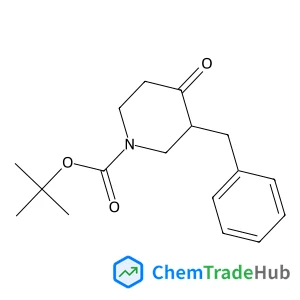
2-Methyl-2-propanyl 3-benzyl-4-oxo-1-piperidinecarboxylate
CAS Number:
193274-82-7
Molecular Formula:
C17H23NO3
Recommended Suppliers






Disclaimer
This page provides academic journal information for reference and research purposes only. We are not affiliated with any journal publishers and do not handle publication submissions. For publication-related inquiries, please contact the respective journal publishers directly.
If you notice any inaccuracies in the information displayed, please contact us at support@chemtradehub.com. We will promptly review and address your concerns.