












Preparation of water-dispersible silver-decorated polymer vesicles and micelles with excellent antibacterial efficacy
Literature Information
Publication Date
2012-05-01
DOI
10.1039/C2PY20181J
Impact Factor
5.582
Authors
Hang Lu, Lang Fan, Qiuming Liu, Jingren Wei, Tianbin Ren
View Original
Abstract
It is well known that silver nanoparticles have excellent antibacterial activities. However, to prepare well-defined, water-dispersible and long-term stable silver nanoparticles still remains insufficient. Presented in this paper are the design and preparation of new water-dispersible silver-decorated polymer vesicles and micelles based on a new kind of amphiphilic block-statistical copolymer, PEO-b-P(DMA-stat-tBA) (polymer 1) and its partially hydrolyzed derivative, PEO-b-P(DMA-stat-tBA-stat-AA) (polymer 2). Here PEO stands for poly(ethylene oxide), DMA for 2-(dimethylamino)ethyl methacrylate, tBA for t-butyl acrylate and AA for acrylic acid. PEO and poly(tBA) are designed to provide permanent hydrophilicity and hydrophobicity for macromolecular self-assembly in water, respectively. Poly(DMA) is introduced for the coordination of Ag+ ions to form silver nanoparticles in situ upon reduction. Poly(AA) is designed to serve the scaffold for the silver nanoparticle formation in the micelle core by electrostatic interactions with Ag+ ions. The silver-decorated polymer vesicles and micelles have been prepared in five steps: Firstly, polymer 1 was synthesized by Atom Transfer Radical Polymerization (ATRP) in the presence of CuBr/PMDETA in methanol at 60 °C. Secondly, a fraction of hydrophobic poly(tBA) in polymer 1 was hydrolyzed into hydrophilic and functional poly(acrylic acid) (PAA) to form polymer 2 in the presence of trifluoroacetic acid (TFA). Thirdly, polymer 1 was self-assembled into polymer vesicles with tuneable sizes ranged from 100–700 nm in basic water–DMF and polymer micelles with ∼50 nm diameter in neutral water–DMF, respectively. Polymer 2 was self-assembled into small micelles with ∼20 nm diameter by direct dissolution in water. Fourthly, the silver precursor AgNO3 was introduced into the polymer micelle or polymer vesicle solution where the Ag+ ion was absorbed in the core of the micelles or the membrane of the vesicles. Finally, the Ag nanoparticles were formed in the core of the micelles or the membrane of the vesicles when the reducing agent sodium borohydride was introduced. 1H NMR, GPC, DLS, UV and TEM were employed to characterize the structure and composition of the block copolymers, polymer micelles and vesicles, and silver-decorated polymer micelles and vesicles. Those water-dispersible silver-decorated polymer micelles and vesicles showed excellent antibacterial efficacy against Escherichia coli (E. coli) with quite low minimum inhibitory concentration (MIC) and minimum bactericidal concentration (MBC).
Related Literature
Synthesis of nanoscaled poly(styrene-co-n-butyl acrylate)/silica particles with dumbbell- and snowman-like morphologies by emulsion polymerization
Lucie Malosse, Etienne Duguet, Muriel Lansalot, Elodie Bourgeat-Lami, Serge Ravaine
2014-06-05
Paper
DOI: 10.1039/C4PY00370E
Control over the assembly and rheology of supramolecular networks via multi-responsive double hydrophilic copolymers
Jérémy Brassinne, Charles-André Fustin, Jean-François Gohy
2017-01-30
Paper
DOI: 10.1039/C6PY02143C
Ultra-sensitive detection of explosives in solution and film as well as the development of thicker film effectiveness by tetraphenylethene moiety in AIE active fluorescent conjugated polymer
Khama Rani Ghosh, Sukanta Kumar Saha
2014-06-11
Paper
DOI: 10.1039/C4PY00673A
Nanoimprinting-induced molecular orientation in poly(3-hexylthiophene) nanogratings and its extraordinary retention after thermal annealing
Xiaohui Li, Zhijun Hu
2017-03-28
Paper
DOI: 10.1039/C7PY00378A
Reduction- and thermo-sensitive core-cross-linked polypeptide hybrid micelles for triggered and intracellular drug release
Yuanfeng Gao
2017-01-06
Paper
DOI: 10.1039/C6PY01929C
Thermo-responsive gold/poly(vinyl alcohol)-b-poly(N-vinylcaprolactam) core–corona nanoparticles as a drug delivery system
Christophe Detrembleur, Marie Hurtgen, Antoine Debuigne, Marie-Claire De Pauw-Gillet, Stéphane Mornet, Etienne Duguet, Christine Jérôme
2014-05-09
Paper
DOI: 10.1039/C4PY00352G
Dendrimer–doxorubicin conjugate as enzyme-sensitive and polymeric nanoscale drug delivery vehicle for ovarian cancer therapy
Chengyuan Zhang, Dayi Pan, Kui Luo, Ning Li, Chunhua Guo, Xiuli Zheng, Zhongwei Gu
2014-05-20
Paper
DOI: 10.1039/C4PY00601A
Controlling the folding of conjugated polymers at the single molecule level via hydrogen bonding
Beiyue Shao, Xinju Zhu, Kyle N. Plunkett, David A. Vanden Bout
2017-01-06
Paper
DOI: 10.1039/C6PY01871H
RAFT/MADIX emulsion copolymerization of vinyl acetate and N-vinylcaprolactam: towards waterborne physically crosslinked thermoresponsive particles
Laura Etchenausia, Abdel Khoukh, Elise Deniau Lejeune, Maud Save
2017-03-16
Paper
DOI: 10.1039/C7PY00221A
Reverse micelles based on β-cyclodextrin-incorporated amphiphilic polyurethane copolymers for protein delivery
Xiaoxu Du, Nan Song, Ying-Wei Yang, Guolin Wu, Jianbiao Ma, Hui Gao
2014-05-07
Paper
DOI: 10.1039/C4PY00278D
You might also like
Compound Q&A
Are there alternatives to 1-(4-Chlorophenyl)-N-hydroxymethanimine (CAS: 3848-36-0) in synthesis?
When considering alternatives to 1-(4-Chlorophenyl)-N-hydroxymethanimine (CAS: 3...
3848-36-01-(4-Chlorophenyl)-N...
Compound Q&A
How should (1R,9S,10S,12S,14E,16S,19R,20R,21S,22R)-3,9,21-Trihydroxy-5,10,12,14,16,20,22-heptamethyl-23,24-dioxatetracyclo[17.3.1.1~6,9~.0~2,7~]tetracosa-2,5,7,14-tetraen-4-one (CAS: 183202-73-5) be stored?
This compound should be stored in a cool, dry place away from direct sunlight. I...
183202-73-5(1R,9S,10S,12S,14E,1...
Compound Q&A
How is 3-(4-Bromophenyl)-5-(2-fluorophenyl)-1,2,4-oxadiazole (CAS: 419553-16-5) typically synthesized?
3-(4-Bromophenyl)-5-(2-fluorophenyl)-1,2,4-oxadiazole is synthesized through a m...
419553-16-53-(4-Bromophenyl)-5-...
Compound Q&A
How is 5-Chloro-2-(4-chlorophenyl)-4-methyl-6-[3-(1-piperidinyl)propoxy]pyrimidine (CAS: 1639220-19-1) typically synthesized?
5-Chloro-2-(4-chlorophenyl)-4-methyl-6-[3-(1-piperidinyl)propoxy]pyrimidine (CAS...
1639220-19-15-Chloro-2-(4-chloro...
Compound Q&A
What industries use 2-Chloro-4-(difluoromethoxy)pyridine (CAS: 1206978-15-5)?
2-Chloro-4-(difluoromethoxy)pyridine is used in the pharmaceutical industry for ...
1206978-15-52-Chloro-4-(difluoro...
Compound Q&A
What regulatory guidelines apply to 3-Chloro-6-methylpyridazine (CAS: 1121-79-5)?
3-Chloro-6-methylpyridazine (CAS: 1121-79-5) is classified under the Globally Ha...
1121-79-53-Chloro-6-methylpyr...
Compound Q&A
Are there alternatives to Methyl 4,5-dimethyl-2-nitrobenzoate in synthesis?
Several alternatives can be used in the synthesis of Methyl 4,5-dimethyl-2-nitro...
90922-74-0Methyl 4,5-dimethyl-...
Compound Q&A
Are there alternatives to (2E,2'E)-3,3'-(1,4-Phenylene)bisacrylaldehyde in synthesis?
Alternatives to (2E,2'E)-3,3'-(1,4-Phenylene)bisacrylaldehyde include other acry...
63405-68-5(2E,2'E)-3,3'-(1,4-P...
Compound Q&A
What is 3-Amino-5-chloropyridin-2-ol hydrochloride (CAS: 1261906-29-9)?
3-Amino-5-chloropyridin-2-ol hydrochloride is an organic compound with the CAS n...
1261906-29-93-Amino-5-chloropyri...
Compound Q&A
What precautions should be taken when handling 6,7-Difluoro-2,3-dihydro-4H-chromen-4-one (CAS: 1092349-93-3)?
When handling 6,7-Difluoro-2,3-dihydro-4H-chromen-4-one, it is essential to wear...
1092349-93-36,7-Difluoro-2,3-dih...
Source Journal
Polymer Chemistry

CiteScore:
8.6
Self-citation Rate:
7.3%
Articles per Year:
457
Polymer Chemistry welcomes submissions in all areas of polymer science that have a strong focus on macromolecular chemistry. Manuscripts may cover a broad range of fields, yet no direct application focus is required.
Recommended Compounds
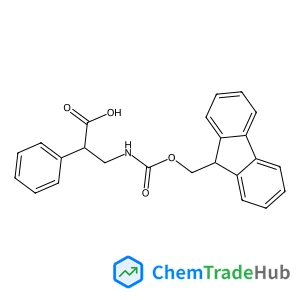
(S)-3-((((9H-Fluoren-9-yl)methoxy)carbonyl)amino)-2-phenylpropanoic acid
CAS Number:
1217663-60-9
Molecular Formula:
C24H21NO4
Recommended Suppliers




Disclaimer
This page provides academic journal information for reference and research purposes only. We are not affiliated with any journal publishers and do not handle publication submissions. For publication-related inquiries, please contact the respective journal publishers directly.
If you notice any inaccuracies in the information displayed, please contact us at support@chemtradehub.com. We will promptly review and address your concerns.