












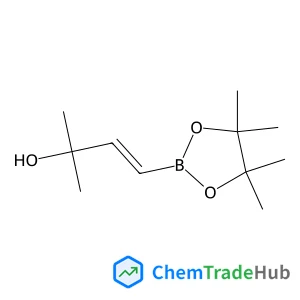
(E)-2-methyl-4-(4,4,5,5-tetramethyl-1,3,2-dioxaborolan-2-yl)but-3-en-2-ol
CAS Number:
581802-26-8
Molecular Formula:
C11H21BO3
Meysam Rahmat, Hossein Ghiasi, Pascal Hubert
A coarse grain approach was selected to simulate nanocomposites made of single-walled carbon nanotubes (SWNTs) and poly(methyl methacrylate) (PMMA). Unlike common coarse grain simulations, which employ Lennard-Jones models as the force field between the beads, the current approach used experiment-based data, and hence is considered a semi-empirical approach. Interaction stress data obtained from atomic force microscopy experiments under water were multiplied by ten to represent the interaction stresses in vacuum and then fed into the simulation. A new planar approach was introduced to simplify the three-dimensional unit cell into a two-dimensional plane. Furthermore, preliminary one-dimensional simulations were carried out to acquire a trade-off between simulation time and accuracy of the results. It was shown that the final results were independent of the initial conditions and converging parameters (the parameters that define the convergence rate). Two sets of planar simulations were performed to model pure PMMA systems and PMMA–SWNT nanocomposites. Polymer chain configuration and density profiles for these systems were obtained and compared. The surface effect on the polymer configuration and density profile was captured and demonstrated to be identical for the two systems. The polymer simulations showed a core section with a constant density, where the surface effect from the free surface did not influence the behaviour of the polymer chains. The effect of nanotube on polymer morphology was observed by layered structures of polymer chains around the nanotube, with preferable bands of peaks and valleys in the radial density profile. Finally, a new method was presented to calculate the interfacial binding energy for nanocomposites. The value of 0.44 kcal mol−1 Å−2 obtained for the PMMA–SWNT nanocomposite was shown to be in good agreement with the previously reported results obtained from atomistic simulations.
Claudio De Rosa, Finizia Auriemma, Oreste Tarallo, Rocco Di Girolamo, Enrico M. Troisi, Simona Esposito, Dario Liguori, Fabrizio Piemontesi, Gianni Vitale, Giampiero Morini
DOI: 10.1039/C6PY01950A
Stephanie M. Barbon, Joe B. Gilroy
DOI: 10.1039/C6PY00441E
Manuela Bader, Gabriel Theurkauff, Katty Den Dauw, Christian Lamotte, Olivier Lhost, Evgueni Kirillov, Jean-François Carpentier
DOI: 10.1039/C4PY00612G
Toyokazu Tsutsuba
DOI: 10.1039/C7PY00100B
DOI: 10.1039/C4PY00829D
Y. Huang, M. A. Shaw, M. R. Warmin, E. S. Mullins, N. Ayres
DOI: 10.1039/C6PY00616G
Hui Zhou, Chuanguang Wu, Qiaolin Wu, Bixuan Guo, Wanting Liu, Guanghua Li, Ying Mu
DOI: 10.1039/C6PY01784C
Hongjun Yang, Zhongrui Wang, Yulei Zheng, Wenyan Huang, Xiaoqiang Xue, Bibiao Jiang
DOI: 10.1039/C7PY00174F
Elisabeth Rieger, Tassilo Gleede, Katja Weber, Angelika Manhart, Manfred Wagner, Frederik R. Wurm
DOI: 10.1039/C7PY00436B
Christophe Detrembleur, Marie Hurtgen, Antoine Debuigne, Marie-Claire De Pauw-Gillet, Stéphane Mornet, Etienne Duguet, Christine Jérôme
DOI: 10.1039/C4PY00352G
When considering alternatives to 1-(4-Chlorophenyl)-N-hydroxymethanimine (CAS: 3...
This compound should be stored in a cool, dry place away from direct sunlight. I...
3-(4-Bromophenyl)-5-(2-fluorophenyl)-1,2,4-oxadiazole is synthesized through a m...
5-Chloro-2-(4-chlorophenyl)-4-methyl-6-[3-(1-piperidinyl)propoxy]pyrimidine (CAS...
2-Chloro-4-(difluoromethoxy)pyridine is used in the pharmaceutical industry for ...
3-Chloro-6-methylpyridazine (CAS: 1121-79-5) is classified under the Globally Ha...
Several alternatives can be used in the synthesis of Methyl 4,5-dimethyl-2-nitro...
Alternatives to (2E,2'E)-3,3'-(1,4-Phenylene)bisacrylaldehyde include other acry...
3-Amino-5-chloropyridin-2-ol hydrochloride is an organic compound with the CAS n...
When handling 6,7-Difluoro-2,3-dihydro-4H-chromen-4-one, it is essential to wear...

Polymer Chemistry welcomes submissions in all areas of polymer science that have a strong focus on macromolecular chemistry. Manuscripts may cover a broad range of fields, yet no direct application focus is required.
![(2S)-2-{[(9H-Fluoren-9-ylmethoxy)carbonyl]amino}-4-(methylselanyl)butanoic acid structure](https://static.chemtradehub.com/structs/121/1217852-49-7-f252.webp "(2S)-2-{[(9H-Fluoren-9-ylmethoxy)carbonyl]amino}-4-(methylselanyl)butanoic acid structure")
![[4-(Isobutyrylamino)phenyl]boronic acid structure](https://static.chemtradehub.com/structs/874/874219-50-8-6ab5.webp "[4-(Isobutyrylamino)phenyl]boronic acid structure")





