












“All-water” chemistry of tandem N-alkylation–reduction–condensation for synthesis of N-arylmethyl-2-substituted benzimidazoles
Literature Information
Publication Date
2012-10-04
DOI
10.1039/C2GC36377A
Impact Factor
10.182
Authors
Damodara N. Kommi, Dinesh Kumar, Rohit Bansal, Rajesh Chebolu, Asit K. Chakraborti
View Original
Abstract
A water-assisted tandem N-alkylation–reduction–condensation process has been devised as a new synthetic route for the one-pot synthesis of N-arylmethyl-2-substituted benzimidazoles. Water plays the crucial and indispensable role through hydrogen bond mediated ‘electrophile–nucleophile dual activation’ in promoting selective N-monobenzylation of o-nitroanilines as an alternative to the transition metal-based chemistry for C–N bond formation (amination) and forms the basis of disposing the substituents on the benzimidazole moiety in regiodefined manner. Water also exerts a beneficial effect in the condensation of N-monobenzylated o-phenylenediamines with aldehydes. The water-assisted C–N bond formation chemistry led to metal/base-free synthesis of N-monobenzylated o-nitroanilines and N-monobenzylated o-phenylenediamines. The indispensable/advantageous role of water in the various stage of the N-alkylation–reduction–condensation process exemplifies an ‘all-water’ chemistry for the synthesis of N-arylmethyl-2-substituted benzimidazoles.
Related Literature
Factors affecting bottlebrush polymer synthesis by the transfer-to method using reversible addition–fragmentation chain transfer (RAFT) polymerization
Scott C. Radzinski, Jeffrey C. Foster, Sally E. Lewis, Eric V. French, John B. Matson
2017-02-06
Paper
DOI: 10.1039/C6PY01982J
The synthesis of microporous polymers using Tröger's base formation
Mariolino Carta, Richard Malpass-Evans, Matthew Croad, Yulia Rogan, Michael Lee, Ian Rose, Neil B. McKeown
2014-06-20
Paper
DOI: 10.1039/C4PY00609G
Fast conversion of terminal thiocarbonylthio groups of RAFT polymers to “clickable” thiol groups via versatile sodium azide
Yang Wu, Yanyan Zhou, Jian Zhu, Wei Zhang, Xiangqiang Pan, Zhengbiao Zhang, Xiulin Zhu
2014-06-17
Communication
DOI: 10.1039/C4PY00732H
Poly(fluoroacrylate)s with tunable surface hydrophobicity via radical copolymerization of 2,2,2-trifluoroethyl α-fluoroacrylate and 2-(trifluoromethyl)acrylic acid
Sanjib Banerjee, Bhausaheb V. Tawade, Vincent Ladmiral, Lionel X. Dupuy, Bruno Améduri
2017-03-07
Paper
DOI: 10.1039/C7PY00209B
One pot synthesis of higher order quasi-block copolymer libraries via sequential RAFT polymerization in an automated synthesizer
Graeme Moad, San H. Thang
2014-05-16
Paper
DOI: 10.1039/C4PY00496E
The in situ formation of nanoparticles via RAFT polymerization-induced self-assembly in a continuous tubular reactor
Jinying Peng, Chun Tian, Lifen Zhang, Zhenping Cheng, Xiulin Zhu
2017-01-26
Paper
DOI: 10.1039/C6PY02133F
From particles to stabilizing blocks – polymerized ionic liquids in aqueous heterophase polymerization
Ran Yu, Klaus Tauer
2014-05-16
Paper
DOI: 10.1039/C4PY00458B
Camptothecin prodrug block copolymer micelles with high drug loading and target specificity
Sue Watson, Anna M. Grabowska
2014-05-15
Paper
DOI: 10.1039/C4PY00369A
Zirconocene-catalyzed stereoselective cyclocopolymerization of 2-methyl-1,5-hexadiene with propylene
Manuela Bader, Gabriel Theurkauff, Katty Den Dauw, Christian Lamotte, Olivier Lhost, Evgueni Kirillov, Jean-François Carpentier
2014-06-27
Paper
DOI: 10.1039/C4PY00612G
Synthetic strategies for the generation of ABCA' type asymmetric tetrablock terpolymers
Siddharth Chanpuriya, Marc A. Hillmyer, Frank S. Bates
2014-06-13
Paper
DOI: 10.1039/C4PY00614C
You might also like
Compound Q&A
What regulatory guidelines apply to 4-Amino-3-bromophenol (CAS: 74440-80-5)?
4-Amino-3-bromophenol (CAS: 74440-80-5) falls under the classification of a haza...
74440-80-54-Amino-3-bromopheno...
Compound Q&A
How should (17beta)-3-Oxoestr-4-en-17-yl acetate (CAS: 1425-10-1) be stored?
(17beta)-3-Oxoestr-4-en-17-yl acetate should be stored in a cool, dry place away...
1425-10-1(17beta)-3-Oxoestr-4...
Compound Q&A
What are the physical and chemical properties of 2-[(2,2-Diethoxyethyl)disulfanyl]-1,1-diethoxyethane (CAS: 76505-71-0)?
2-[(2,2-Diethoxyethyl)disulfanyl]-1,1-diethoxyethane (CAS: 76505-71-0) is a colo...
76505-71-02-[(2,2-Diethoxyethy...
Compound Q&A
What is the market or research trend for 1-(β-D-ribofuranosyl)-1H-imidazo[4,5-c]pyridin-4-amine?
The market and research for 1-(β-D-ribofuranosyl)-1H-imidazo[4,5-c]pyridin-4-ami...
6736-58-91-(beta-D-Ribofurano...
Compound Q&A
How should waste containing Conjugated Estrogen (CAS: 12126-59-9) be handled?
Waste containing Conjugated Estrogen (CAS: 12126-59-9) should be collected and d...
12126-59-9Conjugated Estrogen
Compound Q&A
What is the market or research trend for Bis(2,2,2-trifluoroethyl) (methoxycarbonylmethyl)phosphonate?
The market for Bis(2,2,2-trifluoroethyl) (methoxycarbonylmethyl)phosphonate (CAS...
88738-78-7Bis(2,2,2-trifluoroe...
Compound Q&A
Are there alternatives to 3,4'-Di-O-methylellagic acid (CAS: 57499-59-9) in synthesis?
There are several alternatives to 3,4'-Di-O-methylellagic acid (CAS: 57499-59-9)...
57499-59-93,4'-Di-O-methylella...
Compound Q&A
What regulatory guidelines apply to 2-Chloro-N,N-dimethylpyridin-4-amine (CAS: 59047-70-0)?
2-Chloro-N,N-dimethylpyridin-4-amine (CAS: 59047-70-0) is regulated under the Gl...
59047-70-02-Chloro-N,N-dimethy...
Compound Q&A
What is cerium(3+);oxygen(2-);vanadium(5+) (CAS: 13597-19-8)?
Cerium(3+);oxygen(2-);vanadium(5+) (CAS: 13597-19-8) is a complex inorganic comp...
13597-19-8cerium(3+);oxygen(2-...
Compound Q&A
Is 7-Chloro-1-iodoisoquinoline (CAS: 1203579-27-4) safe?
7-Chloro-1-iodoisoquinoline (CAS: 1203579-27-4) is generally considered safe whe...
1203579-27-47-Chloro-1-iodoisoqu...
Source Journal
Green Chemistry

CiteScore:
16.1
Self-citation Rate:
7.5%
Articles per Year:
944
Green Chemistry provides a unique forum for the publication of innovative research on the development of alternative green and sustainable technologies. The scope of Green Chemistry is based on, but not limited to, the definition proposed by Anastas and Warner (Green Chemistry: Theory and Practice, P T Anastas and J C Warner, Oxford University Press, Oxford, 1998). Green chemistry is the utilisation of a set of principles that reduces or eliminates the use or generation of hazardous substances in the design, manufacture and application of chemical products. Green Chemistry is at the frontiers of this continuously-evolving interdisciplinary science and publishes research that attempts to reduce the environmental impact of the chemical enterprise by developing a technology base that is inherently non-toxic to living things and the environment. Submissions on all aspects of research relating to the endeavour are welcome. The journal publishes original and significant cutting-edge research that is likely to be of wide general appeal. To be published, work must present a significant advance in green chemistry. Papers must contain a comparison with existing methods and demonstrate advantages over those methods before publication can be considered. For more information please see this Editorial. Coverage includes the following, but is not limited to: Design (e.g. biomimicry, design for degradation/recycling/reduced toxicity…) Reagents & Feedstocks (e.g. renewables, CO2, solvents, auxiliary agents, waste utilization…) Synthesis (e.g. organic, inorganic, synthetic biology…) Catalysis (e.g. homogeneous, heterogeneous, enzyme, whole cell…) Process (e.g. process design, intensification, separations, recycling, efficiency…) Energy (e.g. renewable energy, fuels, photovoltaics, fuel cells, energy storage, energy carriers…) Applications (e.g. electronics, dyes, consumer products, coatings, pharmaceuticals, preservatives, building materials, chemicals for industry/agriculture/mining…) Impact (e.g. safety, metrics, LCA, sustainability, (eco)toxicology…) Green chemistry is, by definition, a continuously-evolving frontier. Therefore, the inclusion of a particular material or technology does not, of itself, guarantee that a paper is suitable for the journal. To be suitable, the novel advance should have the potential for reduced environmental impact relative to the state of the art. Green Chemistry does not normally deal with research associated with 'end-of-pipe' or remediation issues.
Recommended Compounds
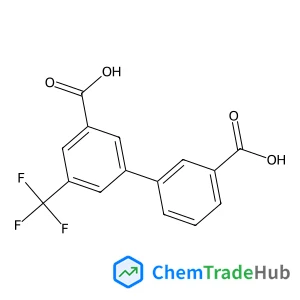
3-(3-Carboxyphenyl)-5-(trifluoromethyl)benzoic acid
CAS Number:
1261930-96-4
Molecular Formula:
C15H9F3O4
Recommended Suppliers







Disclaimer
This page provides academic journal information for reference and research purposes only. We are not affiliated with any journal publishers and do not handle publication submissions. For publication-related inquiries, please contact the respective journal publishers directly.
If you notice any inaccuracies in the information displayed, please contact us at support@chemtradehub.com. We will promptly review and address your concerns.