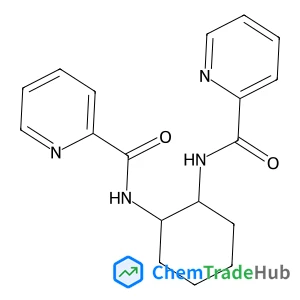
N,N'-(1R,2R)-1,2-Cyclohexanediyldi(2-pyridinecarboxamide)
CAS Number:
218290-24-5
Molecular Formula:
C18H20N4O2
Rewa Rai, Siddharth Pandey
The ring closing metathesis within an ionic liquid 1-butyl-3-methylimidazolium hexafluorophosphate ([bmim][PF6]), a ‘green’ solvent tetraethylene glycol (TEG), and their equimolar mixture is investigated through the intramolecular excimer formation of 6-(1-pyrenyl)hexyl-11-(1-pyrenyl)undecanoate [1]. The excimer formation efficiency correlates directly with the inverse of the bulk viscosity of the systems. A simplistic double exponential decay model based on Birk's scheme is enough to fit the excited state intensity decay of 1 in these liquids. This behavior is in stark contrast to that reported in organic solvents and in scCO2, where three exponentials are required to fit the fluorescence decay. The activation energies of the excimer formation (Ea), viscous flow (Ea,ηbulk), and microviscosity (Ea,ημ) were estimated from the temperature dependence. Ea and Ea,ημ are significantly higher for the equimolar mixture as compared to that for [bmim][PF6] or TEG, whereas Ea,ηbulk is close to the average. This highlights the important outcome that the cyclization dynamics scales with the microviscosity rather than the bulk viscosity of the systems investigated.

Advanced Engineering Materials

Foundations of Chemistry

Angewandte Chemie International Edition

CrystEngComm

Current Pharmaceutical Biotechnology

Mini-Reviews in Medicinal Chemistry

Environmental Toxicology and Pharmacology

Molecular Diversity

Photochemical & Photobiological Sciences

Contact Lens & Anterior Eye
Leszek Lapinski, Maciej J. Nowak, Dariusz C. Bieńko, Danuta Michalska
DOI: 10.1039/B108702A
Christoph Janzen, Petra Imhof, Karl Kleinermanns, Mattanjah S. de Vries
DOI: 10.1039/B110360C
Yide Gao, Changjin Hu, Qin Ran, Yang Chen, Xingxiao Ma, Congxiang Chen
DOI: 10.1039/B105728F
G. Billon, B. Ouddane, L. Gengembre, A. Boughriet
DOI: 10.1039/B108638N
E. Saiz, E. Riande
DOI: 10.1039/B106480K
S. M. Handford-Styring, R. W. Walker
DOI: 10.1039/B108578F
Luís E. S. de Souza, Sylvio Canuto
DOI: 10.1039/B109010K
DOI: 10.1039/B109077C
Kazuki Arihara, Takeo Ohsaka, Fusao Kitamura
DOI: 10.1039/B109879A
Colin J. Crook, Andrew Smith, Richard A. L. Jones, Anthony J. Ryan
DOI: 10.1039/B109977A
6-Bromo-2-methylimidazo[1,2-a]pyrimidine (CAS: 1111638-05-1) falls under various...
While there are no direct alternatives, similar compounds like 1-Pyrrolidineetha...
4-Methyl-2,6-bis(2-methyl-2-propanyl)phenyl methylcarbamate (CAS: 1918-11-2) is ...
2-(3-Bromo-4-fluorophenyl)-1,3-dioxolane (CAS: 77771-04-1) should be stored in a...
4,5,6,7-Tetrahydro-1H-indazole hydrochloride is a white crystalline solid with a...
(2R)-1-Methoxy-3-phenyl-2-propanamine is a chiral organic compound with the CAS ...
Ethyl 1-(1-phenylethyl)-1H-imidazole-5-carboxylate is used in various industries...
4-[(1E,3S)-1-(4-Hydroxyphenyl)-1,4-pentadien-3-yl]phenol (CAS: 17676-24-3) falls...
(S)-3-Amino-5-phenylpentanoic acid hydrochloride is primarily used in the pharma...
7-Methoxy-1-benzothiophene-2-carboxylic acid is typically synthesized by reactin...

Physical Chemistry Chemical Physics (PCCP) is an international journal co-owned by 19 physical chemistry and physics societies from around the world. This journal publishes original, cutting-edge research in physical chemistry, chemical physics and biophysical chemistry. To be suitable for publication in PCCP, articles must include significant innovation and/or insight into physical chemistry; this is the most important criterion that reviewers and Editors will judge against when evaluating submissions. The journal has a broad scope and welcomes contributions spanning experiment, theory, computation and data science. Topical coverage includes spectroscopy, dynamics, kinetics, statistical mechanics, thermodynamics, electrochemistry, catalysis, surface science, quantum mechanics, quantum computing and machine learning. Interdisciplinary research areas such as polymers and soft matter, materials, nanoscience, energy, surfaces/interfaces, and biophysical chemistry are welcomed if they demonstrate significant innovation and/or insight into physical chemistry. Joined experimental/theoretical studies are particularly appreciated when complementary and based on up-to-date approaches.
![9H-Fluoren-9-ylmethyl {15-[(2,5-dioxo-1-pyrrolidinyl)oxy]-15-oxo-3,6,9,12-tetraoxapentadec-1-yl}carbamate structure](https://static.chemtradehub.com/structs/131/1314378-14-7-4316.webp "9H-Fluoren-9-ylmethyl {15-[(2,5-dioxo-1-pyrrolidinyl)oxy]-15-oxo-3,6,9,12-tetraoxapentadec-1-yl}carbamate structure")