












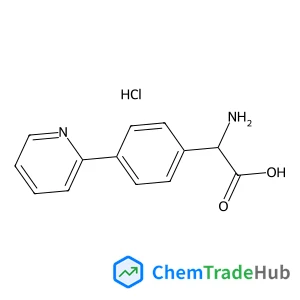
2-Amino-2-(4-(pyridin-2-YL)phenyl)acetic acid hydrochloride
CAS Number:
1135818-89-1
Molecular Formula:
C13H13ClN2O2
Water splitting to form H2 and O2 using semiconductor photocatalysts under sunlight is a possible means of clean energy production from renewable resources. (Oxy)nitrides are regarded as suitable candidates for the application, because of their suitable band edge positions, small band gaps (<3 eV), and stability under irradiation. Since early reports published in 2002 by Domen et al., it has been demonstrated that several (oxy)nitrides are active photocatalysts capable of reducing and oxidizing water in the presence of suitable electron donors and acceptors, respectively, under visible light (λ > 400 nm). Some have achieved direct water splitting into H2 and O2 with good reproducibility. (Oxy)nitrides are also attractive as water-splitting photoelectrodes, and highly efficient photoelectrochemical water splitting has been accomplished using tantalum-based (oxy)nitrides under visible light with good stability. However, there still remain a lot of challenges that have to be addressed in this research field. This perspective highlights recent progress in the development of (oxy)nitride materials for application in photocatalytic and photoelectrochemical water splitting made by the author and his colleagues, especially in the last 5 years.
Hengpan Yang, Xinyao Yu, Jie Shao, Jingxuan Liao, Guodong Li, Qi Hu, Xiaoyao Chai, Qianling Zhang, Jianhong Liu, Chuanxin He
DOI: 10.1039/D0TA03770B
Yufu Tang, Hao Chen, Si Chen, Lei Zhang, Ao Zhang, Quli Fan, Aixi Yu, Zhen Cheng
DOI: 10.1039/C8SC00206A
Liat Avram, Yoram Cohen
DOI: 10.1039/C4CS00197D
Xiaoli Xu, Lingbo Xiao, Yanmin Jia, Zheng Wu, Feifei Wang, Yaojin Wang, Neale O. Haugen, Haitao Huang
DOI: 10.1039/C8EE01016A
Lei Kang, Jinpeng Li, Jinsong Zeng, Wenhua Gao, Jun Xu, Zheng Cheng, Kefu Chen, Bin Wang
DOI: 10.1039/C9TA04815D
Dipankar Ghosh, Ieva Lebedytė, Dmitry S. Yufit, Krishna K. Damodaran, Jonathan W. Steed
DOI: 10.1039/C5CE00901D
Ashish Kumar, Manish Kumar, Vempuluru Navakoteswara Rao, Muthukonda Venkatakrishnan Shankar, Saswata Bhattacharya, Venkata Krishnan
DOI: 10.1039/D1TA04180K
Fangwei Zhan, Ting Bian, Wengao Zhao, Hui Zhang, Mingshang Jin, Deren Yang
DOI: 10.1039/C3CE42362J
(5-Sulfamoyl-3-pyridinyl)boronic acid is primarily used in chemical synthesis, p...
Benzyl 2-methyl-2-(methylsulfonyl)-4-pentenoate is typically synthesized via est...
When handling 8-Fluoroquinolin-6-ol (CAS: 209353-22-0), it is important to use p...
1,3-Dibromo-5-(2-methyl-2-propanyl)benzene (CAS: 129316-09-2) is a crystalline c...
Ethyl 7-chloro-4-oxo-1-(1,3-thiazol-2-yl)-1,4-dihydro-1,8-naphthyridine-3-carbox...
When handling Delta-7-Avenasterol (CAS: 23290-26-8), it is important to wear app...
Proper handling involves the use of personal protective equipment such as gloves...
When handling 2-Methyl-2-proanyl 4-[(2-aminophenyl)amino]-1-piperidinecarboxylat...
N-Methyl-4-chlorobenzylamine hydrochloride (CAS: 65542-24-7) is a organic compou...
[2-(Dodecyloxy)ethoxy]acetic acid (CAS: 27306-90-7) is generally considered safe...

Physical Chemistry Chemical Physics (PCCP) is an international journal co-owned by 19 physical chemistry and physics societies from around the world. This journal publishes original, cutting-edge research in physical chemistry, chemical physics and biophysical chemistry. To be suitable for publication in PCCP, articles must include significant innovation and/or insight into physical chemistry; this is the most important criterion that reviewers and Editors will judge against when evaluating submissions. The journal has a broad scope and welcomes contributions spanning experiment, theory, computation and data science. Topical coverage includes spectroscopy, dynamics, kinetics, statistical mechanics, thermodynamics, electrochemistry, catalysis, surface science, quantum mechanics, quantum computing and machine learning. Interdisciplinary research areas such as polymers and soft matter, materials, nanoscience, energy, surfaces/interfaces, and biophysical chemistry are welcomed if they demonstrate significant innovation and/or insight into physical chemistry. Joined experimental/theoretical studies are particularly appreciated when complementary and based on up-to-date approaches.
![N-[(6-Bromo-3-pyridinyl)methyl]ethanamine structure](https://static.chemtradehub.com/structs/120/120740-05-8-ca55.webp "N-[(6-Bromo-3-pyridinyl)methyl]ethanamine structure")






