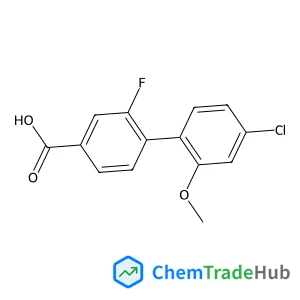
4-(4-Chloro-2-methoxyphenyl)-3-fluorobenzoic acid
CAS Number:
1261970-23-3
Molecular Formula:
C14H10ClFO3
Liat Avram, Yoram Cohen
In the last decade diffusion NMR and diffusion ordered spectroscopy (DOSY) have become important analytical tools for the characterization of supramolecular systems in solution. Diffusion NMR can be used to glean information on the (effective) size and shape of molecular species, as well as to probe inter-molecular interactions and can be used to estimate the association constant (Ka) of a complex. In addition, the diffusion coefficient, as obtained from diffusion NMR, is a much more intuitive parameter than the chemical shift for probing self-association, aggregation and inter-molecular interactions. The diffusion coefficient may be an even more important analytical parameter in systems in which the formed supramolecular entity has the same symmetry as its building units, when there is a large change in the molecular weight, where many molecular species are involved in the formation of the supramolecular systems, and when proton transfer may occur which, in turn, may affect the chemical shift. Some of the self-assembled molecular capsules and cages prepared in the last decade represent such supramolecular systems and in the present review, following a short introduction on diffusion NMR, we survey the contribution of diffusion NMR and DOSY in the field of molecular containers and capsules. We will first focus on the role played by diffusion NMR in the field of hydrogen bond driven self-assembled capsules. We then survey the contributions of diffusion NMR and DOSY to the study and characterization of metal–ligand cages and capsules. Finally, we describe a few recent applications of diffusion NMR in the field of hydrophobic, electrostatic and covalent containers.
Narjes Ansari, Francesc Illas
DOI: 10.1039/C5CP00381D
Rui-Qin Zhang
DOI: 10.1039/C4CP05973E
Chikang Li
DOI: 10.1039/C4CP05049E
S. Niveditha, K. Bhanuprakash
DOI: 10.1039/C5CP01777G
Jing Ge, Zhigang Geng, Shenlong Jiang, Kaili Fan, Zhenkun Guo, Jiahua Hu, Zongwei Chen
DOI: 10.1039/C5CP00323G
A. D. Godbeer, J. S. Al-Khalili, P. D. Stevenson
DOI: 10.1039/C5CP00472A
Antti Viinikanoja, Pia Damlin, Milla Suominen, Carita Kvarnström
DOI: 10.1039/C5CP00942A
R. Z. Martínez, D. Bermejo
DOI: 10.1039/C5CP01264C
(5-Sulfamoyl-3-pyridinyl)boronic acid is primarily used in chemical synthesis, p...
Benzyl 2-methyl-2-(methylsulfonyl)-4-pentenoate is typically synthesized via est...
When handling 8-Fluoroquinolin-6-ol (CAS: 209353-22-0), it is important to use p...
1,3-Dibromo-5-(2-methyl-2-propanyl)benzene (CAS: 129316-09-2) is a crystalline c...
Ethyl 7-chloro-4-oxo-1-(1,3-thiazol-2-yl)-1,4-dihydro-1,8-naphthyridine-3-carbox...
When handling Delta-7-Avenasterol (CAS: 23290-26-8), it is important to wear app...
Proper handling involves the use of personal protective equipment such as gloves...
When handling 2-Methyl-2-proanyl 4-[(2-aminophenyl)amino]-1-piperidinecarboxylat...
N-Methyl-4-chlorobenzylamine hydrochloride (CAS: 65542-24-7) is a organic compou...
[2-(Dodecyloxy)ethoxy]acetic acid (CAS: 27306-90-7) is generally considered safe...

Chem Soc Rev publishes review articles covering important topics at the forefront of the chemical sciences. Reviews should be of the very highest quality and international impact. We particularly encourage international and multidisciplinary collaborations among our authors. Our scope covers the breadth of the chemical sciences, including interdisciplinary topics where the article has a basis in chemistry. Topics include: Analytical chemistry Biomaterials chemistry Bioorganic/medicinal chemistry Catalysis Chemical Biology Coordination Chemistry Crystal Engineering Energy Sustainable chemistry Green chemistry Inorganic chemistry Inorganic materials Main group chemistry Nanoscience Organic chemistry Organic materials Organometallics Physical chemistry Supramolecular chemistry Synthetic methodology Theoretical and computational chemistry