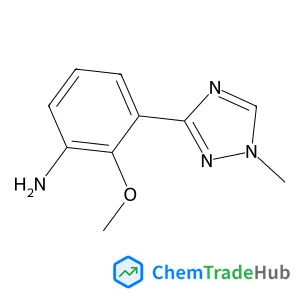
2-Methoxy-3-(1-methyl-1H-1,2,4-triazol-3-yl)aniline
CAS Number:
1609394-10-6
Molecular Formula:
C10H12N4O
János Szanyi, Ja Hun Kwak, Haiyang Zhu, Charles H. F. Peden
The adsorption of CO and NO over Cu-SSZ-13 zeolite catalysts, highly active in the selective catalytic reduction of NOx with NH3, was investigated by FTIR spectroscopy, and the results obtained were compared to those collected from other Cu-ion exchanged zeolites (Y,FAU and ZSM-5). Under low CO pressures and at room temperature (295 K), CO forms monocarbonyls exclusively on the Cu+ ions, while in the presence of gas phase CO dicarbonyls on Cu+ and adsorbed CO on Cu2+ centers form, as well. At low (cryogenic) sample temperatures, tricarbonyl formation on Cu+ sites was also observed. The adsorption of NO produces IR bands that can be assigned to nitrosyls bound to both Cu+ and Cu2+ centers, and NO+ species located in charge compensating cationic positions of the chabasite framework. On the reduced Cu-SSZ-13 samples the formation of N2O was also detected. The assignment of the adsorbed NOx species was aided by adsorption experiments with isotopically labeled 15NO. The movement of Cu ions from the sterically hindered six member ring position to the more accessible cavity positions as a result of their interaction with adsorbates (NO and H2O) was clearly evidenced. Comparisons of the spectroscopy data obtained in the static transmission IR system to those collected in the flow-through diffuse reflectance cell points out that care must be taken when general conclusions are drawn about the adsorptive and reactive properties of metal cation centers based on a set of data collected under well defined, specific experimental conditions.

Journal of Heterocyclic Chemistry

Journal of Physics and Chemistry of Solids

Pharmacological Reviews

Journal of Medicinal Chemistry

Proceedings of the National Academy of Sciences of the United States of America

Fibre Chemistry

Nature

Israel Journal of Chemistry

Journal of Organometallic Chemistry

Journal of Catalysis
Małgorzata Biczysko, Riccardo Tarroni
DOI: 10.1039/B107282J
DOI: 10.1039/B109349E
Mads Kærn, Razvan Satnoianu, Alberto P. Muñuzuri, Michael Menzinger
DOI: 10.1039/B109387H
Michel Mons, Iliana Dimicoli, Benjamin Tardivel, François Piuzzi, Valérie Brenner, Philippe Millié
DOI: 10.1039/B108146M
G. Cuevas, G. Madrid, A. T. Hagler
DOI: 10.1039/B110777C
Gui-xia Liu, Yi-hong Ding, Ze-sheng Li, Qiang Fu, Xu-ri Huang, Chia-chung Sun, Au-chin Tang
DOI: 10.1039/B109758J
Jinglei Lei, Jiuli Luo
DOI: 10.1039/B108572G
DOI: 10.1039/B108775D
Gabriele Raabe, Juergen Koehler
DOI: 10.1039/B108641N
6-Bromo-2-methylimidazo[1,2-a]pyrimidine (CAS: 1111638-05-1) falls under various...
While there are no direct alternatives, similar compounds like 1-Pyrrolidineetha...
4-Methyl-2,6-bis(2-methyl-2-propanyl)phenyl methylcarbamate (CAS: 1918-11-2) is ...
2-(3-Bromo-4-fluorophenyl)-1,3-dioxolane (CAS: 77771-04-1) should be stored in a...
4,5,6,7-Tetrahydro-1H-indazole hydrochloride is a white crystalline solid with a...
(2R)-1-Methoxy-3-phenyl-2-propanamine is a chiral organic compound with the CAS ...
Ethyl 1-(1-phenylethyl)-1H-imidazole-5-carboxylate is used in various industries...
4-[(1E,3S)-1-(4-Hydroxyphenyl)-1,4-pentadien-3-yl]phenol (CAS: 17676-24-3) falls...
(S)-3-Amino-5-phenylpentanoic acid hydrochloride is primarily used in the pharma...
7-Methoxy-1-benzothiophene-2-carboxylic acid is typically synthesized by reactin...

Physical Chemistry Chemical Physics (PCCP) is an international journal co-owned by 19 physical chemistry and physics societies from around the world. This journal publishes original, cutting-edge research in physical chemistry, chemical physics and biophysical chemistry. To be suitable for publication in PCCP, articles must include significant innovation and/or insight into physical chemistry; this is the most important criterion that reviewers and Editors will judge against when evaluating submissions. The journal has a broad scope and welcomes contributions spanning experiment, theory, computation and data science. Topical coverage includes spectroscopy, dynamics, kinetics, statistical mechanics, thermodynamics, electrochemistry, catalysis, surface science, quantum mechanics, quantum computing and machine learning. Interdisciplinary research areas such as polymers and soft matter, materials, nanoscience, energy, surfaces/interfaces, and biophysical chemistry are welcomed if they demonstrate significant innovation and/or insight into physical chemistry. Joined experimental/theoretical studies are particularly appreciated when complementary and based on up-to-date approaches.
![(3aS,6aS)-1-Methyloctahydropyrrolo[3,4-b]pyrrole structure](https://static.chemtradehub.com/structs/877/877212-98-1-9157.webp "(3aS,6aS)-1-Methyloctahydropyrrolo[3,4-b]pyrrole structure")