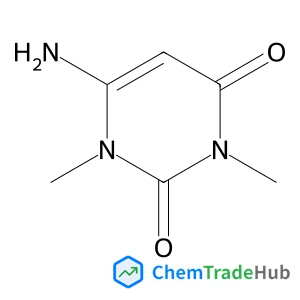
6-amino-1,3-dimethyl-1,2,3,4-tetrahydropyrimidine-2,4-dione
CAS Number:
6642-31-5
Molecular Formula:
C6H9N3O2
Ganesh Vasan, Andreas Erbe
The finite element method (FEM) was used to solve the time-harmonic Maxwell equations in a study of the effect of the incidence angle of infrared light on the surface enhancement caused by colloidal gold particles in attenuated total reflection surface enhanced infrared absorption spectroscopy (ATR-SEIRAS). The spectral enhancement factor was obtained from computations of absorbance from a thin organic layer in the presence and absence of the metal nanostructure. For computations of an isolated particle the enhancement factor is high around the critical angle and decreases with an increase in incidence angle. This trend was also observed in experiments performed with gold particles immobilised on a silane modified silicon ATR crystal. Computations where gold particles are touching each other show low enhancement factors around the critical angle and an increase with increasing incidence angle. These two opposing trends are analysed based on the electric field distribution around the particle.

Nature Medicine

Saudi Pharmaceutical Journal

Russian Journal of Applied Chemistry

Chemistry Education Research and Practice

Russian Journal of Coordination Chemistry

New Journal of Chemistry

Drug Discovery Today

Current Opinion in Colloid & Interface Science

Journal of Natural Medicines

Journal of Saudi Chemical Society
Soumen Das, Mrityunjoy Kar, Sayam Sen Gupta
DOI: 10.1039/C3PY00409K
Neha Yedala, Niket S. Kaisare
DOI: 10.1039/D1RE00382H
Ángeles López-Martín, Francisco Platero, Gerardo Colón, Alfonso Caballero
DOI: 10.1039/D1RE00044F
Harikrishna Erothu, Arun A. Sohdi, Anitha C. Kumar, Andrew J. Sutherland, Christine Dagron-Lartigau, Ahmed Allal, Roger C. Hiorns, Paul D. Topham
DOI: 10.1039/C3PY00505D
Mavila Sudheendran, Marta Horecha, Anton Kiriy, Suren A. Gevorgyan, Frederik C. Krebs
DOI: 10.1039/C2PY20774E
Merve İçli-Özkut, Halil İpek, Baris Karabay, Atilla Cihaner, Ahmet M. Önal
DOI: 10.1039/C3PY21061H
Yujuan Zhang, Chunhong Wang, Defeng Wu, Xintao Guo, Lei Yu, Ming Zhang
DOI: 10.1039/D1RE00154J
Francesca Greco, Inam Arif, Ruth Botting, Cristina Fante, Luigi Quintieri, Chiara Clementi, Oddone Schiavon, Gianfranco Pasut
DOI: 10.1039/C2PY20876H
Miriam González-Castaño, Bogdan Dorneanu, Harvey Arellano-García
DOI: 10.1039/D0RE00478B
Michael H. Allen, Jr., Sean T. Hemp, Musan Zhang, Mingqiang Zhang, Adam E. Smith, Robert B. Moore, Timothy E. Long
DOI: 10.1039/C3PY00043E
4-Nitrophenyl phosphate disodium salt hexahydrate is primarily used as a substra...
2-(Trifluoromethyl)-1,3-oxazole-4-carboxylic Acid (CAS: 1060816-01-4) is widely ...
2-Fluoro-4-biphenylcarboxylic acid should be stored in a cool, dry place at room...
Prednisolone-21-Carboxylic Acid is primarily used in the pharmaceutical industry...
4-(Hydrazinomethyl)-1,2,3-benzenetriol (CAS: 3614-72-0) should be stored in a co...
4-Amino-1-methyl-1H-pyrazole-5-carboxylic acid hydrochloride (CAS: 92534-70-8) i...
Dehydropachymic acid (CAS: 77012-31-8) is regulated by various agencies. It fall...
The market and research trends for 6-[(2,2-Dimethylpropanoyl)amino]nicotinic aci...
1,10-Phenanthroline-2,9-dicarbaldehyde should be stored in a cool, dry place awa...
5-Carbamoyl-11-oxo-10,11-dihydro-5H-dibenzo[b,f]azepin-10-yl acetate can be synt...

Physical Chemistry Chemical Physics (PCCP) is an international journal co-owned by 19 physical chemistry and physics societies from around the world. This journal publishes original, cutting-edge research in physical chemistry, chemical physics and biophysical chemistry. To be suitable for publication in PCCP, articles must include significant innovation and/or insight into physical chemistry; this is the most important criterion that reviewers and Editors will judge against when evaluating submissions. The journal has a broad scope and welcomes contributions spanning experiment, theory, computation and data science. Topical coverage includes spectroscopy, dynamics, kinetics, statistical mechanics, thermodynamics, electrochemistry, catalysis, surface science, quantum mechanics, quantum computing and machine learning. Interdisciplinary research areas such as polymers and soft matter, materials, nanoscience, energy, surfaces/interfaces, and biophysical chemistry are welcomed if they demonstrate significant innovation and/or insight into physical chemistry. Joined experimental/theoretical studies are particularly appreciated when complementary and based on up-to-date approaches.