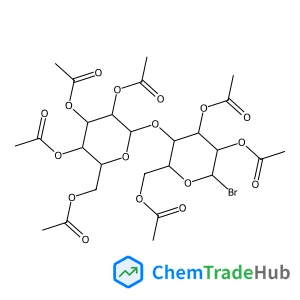
2,3,6-Tri-O-acetyl-4-O-(2,3,4,6-tetra-O-acetyl-beta-D-galactopyranosyl)-alpha-D-glucopyranosyl bromide
CAS Number:
4753-07-5
Molecular Formula:
C26H35BrO17
Marcella Bonchio, Mauro Carraro, Girolamo Casella, Valerio Causin, Federico Rastrelli, Giacomo Saielli
We report the synthesis and characterization of dimeric viologen salts (1′,1′′-(alkane-1,n-diyl)bis(1-ethyl-4,4′-bipyridinium) with n = 4–10) with bis(trifluoromethanesulfonyl)amide (bistriflimide, Tf2N−) as a counteranion. For n = 4, 5 and 6, and for the nonylviologen cation (1,1′-dinonyl-4,4′-bipyridinium) we also prepared salts with the totally inorganic dodecatungstosilicate anion, SiW12O404−, featuring a poly-charged surface and nanosized dimensions. The materials have been characterized by means of calorimetric techniques, X-ray diffraction and solid state NMR and a comparison is made with analogous monomeric viologen salts exhibiting smectic mesophases. A strong odd–even effect is observed in the melting points and in the thermal behaviour of the bistriflimide dimeric systems, similar to what was reported for dipolar calamitic liquid crystal dimers, although the studied viologen dimers are not mesomorphic. By increasing the size of the counteranion we have observed a destabilization of the crystal phases and of the mesophases in favour of a glassy amorphous state. Implications on the design of novel ionic liquid crystals are discussed. The electrochemical behaviour in solution has been investigated by cyclic voltammetry measurements: interestingly, the odd–even effect is clearly visible also in the redox potentials. The spin-pairing of the viologen radical cations formed at each end of the dimer is responsible for the observed redox trend. Insights on the structure of the spin-paired dimer have been obtained by DFT calculations.
Bing Hu, Juan-Juan Li, Yan-Bin Ren, Tian-Xing Zhang, Li-Bin Chen, Xiao-Liu Li, Ke-Rang Wang
DOI: 10.1039/D3TB02432F
Yi Yao, Xiaoxin Shi, Zihong Zhao, Afang Zhang, Wen Li
DOI: 10.1039/D3TB01803B
Zihan Ma, Lishuang Wang, Tingting Chen, Guangning Wang
DOI: 10.1039/D3NJ04883G
Jinzhe Li, Jianguo Zhou
DOI: 10.1039/D3NJ02733C
Ahmad Nuruddin, Muhammad Iqbal, Hutomo Suryo Wasisto
DOI: 10.1039/D3TB01327H
DOI: 10.1039/D3NJ04311H
Lili Wang, Yuyang Zhou, Haixiang Wang, Qiaoli Lu, Jinmei Wang, Dawei Gao
DOI: 10.1039/D3NJ04717B
Alexander S. Ovsyannikov, Aida I. Samigullina, Daut R. Islamov, Mikhail A. Cherosov, Ruslan G. Batulin, Airat G. Kiiamov, Aidar T. Gubaidullin, Pavel V. Dorovatovskii, Svetlana E. Solovieva, Igor S. Antipin
DOI: 10.1039/D3NJ04809H
6-(3-Fluorophenyl)picolinic acid is generally considered safe for laboratory use...
(3R)-3-Pyrrolidinol is used in the pharmaceutical industry as a precursor for dr...
When handling (4R,5R)-4,5-Diethoxycarbonyl-2,2-dimethyldioxolane (CAS: 59779-75-...
1-(6-Chloroimidazo[1,2-b]pyridazin-3-yl)ethanone is often synthesized via a mult...
The market for N-Ethyl-3,4-dimethylbenzylamine (CAS: 39180-83-1) remains steady,...
Tert-butyl 3-(pyrrolidin-1-yl)azetidine-1-carboxylate is a chemical compound wit...
1-Bromo-3-chloro-2,4-dimethoxybenzene (CAS: 1228956-93-1) falls under the classi...
The safety of 8-Bromo-2-methyl-3,4-dihydroisoquinolin-1(2H)-one (CAS: 1368622-07...
Benzyl [(3S)-2,6-dioxo-3-piperidinyl]carbamate is generally safe when handled wi...
1-{[4-(4,4,5,5-Tetramethyl-1,3,2-dioxaborolan-2-yl)phenyl]sulfonyl}pyrrolidine s...

Physical Chemistry Chemical Physics (PCCP) is an international journal co-owned by 19 physical chemistry and physics societies from around the world. This journal publishes original, cutting-edge research in physical chemistry, chemical physics and biophysical chemistry. To be suitable for publication in PCCP, articles must include significant innovation and/or insight into physical chemistry; this is the most important criterion that reviewers and Editors will judge against when evaluating submissions. The journal has a broad scope and welcomes contributions spanning experiment, theory, computation and data science. Topical coverage includes spectroscopy, dynamics, kinetics, statistical mechanics, thermodynamics, electrochemistry, catalysis, surface science, quantum mechanics, quantum computing and machine learning. Interdisciplinary research areas such as polymers and soft matter, materials, nanoscience, energy, surfaces/interfaces, and biophysical chemistry are welcomed if they demonstrate significant innovation and/or insight into physical chemistry. Joined experimental/theoretical studies are particularly appreciated when complementary and based on up-to-date approaches.
![[1-(5-Methyl-2-pyridinyl)-1H-pyrazol-4-yl]methanol structure](https://static.chemtradehub.com/structs/143/1439822-99-7-6cc9.webp "[1-(5-Methyl-2-pyridinyl)-1H-pyrazol-4-yl]methanol structure")