












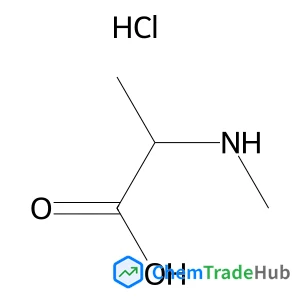
(R)-2-(Methylamino)propanoic acid hydrochloride
CAS Number:
1155878-14-0
Molecular Formula:
C4H10ClNO2
Kuldeep S. Panesar, Angel J. Perez Linde, Anthony J. Horsewill, Walter Köckenberger, John R. Owers-Bradley
Over the years, several strategies have been developed for generating highly polarized nuclear spin systems, including dynamic nuclear polarization, optical pumping, and methods exploiting parahydrogen. Here, we present an alternative strategy, using an enhanced ‘brute-force’ approach (i.e. exposure to low temperatures and high applied magnetic fields). The main problem with this approach is that it may take an excessively long time for the nuclear polarization to approach thermal equilibrium at low temperatures, since nuclear relaxation becomes exceedingly slow due to the loss of molecular motion. We show that low-field thermal mixing can alleviate the problem by increasing the rate at which slowly-relaxing nuclei reach equilibrium. More specifically, we show that polarization can be transferred from a relatively rapidly relaxing 1H reservoir to more slowly relaxing 13C and 31P nuclei. The effects are particularly dramatic for the 31P nuclei, which in experiments at a temperature of 4.2 K and a field of 2 T show a 75-fold enhancement in their effective rate of approach to equilibrium, and an even greater (150-fold) enhancement in the presence of a relaxation agent. The mixing step is also very effective in terms of the amount of polarization transferred—70–90% of the maximum theoretical value in the experiments reported here. These findings have important implications for brute-force polarization, for the problem becomes one of how to relax the solvent protons rather than individual more slowly-relaxing nuclei of interest. This should be a much more tractable proposition, and offers the additional attraction that a wide range of nuclear species can be polarized simultaneously. We further show that the 1H reservoir can be tapped repeatedly through a number of consecutive thermal mixing steps, and that this could provide additional sensitivity enhancement in solid-state NMR.
Anthony C. Jacko, Benjamin J. Powell
DOI: 10.1039/D0CP05999D
DOI: 10.1039/D1CP00202C
Nicolás Ramos-Berdullas, Sara Gil-Guerrero, Ángeles Peña-Gallego, Marcos Mandado
DOI: 10.1039/D0CP06321E
Kai Huang, Xiaohang Huang, Jun Nogami
DOI: 10.1039/D0CP06353C
DOI: 10.1039/D0CP05617K
Ziliang Zhu, Aijie Zhang, Di He, Wentao Li
DOI: 10.1039/D0CP06335E
Yaolong Zhang, Hua Guo, Bin Jiang
DOI: 10.1039/D0CP06535H
Takashi Iwahashi, Tatsuya Ishiyama, Yasunari Sakai, Doseok Kim, Yukio Ouchi
DOI: 10.1039/D1CP00171J
John M. Seddon, Yuval Elani
DOI: 10.1039/D0CP06226J
6-(3-Fluorophenyl)picolinic acid is generally considered safe for laboratory use...
(3R)-3-Pyrrolidinol is used in the pharmaceutical industry as a precursor for dr...
When handling (4R,5R)-4,5-Diethoxycarbonyl-2,2-dimethyldioxolane (CAS: 59779-75-...
1-(6-Chloroimidazo[1,2-b]pyridazin-3-yl)ethanone is often synthesized via a mult...
The market for N-Ethyl-3,4-dimethylbenzylamine (CAS: 39180-83-1) remains steady,...
Tert-butyl 3-(pyrrolidin-1-yl)azetidine-1-carboxylate is a chemical compound wit...
1-Bromo-3-chloro-2,4-dimethoxybenzene (CAS: 1228956-93-1) falls under the classi...
The safety of 8-Bromo-2-methyl-3,4-dihydroisoquinolin-1(2H)-one (CAS: 1368622-07...
Benzyl [(3S)-2,6-dioxo-3-piperidinyl]carbamate is generally safe when handled wi...
1-{[4-(4,4,5,5-Tetramethyl-1,3,2-dioxaborolan-2-yl)phenyl]sulfonyl}pyrrolidine s...

Physical Chemistry Chemical Physics (PCCP) is an international journal co-owned by 19 physical chemistry and physics societies from around the world. This journal publishes original, cutting-edge research in physical chemistry, chemical physics and biophysical chemistry. To be suitable for publication in PCCP, articles must include significant innovation and/or insight into physical chemistry; this is the most important criterion that reviewers and Editors will judge against when evaluating submissions. The journal has a broad scope and welcomes contributions spanning experiment, theory, computation and data science. Topical coverage includes spectroscopy, dynamics, kinetics, statistical mechanics, thermodynamics, electrochemistry, catalysis, surface science, quantum mechanics, quantum computing and machine learning. Interdisciplinary research areas such as polymers and soft matter, materials, nanoscience, energy, surfaces/interfaces, and biophysical chemistry are welcomed if they demonstrate significant innovation and/or insight into physical chemistry. Joined experimental/theoretical studies are particularly appreciated when complementary and based on up-to-date approaches.

![Benzyl spiro[indole-3,4'-piperidine]-1(2H)-carboxylate hydrochloride (1:1) structure](https://static.chemtradehub.com/structs/159/159635-46-8-8de0.webp "Benzyl spiro[indole-3,4'-piperidine]-1(2H)-carboxylate hydrochloride (1:1) structure")




