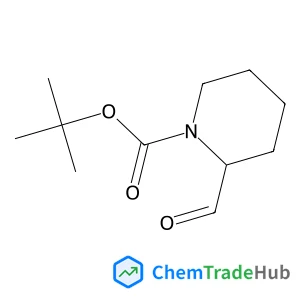
2-Methyl-2-propanyl (2R)-2-formyl-1-piperidinecarboxylate
CAS Number:
134526-69-5
Molecular Formula:
C11H19NO3
Karol J. Fijalkowski, Rafał Jurczakowski, Wiktor Koźmiński
We report the first solid-state impedance study of hydrogen-rich ammonia borane, AB, and its three alkali metal amidoborane derivatives. Temperature-dependent impedance spectra of solid M(NH2BH3) salts are predominated by ionic conductivity, which at room temperature ranges from 5.5 μS cm−1 (M = Li) to 2.2–3.0 mS cm−1 (Na, Na0.5Li0.5), while the activation energy for conductivity is rather high (140–158 kJ mol−1). Variation of conductivity with time can be used to extract information about the evolution of the system during thermal decomposition. By using a combination of impedance spectroscopy, thermogravimetric analysis, scanning calorimetry, evolved gas analysis, infrared absorption spectroscopy as well as 11B and 1H MAS NMR, we were able to reconfirm the complex pathway of thermal decomposition of amidoboranes postulated by two of us earlier (J. Mater. Chem. 2009, 19, 2043).
Chris R. Miller, Robert Vogel, Peter P. T. Surawski, Simon R. Corrie, Andreas Rühmann, Matt Trau
DOI: 10.1039/B509503D
Hao Xu, Tyler B. Norsten, Oktay Uzun, Eunhee Jeoung, Vincent M. Rotello
DOI: 10.1039/B509572G
Leong Ming Gan, Pei Yong Chow, Zhaolin Liu, Ming Han, Chai Hoon Quek
DOI: 10.1039/B508035E
Sanjib Bhattacharyya, Jean-Paul Salvetat, Romain Fleurier, Anke Husmann, Thomas Cacciaguerra, Marie-Louise Saboungi
DOI: 10.1039/B509026A
Juan Qiao, Li. D. Wang, Jun. F. Xie, Gang. T. Lei, Guo. S. Wu, Yong Qiu
DOI: 10.1039/B506907F
Kazuhisa Fujimoto, Yu Muto
DOI: 10.1039/B508189K
José M. Fraile, José I. García, Clara I. Herrerías, José A. Mayoral
DOI: 10.1039/B507739G
Goverdhan Mehta, Kotapalli Pallavi, Jayant D. Umarye
DOI: 10.1039/B506931A
Petr Sazama, Blanka Wichterlová
DOI: 10.1039/B507553J
Natalia Chebotareva, Paul H. H. Bomans, Peter M. Frederik, Nico A. J. M. Sommerdijk, Rint P. Sijbesma
DOI: 10.1039/B507171B
6-(3-Fluorophenyl)picolinic acid is generally considered safe for laboratory use...
(3R)-3-Pyrrolidinol is used in the pharmaceutical industry as a precursor for dr...
When handling (4R,5R)-4,5-Diethoxycarbonyl-2,2-dimethyldioxolane (CAS: 59779-75-...
1-(6-Chloroimidazo[1,2-b]pyridazin-3-yl)ethanone is often synthesized via a mult...
The market for N-Ethyl-3,4-dimethylbenzylamine (CAS: 39180-83-1) remains steady,...
Tert-butyl 3-(pyrrolidin-1-yl)azetidine-1-carboxylate is a chemical compound wit...
1-Bromo-3-chloro-2,4-dimethoxybenzene (CAS: 1228956-93-1) falls under the classi...
The safety of 8-Bromo-2-methyl-3,4-dihydroisoquinolin-1(2H)-one (CAS: 1368622-07...
Benzyl [(3S)-2,6-dioxo-3-piperidinyl]carbamate is generally safe when handled wi...
1-{[4-(4,4,5,5-Tetramethyl-1,3,2-dioxaborolan-2-yl)phenyl]sulfonyl}pyrrolidine s...

Physical Chemistry Chemical Physics (PCCP) is an international journal co-owned by 19 physical chemistry and physics societies from around the world. This journal publishes original, cutting-edge research in physical chemistry, chemical physics and biophysical chemistry. To be suitable for publication in PCCP, articles must include significant innovation and/or insight into physical chemistry; this is the most important criterion that reviewers and Editors will judge against when evaluating submissions. The journal has a broad scope and welcomes contributions spanning experiment, theory, computation and data science. Topical coverage includes spectroscopy, dynamics, kinetics, statistical mechanics, thermodynamics, electrochemistry, catalysis, surface science, quantum mechanics, quantum computing and machine learning. Interdisciplinary research areas such as polymers and soft matter, materials, nanoscience, energy, surfaces/interfaces, and biophysical chemistry are welcomed if they demonstrate significant innovation and/or insight into physical chemistry. Joined experimental/theoretical studies are particularly appreciated when complementary and based on up-to-date approaches.