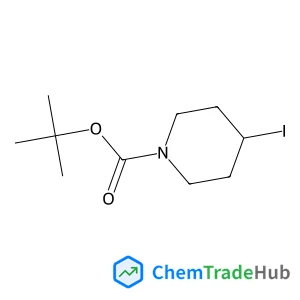
2-Methyl-2-propanyl 4-iodo-1-piperidinecarboxylate
CAS Number:
301673-14-3
Molecular Formula:
C10H18INO2
Quanlong Li, Xin He, Yongliang Cui, Pengfei Shi, Shentong Li, Wangqing Zhang
A new strategy to prepare doubly thermo-responsive nanoparticles constructed with the two diblock copolymers poly(N-isopropylacrylamide)-block-polystyrene (PNIPAM-b-PS) and poly[N,N-(dimethylamino) ethyl methacrylate]-block-polystyrene (PDMAEMA-b-PS) through the two macro-RAFT agents co-mediated dispersion polymerization is proposed. In this two macro-RAFT agents co-mediated dispersion polymerization, two macro-RAFT agents are simultaneously adopted, and the two in situ synthesized diblock copolymers PNIPAM-b-PS and PDMAEMA-b-PS co-assemble into nanoparticles containing a PNIPAM/PDMAEMA mixed corona and a common PS core. It is found that the molecular weight of PNIPAM-b-PS and PDMAEMA-b-PS in the mixed corona–core nanoparticles increases with the monomer conversion, and the size of the mixed corona–core nanoparticles increases with the PS block extension during the two macro-RAFT agents co-mediated dispersion polymerization. In water, the mixed corona–core nanoparticles exhibit two separate phase transition temperatures of 44 °C and 56 °C, corresponding to the PNIPAM and PDMAEMA blocks, respectively, which is confirmed by turbidity analysis, 1H NMR analysis and TEM observation. Our strategy named the two macro-RAFT agents co-mediated dispersion polymerization is believed to be a valid method to prepare multi-thermo-responsive nano-objects constructed with two or more than two thermo-responsive diblock copolymers.
Ryan Zowada, Reza Foudazi
DOI: 10.1039/D3LP00117B
Ke Zhang, Bin Li
DOI: 10.1039/D3EY00208J
Thomas Freese, Jelmer T. Meijer, Maria B. Brands, Georgios Alachouzos, Marc C. A. Stuart, Rafael Tarozo, Dominic Gerlach, Joost Smits, Petra Rudolf, Joost N. H. Reek, Ben L. Feringa
DOI: 10.1039/D3EY00256J
Sun Hwa Park, Ki Chang Kwon, Jong Hun Kang, Min Sang Kwon
DOI: 10.1039/D3EY00165B
Waste containing (6-Bromo-2-naphthyl)oxy](dimethyl)(2-methyl-2-propanyl)silane (...
7-Fluoro-4-isoquinolinecarboxylic acid can be synthesized via a multi-step proce...
2,3,5,6-Tetrabromothieno[3,2-b]thiophene is a crystalline compound with a high m...
1-[4-(Benzylamino)-7,8-dihydro-5H-pyrano[4,3-d]pyrimidin-2-yl]-2-methyl-1H-indol...
The market for imidazo[5,1-d]-1,2,3,5-tetrazine-8-carboxylic acid, 3,4-dihydro-3...
3-(Triisopropylsilyl)propiolaldehyde is a synthetic organic compound with the CA...
6-Nitro-2H-1,4-benzoxazin-3(4H)-one (CAS: 81721-87-1) is subject to various regu...
Waste containing (3-Fluorophenyl)(4-{[(2-methyl-2-propanyl)oxy]carbonyl}-1-piper...
N,N'-4,4'-Biphenyldiyldiisonicotinamide is a white crystalline solid with a mole...
6-Bromo-8-fluoro-2-quinazolinol is primarily used in the pharmaceutical industry...

Polymer Chemistry welcomes submissions in all areas of polymer science that have a strong focus on macromolecular chemistry. Manuscripts may cover a broad range of fields, yet no direct application focus is required.
![N-[(E)-Phenylmethylene]benzenesulfonamide structure](https://static.chemtradehub.com/structs/139/13909-34-7-8167.webp "N-[(E)-Phenylmethylene]benzenesulfonamide structure")