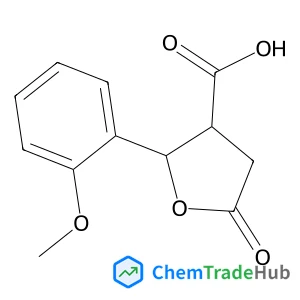
trans-2-(2-Methoxyphenyl)-5-oxotetrahydrofuran-3-carboxylic acid
CAS Number:
99226-02-5
Molecular Formula:
C12H12O5
Jamie M. Messman, Deanna L. Pickel, Monojoy Goswami, David W. Uhrig
Chain-end functionalization of living poly(styryl)lithium using 1-(3-bromopropyl)-2,2,5,5-tetramethyl-1-aza-2,5-disilacyclo-pentane (BTDP) to generate primary amine end-functionalized polystyrene was investigated using high vacuum anionic polymerization techniques. 13C NMR spectroscopy and Matrix Assisted Laser Desorption Ionization Time-of-Flight Mass Spectrometry (MALDI-TOF MS) were used to evaluate polymer end-groups and demonstrated that quantitative amine functionalized polymer was attained under appropriate reaction conditions. In general, the polymerization of styrene was conducted in benzene and the end-capping reaction was performed by adding tetrahydrofuran (THF) to the reaction prior to the addition of BTDP in THF at room temperature. Results indicated that approximately 20% THF by volume is required to obtain 100% end-capping free from side reactions. When too little or no THF was present, side reactions such as lithium halogen exchange followed by Wurtz coupling resulted in unfunctionalized head-to-head dimer as well as other byproducts. Modeling and simulation of the solvent effects using hybrid methods (the so-called QM/MM method) suggest that THF effectively dissociated the anionic chain-end aggregation, thereby resulting in the desired primary amine functionalized polymer. Molecular dynamics (MD) simulations were conducted to develop an understanding of the physics of counterions involved in the end-functionalization process.
Anirban Mondal, Anurag Prakash Sunda, Sundaram Balasubramanian
DOI: 10.1039/C5CP05701A
Yong Seok Hwang, Valery I. Levitas
DOI: 10.1039/C5CP04443J
Ya-Nan Yu, Shi-Yu Lu, Shu-Juan Bao, Qiang-Qiang Sun, Sheng-Hui Liao
DOI: 10.1039/C5CP05790F
Talal M. Althagafi, Saud A. Algarni, Abdullah Al Naim, Javed Mazher, Martin Grell
DOI: 10.1039/C5CP03326H
F. Pedraza, S. A. Mahadik, B. Bouchaud
DOI: 10.1039/C5CP04723D
Arnar Hafliðason, Huasheng Wang, Ágúst Kvaran
DOI: 10.1039/C5CP06097D
Benjamin J. Bergner, Christine Hofmann, Adrian Schürmann, Daniel Schröder, Klaus Peppler, Peter R. Schreiner, Jürgen Janek
DOI: 10.1039/C5CP04505C
Yuanhui Sun, Guangtao Yu, Jingwei Liu, Xiaopeng Shen, Xuri Huang, Wei Chen
DOI: 10.1039/C5CP06069A
I. M. Magin, N. E. Polyakov, A. I. Kruppa, T. V. Leshina, M. A. Miranda, E. Nuin, M. L. Marin
DOI: 10.1039/C5CP04233J
Anne Knorr, Koichi Fumino, Anne-Marie Bonsa
DOI: 10.1039/C5CP03412D
3-Fluoro-2-methylbenzylamine is an organic compound with the CAS number 771573-3...
Tert-butyl 2-(oxetan-3-ylidene)acetate is considered safe for its intended uses ...
Proper personal protective equipment (PPE) such as gloves, goggles, and a lab co...
2-Ethyl-4-methyl-1,3-thiazole is commonly synthesized via the reaction of thiour...
This compound should be stored in a cool, dry place away from direct sunlight an...
L-Lysine Acetate Salt (CAS: 52315-92-1) is subject to various regulatory guideli...
6-Fluoro-3-hydroxy-2-pyrazinecarboxamide (CAS: 259793-96-9) is generally conside...
1,1'-Sulfonylbis(1H-imidazole) is a crystalline solid with a molecular weight of...
4-Methyl-7-nitro-1H-indole-3-carbonitrile (CAS: 289483-82-5) is primarily used i...
Waste containing 5-Bromo-3-indolyl-beta-galactoside (CAS: 97753-82-7) should be ...

Polymer Chemistry welcomes submissions in all areas of polymer science that have a strong focus on macromolecular chemistry. Manuscripts may cover a broad range of fields, yet no direct application focus is required.