


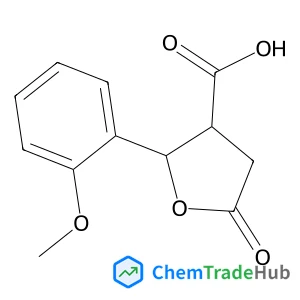
trans-2-(2-Methoxyphenyl)-5-oxotetrahydrofuran-3-carboxylic acid
CAS Number:
99226-02-5
Molecular Formula:
C12H12O5
Mathurin Grogna, Rudi Cloots, André Luxen, Christine Jérôme, Catherine Passirani, Nolwenn Lautram, Jean-F. Desreux, Mike Collodoro, Marie-Claire De Pauw-Gillet, Christophe Detrembleur
Stealth macromolecular platforms bearing alkyne groups and poly(ethylene oxide) brushes were synthesized by reversible addition fragmentation chain transfer (RAFT) polymerization. The anchoring of Gd3+-chelates bearing an azide group was then carried out by the Huisgen 1,3-dipolar cycloaddition (“click”) reaction in mild conditions, leading to macrocontrast agents for MRI applications. The gadolinium complex is hidden in the PEO shell that renders the macrocontrast agents free of any cytotoxicity and stealth to proteins of the immune system. Relaxometry measurements have evidenced an improved relaxivity of the macrocontrast agent compared to ungrafted gadolinium chelate. Moreover, this relaxivity is further enhanced when the spacer length between the Gd3+-chelate and the polymer backbone is shorter, as the result of its decreased tumbling rate. These novel products are therefore promising candidates for MRI applications.

Saudi Pharmaceutical Journal

Russian Journal of Bioorganic Chemistry

Russian Journal of Organic Chemistry

Russian Chemical Bulletin

Current Opinion in Solid State & Materials Science

Journal of Peptide Science

Russian Journal of Applied Chemistry

Chemical Communications

New Journal of Chemistry

Acta Materialia
Gaojian Chen, Martina H. Stenzel
DOI: 10.1039/C1PY00048A
Xuemin Lu, Sufang Xiao, Xumeng Chen, Qinghua Lu
DOI: 10.1039/C1PY00236H
Yisi Guan, Hongting Pu, Decheng Wan
DOI: 10.1039/C0PY00242A
Ken Okamoto, Christine K. Luscombe
DOI: 10.1039/C1PY00171J
Johan P. A. Heuts, Niels M. B. Smeets
DOI: 10.1039/C1PY00224D
Eun Hee Min, Kok Hou Wong, Eki Setijadi, François Ladouceur, Mark Straton, Alexander Argyros
DOI: 10.1039/C1PY00056J
Jaewon Choi, So Yeon Park, Hye Yun Yang, Hae Jin Kim, Kyuwook Ihm, Jeong Ho Nam, Joung Real Ahn, Seung Uk Son
DOI: 10.1039/C1PY00260K
Mathurin Grogna, Rudi Cloots, André Luxen, Christine Jérôme, Catherine Passirani, Nolwenn Lautram, Jean-F. Desreux, Mike Collodoro, Marie-Claire De Pauw-Gillet, Christophe Detrembleur
DOI: 10.1039/C1PY00198A
Natasha A. Birkin, Nicholas J. Arrowsmith, Eun Ju Park, Alexandre P. Richez, Steven M. Howdle
DOI: 10.1039/C1PY00062D
3-Fluoro-2-methylbenzylamine is an organic compound with the CAS number 771573-3...
Tert-butyl 2-(oxetan-3-ylidene)acetate is considered safe for its intended uses ...
Proper personal protective equipment (PPE) such as gloves, goggles, and a lab co...
2-Ethyl-4-methyl-1,3-thiazole is commonly synthesized via the reaction of thiour...
This compound should be stored in a cool, dry place away from direct sunlight an...
L-Lysine Acetate Salt (CAS: 52315-92-1) is subject to various regulatory guideli...
6-Fluoro-3-hydroxy-2-pyrazinecarboxamide (CAS: 259793-96-9) is generally conside...
1,1'-Sulfonylbis(1H-imidazole) is a crystalline solid with a molecular weight of...
4-Methyl-7-nitro-1H-indole-3-carbonitrile (CAS: 289483-82-5) is primarily used i...
Waste containing 5-Bromo-3-indolyl-beta-galactoside (CAS: 97753-82-7) should be ...

Polymer Chemistry welcomes submissions in all areas of polymer science that have a strong focus on macromolecular chemistry. Manuscripts may cover a broad range of fields, yet no direct application focus is required.
![Benzyl spiro[indole-3,4'-piperidine]-1(2H)-carboxylate hydrochloride (1:1) structure](https://static.chemtradehub.com/structs/159/159635-46-8-8de0.webp "Benzyl spiro[indole-3,4'-piperidine]-1(2H)-carboxylate hydrochloride (1:1) structure")
![2-Methyl-2-propanyl [(2S)-1-hydroxy-3-(4-hydroxyphenyl)-2-propanyl]carbamate structure](https://static.chemtradehub.com/structs/833/83345-46-4-eec2.webp "2-Methyl-2-propanyl [(2S)-1-hydroxy-3-(4-hydroxyphenyl)-2-propanyl]carbamate structure")




