












N3-Alkylation during formation of quinazolin-4-ones from condensation of anthranilamides and orthoamides
Literature Information
Publication Date
2011-05-26
DOI
10.1039/C1OB05430A
Impact Factor
3.876
Authors
Amit Nathubhai, Richard Patterson, Timothy J. Woodman, Miranda T. Y. Chui, Hugo H. K. Chung, Stephanie W. S. Lau, Jun Zheng, Matthew D. Lloyd, Andrew S. Thompson, Michael D. Threadgill
View Original
Abstract
Dimethylformamide dimethylacetal (DMFDMA) is widely used as a source of electrophilic one-carbon units at the formate oxidation level; however, electrophilic methylation with this reagent is previously unreported. Reaction of anthranilamide with DMFDMA at 150 °C for short periods gives mainly quinazolin-4-one. However, prolonged reaction with dimethylformamide di(primary-alkyl)acetals leads to subsequent alkylation at N3. 3-Substituted anthranilamides give 8-substituted 3-alkylquinazolin-4-ones. Condensation of anthranilamides with dimethylacetamide dimethylacetal provides 2,3-dimethylquinazolin-4-ones. In these reactions, the source of the N3-alkyl group is the O-alkyl group of the orthoamides. By contrast, reaction with the more sterically crowded dimethylformamide di(isopropyl)acetal diverts the alkylation to the oxygen, giving 4-isopropoxyquinazolines, along with N3-methylquinazolin-4-ones where the methyl is derived from N-Me of the orthoamides. Reaction of anthranilamide with the highly sterically demanding dimethylformamide di(t-butyl)acetal gives largely quinazolin-4-one, whereas dimethylformamide di(neopentyl)acetal forms a mixture of quinazolin-4-one and N3-methylquinazolin-4-one. The observations are rationalised in terms of formation of intermediate cationic electrophiles (alkoxymethylidene-N,N-dimethylammonium) by thermal elimination of the corresponding alkoxide from the orthoamides. These are the first observations of orthoamides as direct alkylating agents.
Related Literature
Multifunctional CuxS- and DOX-loaded AuNR@mSiO2 platform for combined melanoma therapy with inspired antitumor immunity
Yamin Zhang, Biling Jiang, Chen Guo, Liping Liu, Jian Xu, Yujue Wang, Chen Shen, Jinjin Zhu, Guanxin Shen, Hao Jiang, Jintao Zhu, Juan Tao
2021-04-19
Paper
DOI: 10.1039/D1BM00373A
Quantitative UPLC-MS/MS analysis of the gut microbial co-metabolites phenylacetylglutamine, 4-cresyl sulphate and hippurate in human urine: INTERMAP Study
Philip A. Clarke, Magda Bictash, Ian J. Brown, Mark Fidock, Thomas Ryckmans, Queenie Chan, Jeremiah Stamler
2011-10-19
Paper
DOI: 10.1039/C1AY05427A
Selective Fischer–Tropsch synthesis for jet fuel production over Y3+ modified Co/H-β catalysts
Meng Yang, Lingjun Zhu, Yexin Zhuo, Jiacheng Liang, Shurong Wang
2020-05-04
Paper
DOI: 10.1039/D0SE00468E
Effects of cation size and concentration of cationic chlorides on the properties of formamidinium lead iodide based perovskite solar cells
Minjin Kim, Tae Kyung Lee, In Woo Choi, Hye Won Choi, Yimhyun Jo, Jiyun Lee, Gi-Hwan Kim, Sang Kyu Kwak, Dong Suk Kim
2020-05-13
Paper
DOI: 10.1039/D0SE00382D
Morphology oriented CuS nanostructures: superior K-ion storage using surface enhanced pseudocapacitive effects
Chandrasekaran Nithya, Gowtham Thiyagaraj
2020-04-28
Paper
DOI: 10.1039/D0SE00469C
Hyperbranched PEG-based supramolecular nanoparticles for acid-responsive targeted drug delivery
Xiaofei Chen, Xuemei Yao, Chunran Wang, Li Chen, Xuesi Chen
2015-05-13
Paper
DOI: 10.1039/C5BM00061K
You might also like
Compound Q&A
What industries use (1R,3S)-1,3-Cyclopentanediol (CAS: 16326-97-9)?
(1R,3S)-1,3-Cyclopentanediol finds applications in various industries. In the ph...
16326-97-9(1R,3S)-1,3-Cyclopen...
Compound Q&A
What precautions should be taken when handling N'-[4-(Dimethylamino)phenyl]-N,N-dimethyl-1,4-benzenediamine (CAS: 637-31-0)?
When handling N'-[4-(Dimethylamino)phenyl]-N,N-dimethyl-1,4-benzenediamine, it i...
637-31-0N'-[4-(Dimethylamino...
Compound Q&A
Are there alternatives to 5-(2,4-Difluorophenyl)-2-methoxypyrimidine (CAS: 1352318-16-1) in synthesis?
There are several alternatives to 5-(2,4-Difluorophenyl)-2-methoxypyrimidine in ...
1352318-16-15-(2,4-Difluoropheny...
Compound Q&A
What regulatory guidelines apply to 1-(3-Methoxyphenoxy)propan-2-ol (CAS: 382141-68-6)?
1-(3-Methoxyphenoxy)propan-2-ol (CAS: 382141-68-6) must comply with the Globally...
382141-68-61-(3-Methoxyphenoxy)...
Compound Q&A
Is Tetrodotoxin Citrate (CAS: 18660-81-6) safe?
Tetrodotoxin Citrate is extremely dangerous and should be handled with extreme c...
18660-81-6Tetrodotoxin Citrate
Compound Q&A
What are the main uses of 2-Methyl-2-propanyl [(1R,3S)-3-hydroxycyclopentyl]carbamate (CAS: 225641-84-9)?
2-Methyl-2-propanyl [(1R,3S)-3-hydroxycyclopentyl]carbamate (CAS: 225641-84-9) i...
225641-84-92-Methyl-2-propanyl ...
Compound Q&A
How should waste containing 4-(2-Hydroxyhexafluoroisopropyl)Benzoic Acid (CAS: 16261-80-6) be handled?
Waste containing 4-(2-Hydroxyhexafluoroisopropyl)Benzoic Acid (CAS: 16261-80-6) ...
16261-80-64-(2-Hydroxyhexafluo...
Compound Q&A
How is 2-Methyl-2-proanyl {(2S)-1-[(benzyloxy)amino]-3-hydroxy-3-methyl-1-oxo-2-butanyl}carbamate (CAS: 102507-19-7) typically synthesized?
2-Methyl-2-proanyl {(2S)-1-[(benzyloxy)amino]-3-hydroxy-3-methyl-1-oxo-2-butanyl...
102507-19-72-Methyl-2-propanyl ...
Compound Q&A
What is Benzeneethanamine, α-ethyl-, hydrochloride (1:1) (CAS: 20735-15-3)?
Benzeneethanamine, α-ethyl-, hydrochloride (1:1) is an organic compound with the...
20735-15-3Benzeneethanamine, α...
Compound Q&A
Are there alternatives to 3-{(E)-[4-(Dimethylamino)phenyl]diazenyl}benzoic acid (CAS: 20691-84-3) in synthesis?
In the synthesis of compounds similar to 3-{(E)-[4-(Dimethylamino)phenyl]diazeny...
20691-84-33-{(E)-[4-(Dimethyla...
Source Journal
Organic & Biomolecular Chemistry

CiteScore:
3.4
Self-citation Rate:
10.3%
Articles per Year:
1041
Organic & Biomolecular Chemistry (OBC) publishes original and high impact research and reviews in organic chemistry. We welcome research that shows new or significantly improved protocols or methodologies in total synthesis, synthetic methodology or physical and theoretical organic chemistry as well as research that shows a significant advance in the organic chemistry or molecular design aspects of chemical biology, catalysis, supramolecular and macromolecular chemistry, theoretical chemistry, mechanism-oriented physical organic chemistry, medicinal chemistry or natural products. Articles published in the journal should report new work which makes a highly-significant impact in the field. Routine and incremental work is generally not suitable for publication in the journal. More details about key areas of our scope are below. In all cases authors should include in their article clear rationale for why their research has been carried out.
Recommended Compounds
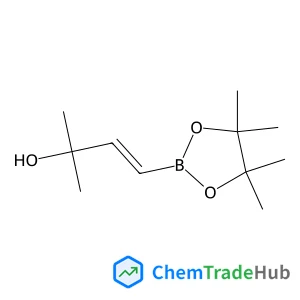
(E)-2-methyl-4-(4,4,5,5-tetramethyl-1,3,2-dioxaborolan-2-yl)but-3-en-2-ol
CAS Number:
581802-26-8
Molecular Formula:
C11H21BO3
![(2S)-2-{[(9H-Fluoren-9-ylmethoxy)carbonyl]amino}-4-(methylselanyl)butanoic acid structure](https://static.chemtradehub.com/structs/121/1217852-49-7-f252.webp "(2S)-2-{[(9H-Fluoren-9-ylmethoxy)carbonyl]amino}-4-(methylselanyl)butanoic acid structure")
(2S)-2-{[(9H-Fluoren-9-ylmethoxy)carbonyl]amino}-4-(methylselanyl)butanoic acid
CAS Number:
1217852-49-7
Molecular Formula:
C20H21NO4Se
Recommended Suppliers





Disclaimer
This page provides academic journal information for reference and research purposes only. We are not affiliated with any journal publishers and do not handle publication submissions. For publication-related inquiries, please contact the respective journal publishers directly.
If you notice any inaccuracies in the information displayed, please contact us at support@chemtradehub.com. We will promptly review and address your concerns.