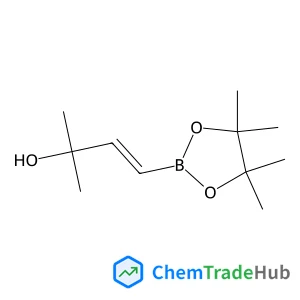
(E)-2-methyl-4-(4,4,5,5-tetramethyl-1,3,2-dioxaborolan-2-yl)but-3-en-2-ol
CAS Number:
581802-26-8
Molecular Formula:
C11H21BO3
Philip A. Clarke, Magda Bictash, Ian J. Brown, Mark Fidock, Thomas Ryckmans, Queenie Chan, Jeremiah Stamler
The role of the gut microbiome in human health, and non-invasive measurement of gut dysbiosis are of increasing clinical interest. New high-throughput methods are required for the rapid measurement of gut microbial metabolites and to establish reference ranges in human populations. We used ultra-performance liquid chromatography tandem mass spectrometry (UPLC-MS/MS) -- positive and negative electrospray ionization modes, multiple reaction monitoring transitions -- to simultaneously measure three urinary metabolites (phenylacetylglutamine, 4-cresyl sulphate and hippurate) that are potential biomarkers of gut function, among multi-ethnic US men and women aged 40–59 from the INTERMAP epidemiologic study (n = 2000, two timed 24-hr urine collections/person). Metabolite concentrations were quantified via stable isotope labeled internal standards. The assay was linear in the ranges 1ng mL−1 (lower limit of quantification) to 1000ng mL−1 (phenylacetylglutamine and 4-cresyl sulfate) and 3ng mL−1 to 3000ng mL−1 (hippurate). These quantitative data provide new urinary reference ranges for population-based human samples: mean (standard deviation) 24-hr urinary excretion for phenylacetylglutamine was: 1283.0 (751.7) μmol/24-hr (men), 1145.9 (635.5) μmol/24-hr (women); for 4-cresyl sulphate, 1002.5 (737.1) μmol/24-hr (men), 1031.8 (687.9) μmol/24-hr (women); for hippurate, 6284.6 (4008.1) μmol/24-hr (men), 4793.0 (3293.3) μmol/24-hr (women). Metabolic profiling by UPLC-MS/MS in a large sample of free-living individuals has provided new data on urinary reference ranges for three urinary microbial co-metabolites, and demonstrates the applicability of this approach to epidemiological investigations.
Huan-Huan Ding, Mu-Han Zhao, Le Zhai, Jian-Bin Zhen, Le-Yun Sun, Jia-Zhu Chigan, Cheng Chen, Jia-Qi Li, Han Gao, Ke-Wu Yang
DOI: 10.1039/D0PY01751E
Marcel Fickenscher, Tom Reimers, Holger Frey
DOI: 10.1039/D1PY00302J
Junle Zhang, Mengya Li, Yanjie He, Xiaomeng Zhang, Zhe Cui, Peng Fu, Minying Liu, Xiaoguang Qiao, Qingxiang Zhao, Xinchang Pang
DOI: 10.1039/D1PY00088H
Wei Wen
DOI: 10.1039/D1PY00223F
Fanfan Li, Yi Yu, Hanyu Lv, Guiting Cai, Yanwu Zhang
DOI: 10.1039/D0PY01643H
Georg M. Scheutz, Justine Elgoyhen, Kyle C. Bentz, Hao Sun, Junpeng Zhao, Daniel A. Savin, Brent S. Sumerlin
DOI: 10.1039/D1PY00780G
Anna P. Constantinou, Georgios Patias, Birsen Somuncuoğlu, Toby Brock, Daniel W. Lester, David M. Haddleton, Theoni K. Georgiou
DOI: 10.1039/D1PY00444A
Charlotte E. Ellis, Tomoya Fukui, Cristina Cordoba, Arthur Blackburn, Ian Manners
DOI: 10.1039/D1PY00571E
(1R,3S)-1,3-Cyclopentanediol finds applications in various industries. In the ph...
When handling N'-[4-(Dimethylamino)phenyl]-N,N-dimethyl-1,4-benzenediamine, it i...
There are several alternatives to 5-(2,4-Difluorophenyl)-2-methoxypyrimidine in ...
1-(3-Methoxyphenoxy)propan-2-ol (CAS: 382141-68-6) must comply with the Globally...
Tetrodotoxin Citrate is extremely dangerous and should be handled with extreme c...
2-Methyl-2-propanyl [(1R,3S)-3-hydroxycyclopentyl]carbamate (CAS: 225641-84-9) i...
Waste containing 4-(2-Hydroxyhexafluoroisopropyl)Benzoic Acid (CAS: 16261-80-6) ...
2-Methyl-2-proanyl {(2S)-1-[(benzyloxy)amino]-3-hydroxy-3-methyl-1-oxo-2-butanyl...
Benzeneethanamine, α-ethyl-, hydrochloride (1:1) is an organic compound with the...
In the synthesis of compounds similar to 3-{(E)-[4-(Dimethylamino)phenyl]diazeny...
Analytical Methods welcomes early applications of new analytical and bioanalytical methods and technology demonstrating the potential for societal impact. We require that methods and technology reported in the journal are sufficiently innovative, robust, accurate, and compared to other available methods for the intended application. Developments with interdisciplinary approaches are particularly welcome. Systems should be proven with suitably complex and analytically challenging samples. We encourage developments within, but not limited to, the following technologies and applications: global health, point-of-care and molecular diagnostics biosensors and bioengineering drug development and pharmaceutical analysis applied microfluidics and nanotechnology omics studies, such as proteomics, metabolomics or glycomics environmental, agricultural and food science neuroscience biochemical and clinical analysis forensic analysis industrial process and method development