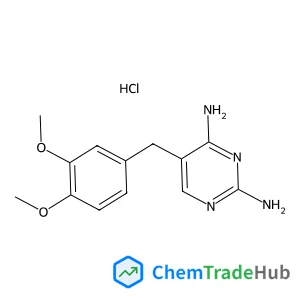
5-(3,4-Dimethoxybenzyl)-2,4-pyrimidinediamine hydrochloride (1:1)
CAS Number:
2507-23-5
Molecular Formula:
C13H17ClN4O2
Xiaofei Chen, Xuemei Yao, Chunran Wang, Li Chen, Xuesi Chen
Herein, hyperbranched poly(ethylene glycol)-based supramolecular nanoparticles with pH-sensitive properties were designed and used for targeted drug delivery. Via host–guest recognition between benzimidazole anchored poly(ethylene glycol)-hyperbranched polyglycerol (PEG-HPG-BM) and folic acid modified CD (FA-CD), targeted supramolecular nanoparticles (TSNs) were fabricated. At neutral aqueous conditions TSNs could load the model drug DOX. While under intracellular acidic conditions the loaded-drug would be released due to the protonation of BM. This protonation allowed the supramolecular nanoparticles to expand or even disassemble, which showes the pH-dependent property. The introduction of the active targeting FA molecule and the specific interactions with the receptor of HeLa cells means that DOX-loaded TSNs show a significantly improved anticancer efficacy. In vitro drug release assays and intracellular experiments confirmed that TSNs had an obvious pH-sensitive property and remarkably improved anticancer effects, which hold great potential for further biomedical applications such as anticancer drug delivery.
Yusuke Ishii, Yoshiei Soeda, Yuji Kubo
DOI: 10.1039/B703670A
Ayman Karam, Yanlong Gu, François Jérôme, Jean-Paul Douliez, Joël Barrault
DOI: 10.1039/B702997G
Kil Suk Kim, Su Bum Noh, Takayuki Katsuda, Shuji Ito, Atsuhiro Osuka, Dongho Kim
DOI: 10.1039/B704986B
Hui-suk Yun, Seung-eon Kim, Yong-teak Hyeon
DOI: 10.1039/B702103H
Su-Na Wang, Hang Xing, Yi-Zhi Li, Junfeng Bai, Manfred Scheer, Yi Pan, Xiao-Zeng You
DOI: 10.1039/B701186E
Ashok K. Prasad, Yogesh Yadav, Rajesh Kumar, Sunil K. Sharma, Shamkant Patkar, Lene Lange, Jesper Wengel, Virinder S. Parmar
DOI: 10.1039/B618426J
Claudia Höbartner, P. I. Pradeepkumar, Scott K. Silverman
DOI: 10.1039/B704507G
Hiroshi Tsukube, Yukiko Suzuki, Dharam Paul, Yumiko Kataoka, Satoshi Shinoda
DOI: 10.1039/B618847H
Harriet Teare, Edward G. Robins, Erik Årstad, Sajinder K. Luthra, Véronique Gouverneur
DOI: 10.1039/B701177F
(1R,3S)-1,3-Cyclopentanediol finds applications in various industries. In the ph...
When handling N'-[4-(Dimethylamino)phenyl]-N,N-dimethyl-1,4-benzenediamine, it i...
There are several alternatives to 5-(2,4-Difluorophenyl)-2-methoxypyrimidine in ...
1-(3-Methoxyphenoxy)propan-2-ol (CAS: 382141-68-6) must comply with the Globally...
Tetrodotoxin Citrate is extremely dangerous and should be handled with extreme c...
2-Methyl-2-propanyl [(1R,3S)-3-hydroxycyclopentyl]carbamate (CAS: 225641-84-9) i...
Waste containing 4-(2-Hydroxyhexafluoroisopropyl)Benzoic Acid (CAS: 16261-80-6) ...
2-Methyl-2-proanyl {(2S)-1-[(benzyloxy)amino]-3-hydroxy-3-methyl-1-oxo-2-butanyl...
Benzeneethanamine, α-ethyl-, hydrochloride (1:1) is an organic compound with the...
In the synthesis of compounds similar to 3-{(E)-[4-(Dimethylamino)phenyl]diazeny...
Biomaterials Science is an international high impact journal exploring the science of biomaterials and their translation towards clinical use. Its scope encompasses new concepts in biomaterials design, studies into the interaction of biomaterials with the body, and the use of materials to answer fundamental biological questions. Papers do not necessarily need to report a new biomaterial but should provide novel insight into the biological applications of the biomaterial. Articles that primarily focus on demonstrating novel materials chemistry and bring a molecular picture to bear on a given material’s suitability as a biomaterial are more suited to our companion journal, Journal of Materials Chemistry B. Biomaterials Science publishes primary research and review-type articles in the following areas: molecular design of biomaterials, including translation of emerging chemistries to biomaterials science of cells and materials at the nanoscale and microscale materials as model systems for stem cell and human biology materials for tissue engineering and regenerative medicine (Nano)materials and (nano)systems for therapeutic delivery interactions at the biointerface biologically inspired and biomimetic materials, including bio-inspired self-assembly systems and cell-inspired synthetic tools next-generation biomaterials tools and methods
![(2S)-2-{[(9H-Fluoren-9-ylmethoxy)carbonyl]amino}-4-(methylselanyl)butanoic acid structure](https://static.chemtradehub.com/structs/121/1217852-49-7-f252.webp "(2S)-2-{[(9H-Fluoren-9-ylmethoxy)carbonyl]amino}-4-(methylselanyl)butanoic acid structure")