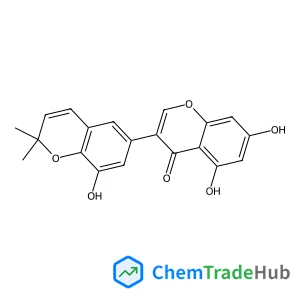
5,7,8'-Trihydroxy-2',2'-dimethyl-2'H,4H-3,6'-bichromen-4-one
CAS Number:
129280-33-7
Molecular Formula:
C20H16O6
The first page of this article is displayed as the abstract.
DOI: 10.1039/C9QO01537J
Jonathan Barrios-Rivera, Yingjian Xu, Martin Wills
DOI: 10.1039/C8OB02889C
Sudha Devi, Indu Bala, Santosh Prasad Gupta, Pravesh Kumar, Santanu Kumar Pal, Sugumar Venkataramani
DOI: 10.1039/C8OB01579A
Luyao Li, Bo Zhu, Huihui Fan, Zhiyong Jiang, Junbiao Chang
DOI: 10.1039/D0QO00348D
Steven C. Schlitzer, Dhanarajan Arunprasath, Katelyn G. Stevens, Indrajeet Sharma
DOI: 10.1039/C9QO01336A
Yuanqi Wu, Bing Xu, Bing Liu, Zhan-Ming Zhang, Yu Liu
DOI: 10.1039/C8OB02922A
Si-Meng Zhao, Mei-Fen Bao, Xiang-Hai Cai
DOI: 10.1039/D0QO00296H
Sem Raj Tamang, Anthony F. Cozzolino, Michael Findlater
DOI: 10.1039/C8OB02661K
Hidetoshi Noda, Yasuko Asada, Masakatsu Shibasaki, Naoya Kumagai
DOI: 10.1039/C8OB02695E
(1R,3S)-1,3-Cyclopentanediol finds applications in various industries. In the ph...
When handling N'-[4-(Dimethylamino)phenyl]-N,N-dimethyl-1,4-benzenediamine, it i...
There are several alternatives to 5-(2,4-Difluorophenyl)-2-methoxypyrimidine in ...
1-(3-Methoxyphenoxy)propan-2-ol (CAS: 382141-68-6) must comply with the Globally...
Tetrodotoxin Citrate is extremely dangerous and should be handled with extreme c...
2-Methyl-2-propanyl [(1R,3S)-3-hydroxycyclopentyl]carbamate (CAS: 225641-84-9) i...
Waste containing 4-(2-Hydroxyhexafluoroisopropyl)Benzoic Acid (CAS: 16261-80-6) ...
2-Methyl-2-proanyl {(2S)-1-[(benzyloxy)amino]-3-hydroxy-3-methyl-1-oxo-2-butanyl...
Benzeneethanamine, α-ethyl-, hydrochloride (1:1) is an organic compound with the...
In the synthesis of compounds similar to 3-{(E)-[4-(Dimethylamino)phenyl]diazeny...

Physical Chemistry Chemical Physics (PCCP) is an international journal co-owned by 19 physical chemistry and physics societies from around the world. This journal publishes original, cutting-edge research in physical chemistry, chemical physics and biophysical chemistry. To be suitable for publication in PCCP, articles must include significant innovation and/or insight into physical chemistry; this is the most important criterion that reviewers and Editors will judge against when evaluating submissions. The journal has a broad scope and welcomes contributions spanning experiment, theory, computation and data science. Topical coverage includes spectroscopy, dynamics, kinetics, statistical mechanics, thermodynamics, electrochemistry, catalysis, surface science, quantum mechanics, quantum computing and machine learning. Interdisciplinary research areas such as polymers and soft matter, materials, nanoscience, energy, surfaces/interfaces, and biophysical chemistry are welcomed if they demonstrate significant innovation and/or insight into physical chemistry. Joined experimental/theoretical studies are particularly appreciated when complementary and based on up-to-date approaches.