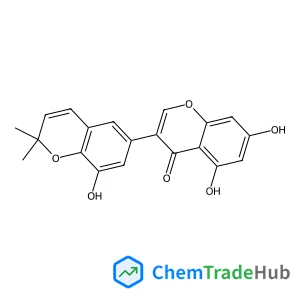
5,7,8'-Trihydroxy-2',2'-dimethyl-2'H,4H-3,6'-bichromen-4-one
CAS Number:
129280-33-7
Molecular Formula:
C20H16O6
Oksana Plekan, Andrew Cassidy, Richard Balog, Nykola C. Jones, David Field
We report here the discovery of a new form of spontaneously polarized material. Examples of this material, in the form of films, demonstrate the property that they spontaneously harbour electric fields which may exceed 108Vm−1, achieving potentials of tens of volts on the film surface. The molecules presently identified form a diverse group, thus far of six species, with gas phase dipoles lying between 0.08 D and 0.5 D: propane (0.08 D), isopentane (0.13 D), nitrous oxide (0.167 D), isoprene (0.25 D), toluene (0.385 D) and CF3Cl (Freon-13; 0.5 D). Here we concentrate on an understanding of the nature of the interactions which give rise to the spontaneously polarized state, using the measured temperature dependence of the electric field in N2O as a diagnostic. We show that the polarized state can arise through a mechanism of non-linear dipole alignment in a single domain in which dipole alignment generates the electric field within the film and the field generates dipole alignment. Non-local interactions take place over the dimension of the thickness of the film and permeate the entire medium through the agency of the electric field. This new type of material may have wide ranging applications in devices and in nanotechnology.

Herald of the Russian Academy of Sciences

Bioorganic & Medicinal Chemistry Letters

Critical Reviews in Solid State and Materials Sciences

Electroanalysis

Journal of Chemical Sciences

Heteroatom Chemistry

Journal of the Indian Institute of Science

Biocatalysis and Biotransformation

Bioorganic & Medicinal Chemistry

Polycyclic Aromatic Compounds
Chuan-Ming Hong, Fei-Fei Zou, Xin Zhuang, Zhen Luo, Zheng-Qiang Liu, Li-Qing Ren, Qing-Hua Li, Tang-Lin Liu
DOI: 10.1039/D1QO01446C
Zhipeng Zheng, Shanshan Shi, Qianru Ma, Yufei Yang, Yan Liu, Guo Tang
DOI: 10.1039/D1QO01178B
T. M. M. Maiden, N. Mbelesi, P. A. Procopiou, S. Swanson, J. P. A. Harrity
DOI: 10.1039/C8OB00935J
Nivedita S. Mahajani, John D. Chisholm
DOI: 10.1039/C8OB00687C
Michal Szostak
DOI: 10.1039/D1QO01539G
Xiao-Yu Zhang, Song Yang, Yin Wei
DOI: 10.1039/C8OB01765D
Yan-Hui Fan, Xiao-Yu Guan, Wen-Pei Li, Cheng-Zhou Lin, De-Xian Bing, Mei-Zhi Sun, Guo Cheng, Jing Cao, Jun-Jie Chen, Qing-Hai Deng
DOI: 10.1039/D1QO01687C
Debashruti Bandyopadhyay, Annaram Thirupathi, Nagsen Munjaji Dhage, Nirmala Mohanta, S. Peruncheralathan
DOI: 10.1039/C8OB01712C
Rabiul Alam, Abu Saleh Musha Islam, Mihir Sasmal, Atul Katarkar, Mahammad Ali
DOI: 10.1039/C8OB00822A
Gérard Audran, Mitchell T. Blyth, Michelle L. Coote, Georg Gescheidt, Micael Hardy, Jeffrey Havot, Maxence Holzritter, Samuel Jacoutot, Jean-Patrick Joly, Sylvain R. A. Marque, Tataye Moussounda Moussounda Koumba, Dmytro Neshchadin, Enzo Vaiedelich
DOI: 10.1039/D1QO01276B
(1R,3S)-1,3-Cyclopentanediol finds applications in various industries. In the ph...
When handling N'-[4-(Dimethylamino)phenyl]-N,N-dimethyl-1,4-benzenediamine, it i...
There are several alternatives to 5-(2,4-Difluorophenyl)-2-methoxypyrimidine in ...
1-(3-Methoxyphenoxy)propan-2-ol (CAS: 382141-68-6) must comply with the Globally...
Tetrodotoxin Citrate is extremely dangerous and should be handled with extreme c...
2-Methyl-2-propanyl [(1R,3S)-3-hydroxycyclopentyl]carbamate (CAS: 225641-84-9) i...
Waste containing 4-(2-Hydroxyhexafluoroisopropyl)Benzoic Acid (CAS: 16261-80-6) ...
2-Methyl-2-proanyl {(2S)-1-[(benzyloxy)amino]-3-hydroxy-3-methyl-1-oxo-2-butanyl...
Benzeneethanamine, α-ethyl-, hydrochloride (1:1) is an organic compound with the...
In the synthesis of compounds similar to 3-{(E)-[4-(Dimethylamino)phenyl]diazeny...

Physical Chemistry Chemical Physics (PCCP) is an international journal co-owned by 19 physical chemistry and physics societies from around the world. This journal publishes original, cutting-edge research in physical chemistry, chemical physics and biophysical chemistry. To be suitable for publication in PCCP, articles must include significant innovation and/or insight into physical chemistry; this is the most important criterion that reviewers and Editors will judge against when evaluating submissions. The journal has a broad scope and welcomes contributions spanning experiment, theory, computation and data science. Topical coverage includes spectroscopy, dynamics, kinetics, statistical mechanics, thermodynamics, electrochemistry, catalysis, surface science, quantum mechanics, quantum computing and machine learning. Interdisciplinary research areas such as polymers and soft matter, materials, nanoscience, energy, surfaces/interfaces, and biophysical chemistry are welcomed if they demonstrate significant innovation and/or insight into physical chemistry. Joined experimental/theoretical studies are particularly appreciated when complementary and based on up-to-date approaches.