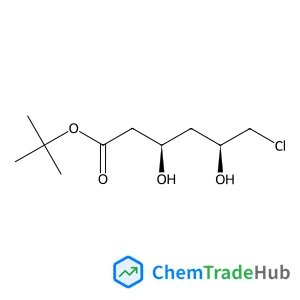
2-Methyl-2-propanyl (3R,5S)-6-chloro-3,5-dihydroxyhexanoate
CAS Number:
154026-93-4
Molecular Formula:
C10H19ClO4
Elin K. Esbjörner, Patrick J. Riss, Duncan A. White, Franklin I. Aigbirhio, Gergely Toth, Mark E. Welland, Christopher M. Dobson, Tuomas P. J. Knowles
Much effort has focussed in recent years on probing the interactions of small molecules with amyloid fibrils and other protein aggregates. Understanding and control of such interactions are important for the development of diagnostic and therapeutic strategies in situations where protein aggregation is associated with disease. In this perspective article we give an overview over the toolbox of biophysical methods for the study of such amyloid-small molecule interactions. We discuss in detail two recently developed techniques within this framework: linear dichroism, a promising extension of the more traditional spectroscopic techniques, and biosensing methods, where surface-bound amyloid fibrils are exposed to solutions of small molecules. Both techniques rely on the measurement of physical properties that are very directly linked to the binding of small molecules to amyloid aggregates and therefore provide an attractive route to probe these important interactions.
Fabrizio Caroleo, Manuela Stefanelli, Gabriele Magna, Mariano Venanzi, Roberto Paolesse, Simona Sennato, Marilena Carbone, Donato Monti
DOI: 10.1039/C8OB02689K
Jianxiao Li, Shaorong Yang, Wanqing Wu, Huanfeng Jiang
DOI: 10.1039/D0QO00377H
Wenbo Ma, Nikolaos Kaplaneris, Xinyue Fang, Linghui Gu, Ruhuai Mei, Lutz Ackermann
DOI: 10.1039/C9QO01497G
Zhiwen Liu, Liang Ma, Liping Zhang, Wenjun Zhang, Yiguang Zhu, Yuchan Chen, Weimin Zhang, Changsheng Zhang
DOI: 10.1039/C8OB02775G
Yuanqi Wu, Bing Xu, Bing Liu, Zhan-Ming Zhang, Yu Liu
DOI: 10.1039/C8OB02922A
Sourav Roy, Suman Pradhan, Krishan Kumar, Indranil Chatterjee
DOI: 10.1039/D0QO00354A
DOI: 10.1039/C8OB02284D
Mengmeng Zhang, Liming Yang, Chao Tian, Meng Zhou, Guangming Li
DOI: 10.1039/C9OB00136K
(1R,3S)-1,3-Cyclopentanediol finds applications in various industries. In the ph...
When handling N'-[4-(Dimethylamino)phenyl]-N,N-dimethyl-1,4-benzenediamine, it i...
There are several alternatives to 5-(2,4-Difluorophenyl)-2-methoxypyrimidine in ...
1-(3-Methoxyphenoxy)propan-2-ol (CAS: 382141-68-6) must comply with the Globally...
Tetrodotoxin Citrate is extremely dangerous and should be handled with extreme c...
2-Methyl-2-propanyl [(1R,3S)-3-hydroxycyclopentyl]carbamate (CAS: 225641-84-9) i...
Waste containing 4-(2-Hydroxyhexafluoroisopropyl)Benzoic Acid (CAS: 16261-80-6) ...
2-Methyl-2-proanyl {(2S)-1-[(benzyloxy)amino]-3-hydroxy-3-methyl-1-oxo-2-butanyl...
Benzeneethanamine, α-ethyl-, hydrochloride (1:1) is an organic compound with the...
In the synthesis of compounds similar to 3-{(E)-[4-(Dimethylamino)phenyl]diazeny...

Physical Chemistry Chemical Physics (PCCP) is an international journal co-owned by 19 physical chemistry and physics societies from around the world. This journal publishes original, cutting-edge research in physical chemistry, chemical physics and biophysical chemistry. To be suitable for publication in PCCP, articles must include significant innovation and/or insight into physical chemistry; this is the most important criterion that reviewers and Editors will judge against when evaluating submissions. The journal has a broad scope and welcomes contributions spanning experiment, theory, computation and data science. Topical coverage includes spectroscopy, dynamics, kinetics, statistical mechanics, thermodynamics, electrochemistry, catalysis, surface science, quantum mechanics, quantum computing and machine learning. Interdisciplinary research areas such as polymers and soft matter, materials, nanoscience, energy, surfaces/interfaces, and biophysical chemistry are welcomed if they demonstrate significant innovation and/or insight into physical chemistry. Joined experimental/theoretical studies are particularly appreciated when complementary and based on up-to-date approaches.