













Determination of gas phase protein ion densities via ion mobility analysis with charge reduction
Literature Information
Publication Date
2011-11-10
DOI
10.1039/C1CP22127B
Impact Factor
3.676
Authors
Anne Maißer, Vinay Premnath, Abhimanyu Ghosh, Tuan Anh Nguyen, Michel Attoui, Christopher J. Hogan, Jr.
View Original
Abstract
We use a charge reduction electrospray (ESI) source and subsequent ion mobility analysis with a differential mobility analyzer (DMA, with detection via both a Faraday cage electrometer and a condensation particle counter) to infer the densities of single and multiprotein ions of cytochrome C, lysozyme, myoglobin, ovalbumin, and bovine serum albumin produced from non-denaturing (20 mM aqueous ammonium acetate) and denaturing (1 : 49.5 : 49.5, formic acid : methanol : water) ESI. Charge reduction is achieved through use of a Po-210 radioactive source, which generates roughly equal concentrations of positive and negative ions. Ions produced by the source collide with and reduce the charge on ESI generated drops, preventing Coulombic fissions, and unlike typical protein ESI, leading to gas-phase protein ions with +1 to +3 excess charges. Therefore, charge reduction serves to effectively mitigate any role that Coulombic stretching may play on the structure of the gas phase ions. Density inference is made via determination of the mobility diameter, and correspondingly the spherical equivalent protein volume. Through this approach it is found that for both non-denaturing and denaturing ESI-generated ions, gas-phase protein ions are relatively compact, with average densities of 0.97 g cm−3 and 0.86 g cm−3, respectively. Ions from non-denaturing ESI are found to be slightly more compact than predicted from the protein crystal structures, suggesting that low charge state protein ions in the gas phase are slightly denser than their solution conformations. While a slight difference is detected between the ions produced with non-denaturing and denaturing ESI, the denatured ions are found to be much more dense than those examined previously by drift tube mobility analysis, in which charge reduction was not employed. This indicates that Coulombic stretching is typically what leads to non-compact ions in the gas-phase, and suggests that for gas phase measurements to be correlated to biomolecular structures in solution, low charge state ions should be analyzed. Further, to determine if different solution conditions give rise to ions of different structure, ions of similar charge state should be compared. Non-denatured protein ion densities are found to be in excellent agreement with non-denatured protein ion densities inferred from prior DMA and drift tube measurements made without charge reduction (all ions with densities in the 0.85–1.10 g cm−3 range), showing that these ions are not strongly influenced by Coulombic stretching nor by analysis method.
Related Literature
Asymmetric organocatalytic double 1,6-addition: rapid access to chiral chromans with molecular complexity
Sourav Roy, Suman Pradhan, Krishan Kumar, Indranil Chatterjee
2020-04-28
Research Article
DOI: 10.1039/D0QO00354A
Synthesis of naphtho[1′,2′:4,5]imidazo[1,2-a]pyridines via Rh(iii)-catalyzed C–H functionalization of 2-arylimidazo[1,2-a]pyridines with cyclic 2-diazo-1,3-diketones featuring with a ring opening and reannulation
Bin Li, Nana Shen, Yujie Yang, Xinying Zhang, Xuesen Fan
2020-02-26
Research Article
DOI: 10.1039/D0QO00073F
Bicyclic acetals: biological relevance, scaffold analysis, and applications in diversity-oriented synthesis
Elena Lenci, Fernanda I. Saldívar-Gonzalez, José L. Medina-Franco
2018-12-19
Review Article
DOI: 10.1039/C8OB02808G
Posttranscriptional spin labeling of RNA by tetrazine-based cycloaddition
Christof Domnick, Gregor Hagelueken, Frank Eggert, Olav Schiemann, Stephanie Kath-Schorr
2018-11-28
Communication
DOI: 10.1039/C8OB02597E
Imidazole carbamate probes for affinity guided azide-transfer to metal-binding proteins
Johan Palmfeldt
2019-01-16
Communication
DOI: 10.1039/C8OB03017K
Expeditious access of chromone analogues via a Michael addition-driven multicomponent reaction
Liu-Jun He, Ya-Fei Luo, Dian-Yong Tang, Wei Yan, Hui-Kuan Lin, Hong-yu Li, Zhong-Zhu Chen, Zhi-Gang Xu
2020-03-06
Research Article
DOI: 10.1039/D0QO00145G
Recent developments in palladium-catalyzed C–S bond formation
Jianxiao Li, Shaorong Yang, Wanqing Wu, Huanfeng Jiang
2020-04-22
Review Article
DOI: 10.1039/D0QO00377H
Diastereoselective synthesis of 3,3-disubstituted 3-nitro-4-chromanone derivatives as potential antitumor agents
Huiqing Chen, Jia Xie, Dong Xing, Jinping Wang, Jie Tang, Zhengfang Yi, Fei Xia, Wen-Wei Qiu, Fan Yang
2019-01-07
Communication
DOI: 10.1039/C8OB02761G
Graphene oxide: a green oxidant-acid bifunctional carbon material for the synthesis of functionalized isoindolin-1-ones via formal amide insertion and substitution
Xiangjun Peng, Dan Hu, Panpan Huang, Huiwu Liao, Yong Zeng, Qian Liu, Liangxian Liu
2020-06-15
Research Article
DOI: 10.1039/D0QO00498G
You might also like
Compound Q&A
What industries use (1R,3S)-1,3-Cyclopentanediol (CAS: 16326-97-9)?
(1R,3S)-1,3-Cyclopentanediol finds applications in various industries. In the ph...
16326-97-9(1R,3S)-1,3-Cyclopen...
Compound Q&A
What precautions should be taken when handling N'-[4-(Dimethylamino)phenyl]-N,N-dimethyl-1,4-benzenediamine (CAS: 637-31-0)?
When handling N'-[4-(Dimethylamino)phenyl]-N,N-dimethyl-1,4-benzenediamine, it i...
637-31-0N'-[4-(Dimethylamino...
Compound Q&A
Are there alternatives to 5-(2,4-Difluorophenyl)-2-methoxypyrimidine (CAS: 1352318-16-1) in synthesis?
There are several alternatives to 5-(2,4-Difluorophenyl)-2-methoxypyrimidine in ...
1352318-16-15-(2,4-Difluoropheny...
Compound Q&A
What regulatory guidelines apply to 1-(3-Methoxyphenoxy)propan-2-ol (CAS: 382141-68-6)?
1-(3-Methoxyphenoxy)propan-2-ol (CAS: 382141-68-6) must comply with the Globally...
382141-68-61-(3-Methoxyphenoxy)...
Compound Q&A
Is Tetrodotoxin Citrate (CAS: 18660-81-6) safe?
Tetrodotoxin Citrate is extremely dangerous and should be handled with extreme c...
18660-81-6Tetrodotoxin Citrate
Compound Q&A
What are the main uses of 2-Methyl-2-propanyl [(1R,3S)-3-hydroxycyclopentyl]carbamate (CAS: 225641-84-9)?
2-Methyl-2-propanyl [(1R,3S)-3-hydroxycyclopentyl]carbamate (CAS: 225641-84-9) i...
225641-84-92-Methyl-2-propanyl ...
Compound Q&A
How should waste containing 4-(2-Hydroxyhexafluoroisopropyl)Benzoic Acid (CAS: 16261-80-6) be handled?
Waste containing 4-(2-Hydroxyhexafluoroisopropyl)Benzoic Acid (CAS: 16261-80-6) ...
16261-80-64-(2-Hydroxyhexafluo...
Compound Q&A
How is 2-Methyl-2-proanyl {(2S)-1-[(benzyloxy)amino]-3-hydroxy-3-methyl-1-oxo-2-butanyl}carbamate (CAS: 102507-19-7) typically synthesized?
2-Methyl-2-proanyl {(2S)-1-[(benzyloxy)amino]-3-hydroxy-3-methyl-1-oxo-2-butanyl...
102507-19-72-Methyl-2-propanyl ...
Compound Q&A
What is Benzeneethanamine, α-ethyl-, hydrochloride (1:1) (CAS: 20735-15-3)?
Benzeneethanamine, α-ethyl-, hydrochloride (1:1) is an organic compound with the...
20735-15-3Benzeneethanamine, α...
Compound Q&A
Are there alternatives to 3-{(E)-[4-(Dimethylamino)phenyl]diazenyl}benzoic acid (CAS: 20691-84-3) in synthesis?
In the synthesis of compounds similar to 3-{(E)-[4-(Dimethylamino)phenyl]diazeny...
20691-84-33-{(E)-[4-(Dimethyla...
Source Journal
Physical Chemistry Chemical Physics

CiteScore:
5.5
Self-citation Rate:
10.3%
Articles per Year:
3036
Physical Chemistry Chemical Physics (PCCP) is an international journal co-owned by 19 physical chemistry and physics societies from around the world. This journal publishes original, cutting-edge research in physical chemistry, chemical physics and biophysical chemistry. To be suitable for publication in PCCP, articles must include significant innovation and/or insight into physical chemistry; this is the most important criterion that reviewers and Editors will judge against when evaluating submissions. The journal has a broad scope and welcomes contributions spanning experiment, theory, computation and data science. Topical coverage includes spectroscopy, dynamics, kinetics, statistical mechanics, thermodynamics, electrochemistry, catalysis, surface science, quantum mechanics, quantum computing and machine learning. Interdisciplinary research areas such as polymers and soft matter, materials, nanoscience, energy, surfaces/interfaces, and biophysical chemistry are welcomed if they demonstrate significant innovation and/or insight into physical chemistry. Joined experimental/theoretical studies are particularly appreciated when complementary and based on up-to-date approaches.
Recommended Compounds

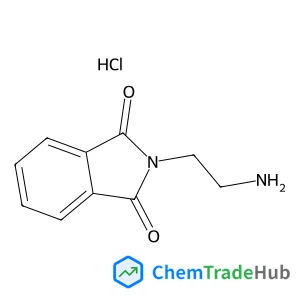
2-(2-Aminoethyl)-1H-isoindole-1,3(2H)-dione hydrochloride (1:1)
CAS Number:
30250-67-0
Molecular Formula:
C10H11ClN2O2
Recommended Suppliers





Disclaimer
This page provides academic journal information for reference and research purposes only. We are not affiliated with any journal publishers and do not handle publication submissions. For publication-related inquiries, please contact the respective journal publishers directly.
If you notice any inaccuracies in the information displayed, please contact us at support@chemtradehub.com. We will promptly review and address your concerns.