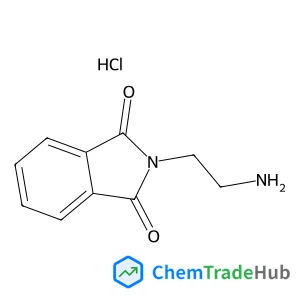
2-(2-Aminoethyl)-1H-isoindole-1,3(2H)-dione hydrochloride (1:1)
CAS Number:
30250-67-0
Molecular Formula:
C10H11ClN2O2
Xiangjun Peng, Dan Hu, Panpan Huang, Huiwu Liao, Yong Zeng, Qian Liu, Liangxian Liu
A formal amide insertion and substitution reaction for the synthesis of functionalized isoindolin-1-ones was developed on the basis of graphene oxide (GO) as a green and oxidant-acid bifunctional carbon material. A series of N-acylisoindolin-1-ones were synthesized in good to excellent yields directly from benzoisofurans and nitriles in the presence of GO without the need for any additives or metals.
Ching Yoong Loh, Rui Huang, Roy Bell, Ming Xie
DOI: 10.1039/D3SU00340J
Francielle Miranda de Matos, Gabriela Boscariol Rasera, Ruann Janser Soares de Castro
DOI: 10.1039/D3FB00097D
DOI: 10.1039/D3FB00108C
Ram Asrey, Swati Sharma, Kalyan Barman, Uma Prajapati, Narender Negi
DOI: 10.1039/D3FB00037K
Akiho Horibe, Tomoko Murayama, Tsuyoshi Kawai, Yoshiyuki Nonoguchi
DOI: 10.1039/D3LF00119A
Reshab Majumder, Saptadip Miatur, Akash Saha, Shamim Hossain
DOI: 10.1039/D3FB00169E
Weiliang Han, Weigao Han, Zhicheng Tang
DOI: 10.1039/D3LF00147D
(1R,3S)-1,3-Cyclopentanediol finds applications in various industries. In the ph...
When handling N'-[4-(Dimethylamino)phenyl]-N,N-dimethyl-1,4-benzenediamine, it i...
There are several alternatives to 5-(2,4-Difluorophenyl)-2-methoxypyrimidine in ...
1-(3-Methoxyphenoxy)propan-2-ol (CAS: 382141-68-6) must comply with the Globally...
Tetrodotoxin Citrate is extremely dangerous and should be handled with extreme c...
2-Methyl-2-propanyl [(1R,3S)-3-hydroxycyclopentyl]carbamate (CAS: 225641-84-9) i...
Waste containing 4-(2-Hydroxyhexafluoroisopropyl)Benzoic Acid (CAS: 16261-80-6) ...
2-Methyl-2-proanyl {(2S)-1-[(benzyloxy)amino]-3-hydroxy-3-methyl-1-oxo-2-butanyl...
Benzeneethanamine, α-ethyl-, hydrochloride (1:1) is an organic compound with the...
In the synthesis of compounds similar to 3-{(E)-[4-(Dimethylamino)phenyl]diazeny...

Organic Chemistry Frontiers publishes high-quality research from across organic chemistry. Emphases are placed on studies that make significant contributions to the field of organic chemistry by reporting either new or significantly improved protocols or methodologies. Topics include, but are not limited to the following: Organic synthesis Development of synthetic methodologies Catalysis Natural products Functional organic materials Supramolecular and macromolecular chemistry Physical and computational organic chemistry
![N-[(9H-Fluoren-9-ylmethoxy)carbonyl]-beta-phenyl-L-phenylalanine structure](https://static.chemtradehub.com/structs/201/201484-50-6-c2fc.webp "N-[(9H-Fluoren-9-ylmethoxy)carbonyl]-beta-phenyl-L-phenylalanine structure")