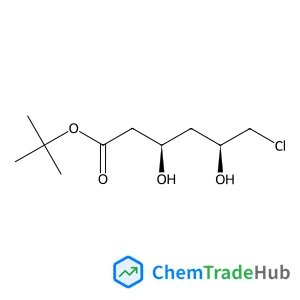
2-Methyl-2-propanyl (3R,5S)-6-chloro-3,5-dihydroxyhexanoate
CAS Number:
154026-93-4
Molecular Formula:
C10H19ClO4
R.-P. Baumann, J. Eussner
The light-driven proton pump bacteriorhodopsin (BR) embedded in a purple membrane (PM) from Halobacterium salinarum undergoes a series of conformational changes while transporting a proton from the cytoplasmic to the extracellular side over the course of the so-called photocycle. Wild-type BR variant D85T, where aspartic acid 85 is replaced by threonine, allows for the study of structural intermediates of this photocycle that are formed in a light-dependent manner in the wild-type and in thermal equilibrium by tuning the pH of the D85T purple membrane suspension. Especially the last and least studied O-intermediate of the photocycle of bacteriorhodopsin has caught recent attention. First AFM images of D85T under acidic conditions resembling wild-type BR under physiological conditions in the O-photocycle-intermediate are presented. Bacteriorhodopsins embedded in the strongly bent purple membranes were analyzed by single molecule force spectroscopy (SMFS) providing the first single molecule force spectra of BR in the O-intermediate. SMFS was further employed to determine the absolute sign of membrane curvature. Complementary electrostatic force microscopy (EFM) was performed to support PM side discrimination and determination of the bending direction. Bending of PM-D85T was analyzed in more detail providing further insight into the structure–function relationship of the bacteriorhodopsin proton pump as well as PM behaviour at the solid–liquid junction. Findings reported here are of general interest to the field of chemomechanical transducers.
Mir Sayed Shah Danish
DOI: 10.1039/D3SU00179B
Ali Asad Yousaf, Kashif Sarfraz Abbasi, Muhammad Suhail Ibrahim, Asma Sohail, Mamoona Faiz, Mehwish Khadim
DOI: 10.1039/D3FB00113J
Kavita Devi, Ghanshyam S. Chauhan, Sunita Ranote, Sandeep Chauhan, Kiran Kumar
DOI: 10.1039/D3LP00118K
Ching Yoong Loh, Rui Huang, Roy Bell, Ming Xie
DOI: 10.1039/D3SU00340J
Kacper P. Krakowiak, Ruaraidh D. McIntosh, David Ellis
DOI: 10.1039/D3FB00088E
Kannan Vignesh, Dev Kumar Yadav, D. D. Wadikar, A. D. Semwal
DOI: 10.1039/D3FB00074E
Jyoti Dhariwal, Gyandshwar K. Rao, Dipti Vaya
DOI: 10.1039/D3SU00375B
Aswathi P. V., Anju Sebastian, Lulu Varghese, Joseph V. P., Jolly Andrews
DOI: 10.1039/D3FB00126A
Filipe Maciel, Hugo Pereira, Joana Silva
DOI: 10.1039/D3FB00110E
(1R,3S)-1,3-Cyclopentanediol finds applications in various industries. In the ph...
When handling N'-[4-(Dimethylamino)phenyl]-N,N-dimethyl-1,4-benzenediamine, it i...
There are several alternatives to 5-(2,4-Difluorophenyl)-2-methoxypyrimidine in ...
1-(3-Methoxyphenoxy)propan-2-ol (CAS: 382141-68-6) must comply with the Globally...
Tetrodotoxin Citrate is extremely dangerous and should be handled with extreme c...
2-Methyl-2-propanyl [(1R,3S)-3-hydroxycyclopentyl]carbamate (CAS: 225641-84-9) i...
Waste containing 4-(2-Hydroxyhexafluoroisopropyl)Benzoic Acid (CAS: 16261-80-6) ...
2-Methyl-2-proanyl {(2S)-1-[(benzyloxy)amino]-3-hydroxy-3-methyl-1-oxo-2-butanyl...
Benzeneethanamine, α-ethyl-, hydrochloride (1:1) is an organic compound with the...
In the synthesis of compounds similar to 3-{(E)-[4-(Dimethylamino)phenyl]diazeny...

Physical Chemistry Chemical Physics (PCCP) is an international journal co-owned by 19 physical chemistry and physics societies from around the world. This journal publishes original, cutting-edge research in physical chemistry, chemical physics and biophysical chemistry. To be suitable for publication in PCCP, articles must include significant innovation and/or insight into physical chemistry; this is the most important criterion that reviewers and Editors will judge against when evaluating submissions. The journal has a broad scope and welcomes contributions spanning experiment, theory, computation and data science. Topical coverage includes spectroscopy, dynamics, kinetics, statistical mechanics, thermodynamics, electrochemistry, catalysis, surface science, quantum mechanics, quantum computing and machine learning. Interdisciplinary research areas such as polymers and soft matter, materials, nanoscience, energy, surfaces/interfaces, and biophysical chemistry are welcomed if they demonstrate significant innovation and/or insight into physical chemistry. Joined experimental/theoretical studies are particularly appreciated when complementary and based on up-to-date approaches.
![N-[(9H-Fluoren-9-ylmethoxy)carbonyl]-beta-phenyl-L-phenylalanine structure](https://static.chemtradehub.com/structs/201/201484-50-6-c2fc.webp "N-[(9H-Fluoren-9-ylmethoxy)carbonyl]-beta-phenyl-L-phenylalanine structure")