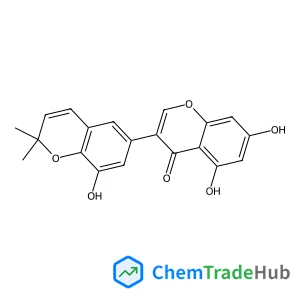
5,7,8'-Trihydroxy-2',2'-dimethyl-2'H,4H-3,6'-bichromen-4-one
CAS Number:
129280-33-7
Molecular Formula:
C20H16O6
Aleksandr Kalinko, Alexei Kuzmin, Dzintars Berzins, Juris Purans
The electrochemical changes induced by an electric field in Fe-doped SrTiO3 have been investigated by X-ray absorption spectroscopy (XANES and EXAFS), electron paramagnetic resonance (EPR) and Raman spectroscopy. A detailed study of the Fe dopant in the regions around the anode and cathode reveals new insights into the local structure and valence state of Fe in SrTiO3 single crystals. The ab initio full multiple-scattering XANES calculations give an evidence of the oxygen vacancy presence in the first coordination shell of iron. Differences in the length and disorder of the Fe–O bonds as extracted from EXAFS are correlated to the unequivocal identification of the defect type by complementary spectroscopical techniques to identify the valence state of the Fe-dopant and the presence of the Fe − VÖ complexes. Through this combinatorial approach, novel structural information on Fe − VÖ complexes is provided by X-ray absorption spectroscopy, and the relation of Fe–O bond length, doping level and oxidation state in SrTi1−xFexO3 is briefly discussed.

Critical Reviews in Solid State and Materials Sciences

Medicinal Chemistry Research

Electroanalysis

Bioorganic & Medicinal Chemistry

Biocatalysis and Biotransformation

Journal of the Indian Institute of Science

NDT & E International

Atomization and Sprays

Acta Metallurgica Sinica-English Letters

Polycyclic Aromatic Compounds
Akinari Sumita, Yuko Otani, Tomohiko Ohwada
DOI: 10.1039/C8OB00708J
Shengnan Liu, Qiong Wang, Fang Huang, Wenjuan Wang, Chong Yang, Jianbiao Liu, Dezhan Chen
DOI: 10.1039/D1QO01500A
Rui Yan
DOI: 10.1039/C8OB00723C
Olga Bakulina, Dmitry Dar'in, Mikhail Krasavin
DOI: 10.1039/C8OB00768C
Yao Peng, Jian Lei, Renhua Qiu, Lingteng Peng, Chak-Tong Au, Shuang-Feng Yin
DOI: 10.1039/C8OB00907D
Xiu Yang, Wei-Dong Meng, Xiu-Hua Xu, Yangen Huang
DOI: 10.1039/D1QO01170G
Xuan Li, Xiaolong Zhu, Xiuyan Song, Qirong Deng, Jian Lv
DOI: 10.1039/D1QO01548F
Jian Huang, Wei Chen, Jiazhi Liang, Qin Yang, Zhihong Deng, Zhibin Song, Yiyuan Peng
DOI: 10.1039/D1QO01186C
DeGuang Liu, ZheYuan Xu, MingQiang Liu, Yao Fu
DOI: 10.1039/D1QO01560E
(1R,3S)-1,3-Cyclopentanediol finds applications in various industries. In the ph...
When handling N'-[4-(Dimethylamino)phenyl]-N,N-dimethyl-1,4-benzenediamine, it i...
There are several alternatives to 5-(2,4-Difluorophenyl)-2-methoxypyrimidine in ...
1-(3-Methoxyphenoxy)propan-2-ol (CAS: 382141-68-6) must comply with the Globally...
Tetrodotoxin Citrate is extremely dangerous and should be handled with extreme c...
2-Methyl-2-propanyl [(1R,3S)-3-hydroxycyclopentyl]carbamate (CAS: 225641-84-9) i...
Waste containing 4-(2-Hydroxyhexafluoroisopropyl)Benzoic Acid (CAS: 16261-80-6) ...
2-Methyl-2-proanyl {(2S)-1-[(benzyloxy)amino]-3-hydroxy-3-methyl-1-oxo-2-butanyl...
Benzeneethanamine, α-ethyl-, hydrochloride (1:1) is an organic compound with the...
In the synthesis of compounds similar to 3-{(E)-[4-(Dimethylamino)phenyl]diazeny...

Physical Chemistry Chemical Physics (PCCP) is an international journal co-owned by 19 physical chemistry and physics societies from around the world. This journal publishes original, cutting-edge research in physical chemistry, chemical physics and biophysical chemistry. To be suitable for publication in PCCP, articles must include significant innovation and/or insight into physical chemistry; this is the most important criterion that reviewers and Editors will judge against when evaluating submissions. The journal has a broad scope and welcomes contributions spanning experiment, theory, computation and data science. Topical coverage includes spectroscopy, dynamics, kinetics, statistical mechanics, thermodynamics, electrochemistry, catalysis, surface science, quantum mechanics, quantum computing and machine learning. Interdisciplinary research areas such as polymers and soft matter, materials, nanoscience, energy, surfaces/interfaces, and biophysical chemistry are welcomed if they demonstrate significant innovation and/or insight into physical chemistry. Joined experimental/theoretical studies are particularly appreciated when complementary and based on up-to-date approaches.